


















How Google’s Core Web Vitals Impact Your SEO and GEO Rankings: The Definitive Guide
The evolution of search has reached a critical tipping point where technical performance is synonymous with brand authority. As the Google Page Experience update continues to redefine the digital landscape, the priority for any growth-oriented business has shifted: speed and stability are no longer secondary concerns—they are the primary drivers of SEO for lead generation.
The Business Case: Performance as a Conversion Catalyst
The modern search landscape is now dual-faceted. Your website must not only appeal to human users who demand instantaneous gratification but also satisfy the stringent technical requirements of Generative Engine Optimization (GEO). AI models and “Answer Engines” prioritize technically sound websites as credible sources for their citations. If your LCP optimization (Largest Contentful Paint) fails to meet the 2.5-second threshold, you aren’t just losing a ranking spot; you are being filtered out of the generative summaries that drive modern B2B discovery.
At Opal Infotech, we view these metrics through a purely commercial lens. Technical health directly correlates with lower bounce rates and higher user trust. A stable, responsive interface ensures that a potential lead remains engaged long enough to convert, effectively transforming technical scores into tangible ROI.
The 25-Year Perspective: From Keywords to Experience Engineering
Having pioneered digital strategies for over a quarter-century, the team at Opal Infotech has navigated every major tectonic shift in search history. We have managed the transition from the early era of keyword density to the rise of backlink authority and now into the sophisticated age of Experience Engineering.
Our 25 years of in-depth experience have taught us that while algorithms change, the core objective of search remains constant: providing the best possible answer with the least possible friction. By integrating technical SEO services with high-performance web development, we bridge the gap between “ranking” and “revenue.” We do not just optimize for bots; we architect digital environments where speed meets strategy.
LCP (Largest Contentful Paint)
Is your primary value proposition visible instantly?
INP (Interaction to Next Paint)
Does your site respond to a user’s intent without lag?
CLS (Cumulative Layout Shift)
Is your layout visually stable, or does it frustrate the buyer’s journey?
Understanding the Core Web Vitals‘ impact on SEO requires more than a simple plugin; it requires a legacy of architectural knowledge. In the following sections, we will break down exactly how to master these vitals to secure your position in both traditional and AI-driven search results.


The Three Pillars of Page Experience: Beyond the Acronyms
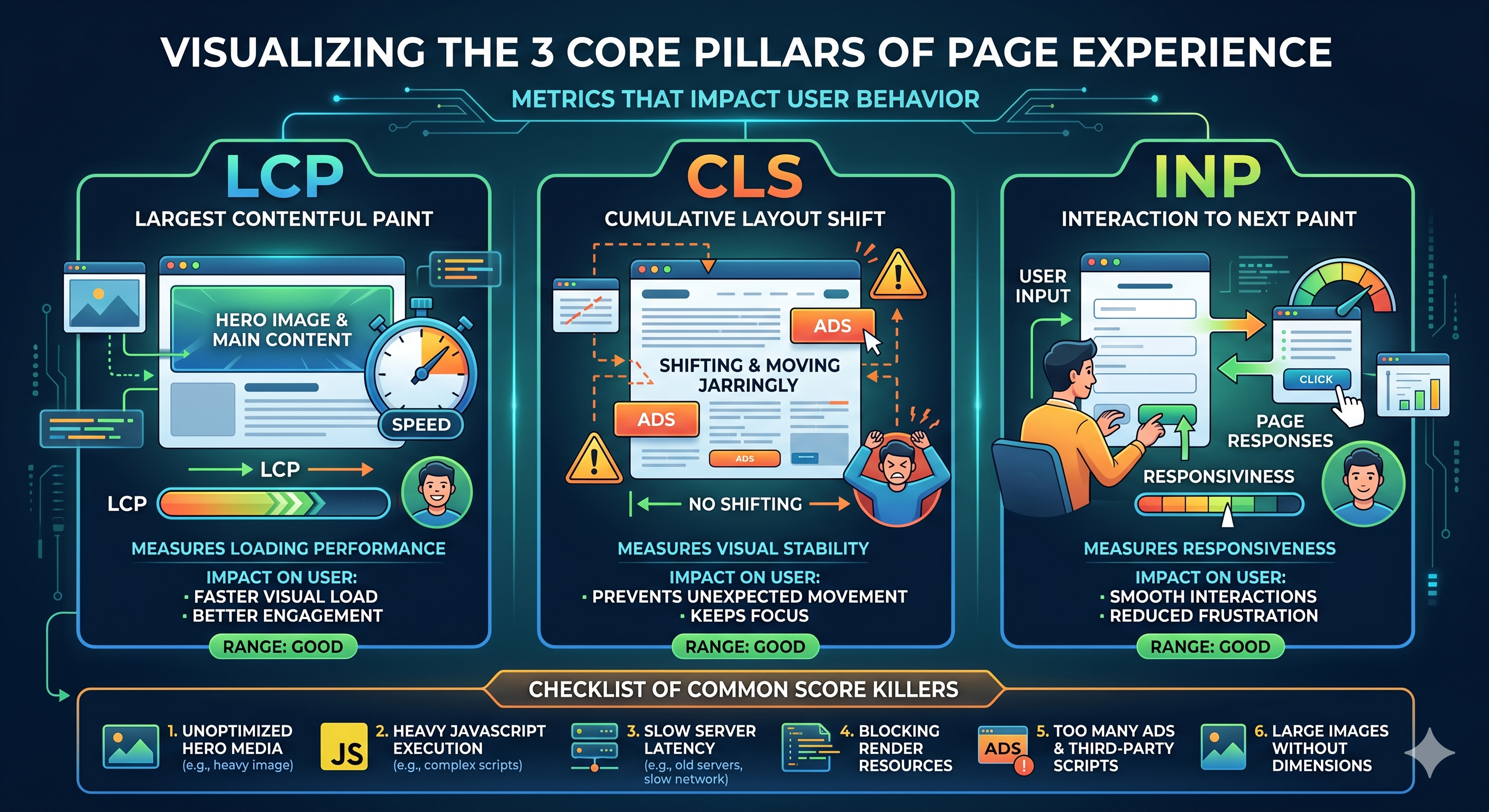
To effectively manage a digital presence, one must look past the technical jargon and understand how specific performance metrics dictate user behavior. At Opal Infotech, our technical architects categorize these metrics not just as “scores,” but as critical touchpoints in the customer journey.
Largest Contentful Paint (LCP): Loading Performance and the “Golden Threshold”
LCP measures the time it takes for the largest visual element on a page—typically a hero image, a primary heading, or a featured product video—to become visible to the user. In the context of SEO for lead generation, LCP is the digital equivalent of a first impression.

- Google defines the “Golden Threshold” for LCP as 2.5 seconds or faster. Exceeding this limit signals to both search engines and users that the site is sluggish, often leading to immediate bounce-backs. For high-performance e-commerce and B2B sites, achieving a “Good” LCP involves more than just image compression; it requires sophisticated server-side optimizations, the use of Content Delivery Networks (CDNs), and the elimination of render-blocking resources. Our experience in managing global server architectures ensures that your largest content elements serve as an invitation to engage, rather than a barrier to entry.
Cumulative Layout Shift (CLS): Solving Visual Instability
There is nothing more detrimental to user trust than a “jumpy” website. CLS measures visual stability by quantifying how often elements move unexpectedly while a page is still loading. This is a frequent challenge in complex e-commerce layouts built on Magento, Shopify, or WooCommerce, where dynamic ad placements, slow-loading fonts, or unoptimized images can push content down just as a user is about to click.
- A high CLS score is a direct threat to conversion rates. If a “Buy Now” button shifts and the user accidentally clicks a different link, the friction created can terminate a potential sale. By enforcing strict size attributes for images and video elements and ensuring that dynamic content never overrides existing space, we stabilize the visual environment. At Opal Infotech, we ensure that your site’s interface remains anchored, providing the reliable experience necessary for international branding.
Interaction to Next Paint (INP): The Game-Changer for Interactive Platforms
In March 2024, Google officially replaced First Input Delay (FID) with Interaction to Next Paint (INP). While FID only measured the delay of the first interaction, INP assesses the latency of all interactions a user has with a page. This shift was a significant game-changer, particularly for interactive B2B platforms and custom PHP frameworks where users frequently interact with filters, calculators, or contact forms.

- INP provides a more holistic view of a site’s responsiveness. A site might load quickly (good LCP), but if a user clicks a “Request a Quote” button and the site hangs for a second before showing a response, the INP score will suffer. Optimizing for INP requires deep-level code auditing to minimize “Long Tasks” that block the main thread. Our team specializes in streamlining these interactive elements to ensure that every click, tap, or keypress feels instantaneous.
Technical Checklist: Common “Score Killers” Identified by Opal Infotech
Based on our 25 years of technical SEO audits, we have identified several recurring issues that compromise Core Web Vitals. Use this checklist to evaluate your current standing:
- Unoptimized Hero Media: Large, uncompressed banners or auto-playing videos that have not been lazy-loaded or formatted for modern web standards (e.g., WebP or AVIF).
- JavaScript Execution Heaviness: Excessive third-party scripts (trackers, chatbots, or heavy widgets) that clog the main thread and spike INP scores.
- CSS Without Dimensions: Images or containers missing explicit width and height attributes, which is the leading cause of CLS in responsive web designs.
- Server Latency: Poorly configured hosting environments or slow Time to First Byte (TTFB) create a bottleneck for LCP.
- Web Font Delays: Using heavy custom fonts that cause “Flash of Unstyled Text” (FOUT) or “Flash of Invisible Text” (FOIT), impacting both LCP and CLS.
- Render-Blocking Resources: Critical CSS or JavaScript that forces the browser to pause rendering, delaying the appearance of the main content.
By systematically addressing these “Score Killers,” we transition your website from a static brochure to a high-speed lead generation engine capable of dominating both traditional search and the new frontier of Generative Engine Optimization.
Real Feedback, Real Results
“Excellent services, Excellent Design, and SEO services”
Dr Bhavin Vadodariya – India
Core Web Vitals in the Era of Generative Engine Optimization (GEO)
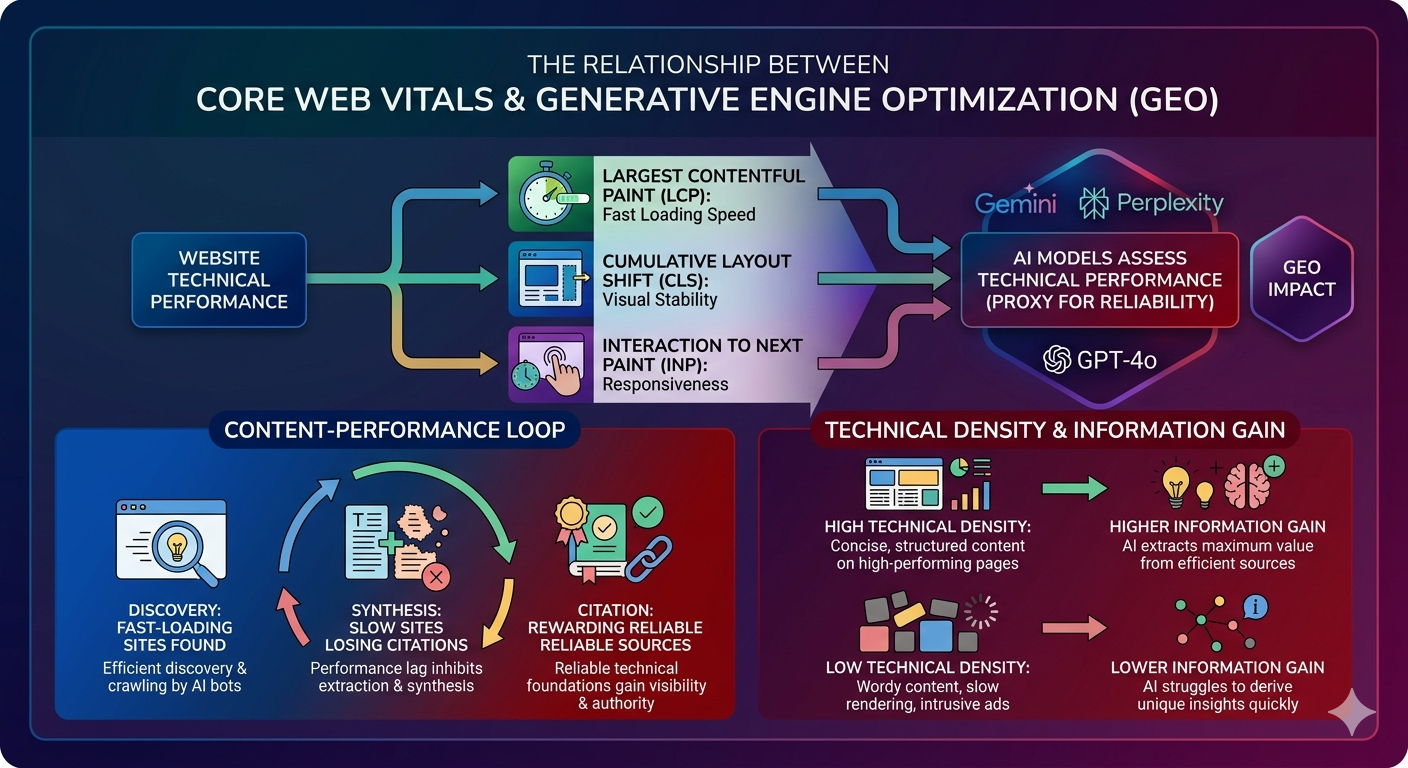
As the digital landscape transitions from a list of links to a series of synthesized answers, a new discipline has emerged: Generative Engine Optimization (GEO). While traditional SEO focuses on human clicks, GEO focuses on becoming the primary source of truth for Large Language Models (LLMs). In this new era, Core Web Vitals have transcended their role as mere “speed metrics” to become fundamental signals of source reliability.
AI as a User: Technical Performance as a Proxy for Reliability
Advanced AI models like Gemini, Perplexity, and GPT-4o do not just “read” your text; they evaluate the environment in which that text lives. For an LLM to cite your website as a definitive source, it must first successfully crawl and parse your content without friction.
From a technical perspective, LLMs use performance metrics as a proxy for authority. A website that consistently passes its Core Web Vitals signals to AI crawlers that the platform is professionally maintained, technically sound, and stable. Conversely, a site with high layout shifts (CLS) or slow interaction times (INP) suggests technical debt—a red flag that can cause AI models to favor a more stable competitor as a “trusted” source. At Opal Infotech, we treat your website’s technical health as its digital credentials, ensuring it meets the rigorous standards required to be indexed by these high-intelligence engines.
The Content-Performance Loop: Why Slow Sites Lose Citations
In the world of Answer Engine Optimization (AEO), visibility is determined by the “Generative Summary”—the concise AI answer at the top of the search results. There is a direct “Content-Performance Loop” at play here:

AI agents prioritize fast-loading pages for real-time data retrieval.
If your site’s LCP is high, an AI agent may time out or prioritize a faster secondary source to minimize its own processing latency.
Only the most accessible and reliable sources are rewarded with a citation link within the AI summary.
A slow site essentially creates a “blind spot” for AI models. If your technical foundation is weak, your high-quality content remains invisible to the very engines that now dictate B2B discovery. Our team leverages 25 years of architectural SEO knowledge to ensure your site is not just “fast for users,” but “optimized for AI agents,” keeping you at the forefront of generative search.
Information Gain & Speed: The Correlation with Technical Density
One of the most critical factors in GEO is Information Gain—the measure of unique, valuable insights your content provides relative to what already exists online. However, Information Gain is heavily dependent on Technical Density.
Technical density refers to how efficiently information is delivered to a crawler. High-performing sites with optimized code structures allow AI models to extract maximum “Information Gain” with minimal computational effort. When a page loads instantly and the document object model (DOM) is clean, the “Signal-to-Noise Ratio” is maximized.
- Fast Loading = Lower Friction: Allows for deeper and more frequent indexing by AI agents.
- Clean Architecture = Better Understanding: Helps LLMs correctly categorize your unique data points and expert perspectives.
By optimizing for Core Web Vitals, we increase your site’s technical density, making it easier for AI models to recognize your unique value. This synergy between speed and substance is what allows Opal Infotech to secure top-tier placements in an increasingly automated search environment.

Let’s Chat

Solving Performance Bottlenecks Across Diverse Frameworks
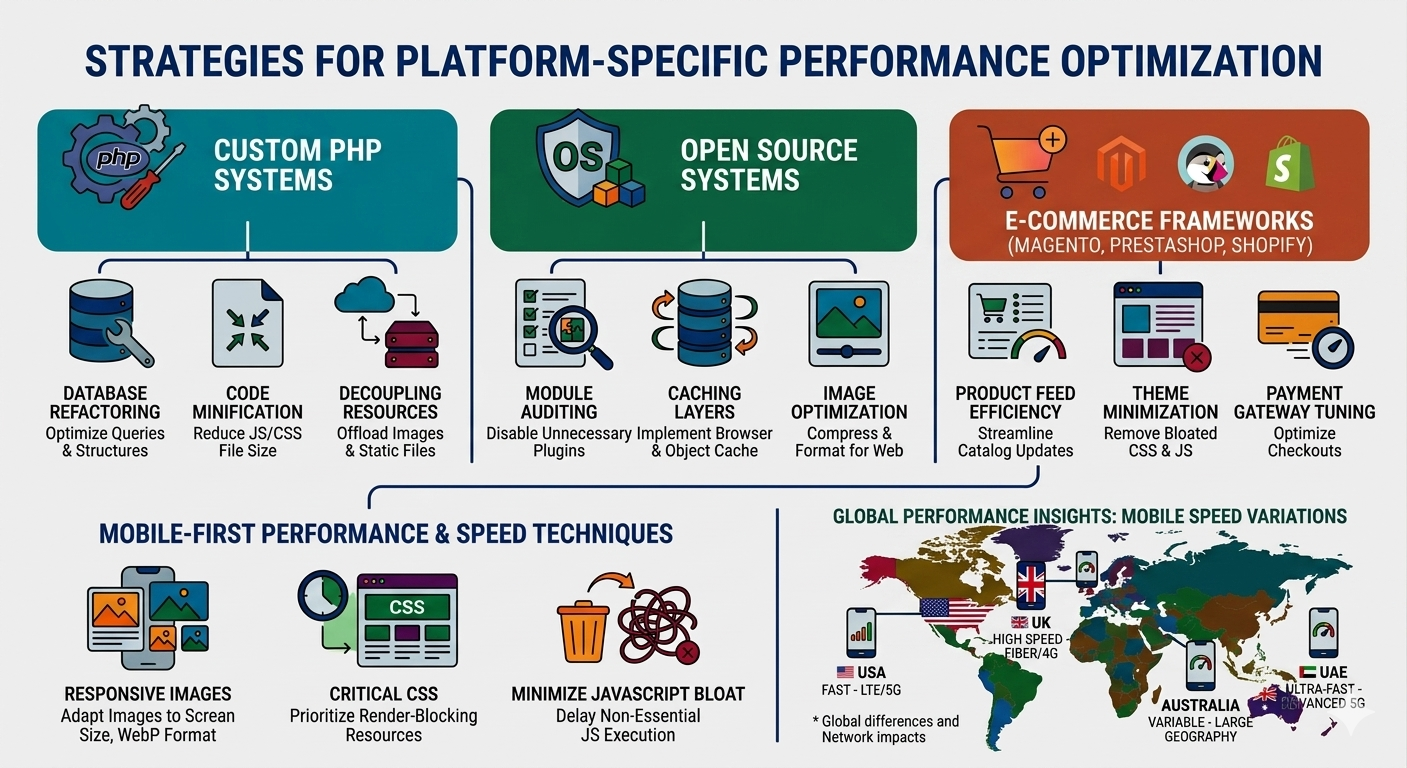
A “one-size-fits-all” approach to web performance is a relic of the past. At Opal Infotech, our technical architects recognize that the strategy for optimizing a custom-coded corporate portal differs vastly from the requirements of a high-volume e-commerce engine. With over 25 years of experience in full-stack development, we specialize in platform-specific engineering that aligns with Google’s evolving metrics.
Custom PHP & Open Source: Optimizing Legacy Systems
Custom PHP frameworks and legacy open-source systems often suffer from “Technical Debt”—outdated code structures that were developed before the era of Core Web Vitals. These systems frequently struggle with high Server Response Times (TTFB), which directly cascades into poor LCP scores.
To optimize these frameworks, we move beyond superficial caching. Our process involves:

Database Refactoring: Optimizing SQL queries to prevent bottlenecks during content retrieval.

Code Minification and Compression: Removing redundant characters from the source code and utilizing Gzip or Brotli compression to reduce file sizes.
Decoupling Resources : Moving non-essential legacy scripts to the footer or using async and defer attributes to ensure they do not block the initial render.
By modernizing the underlying architecture without compromising the system’s core functionality, we ensure that even long-standing custom platforms can compete on a level playing field with modern, lightweight frameworks.
The E-commerce Challenge: PrestaShop, Magento, and Shopify
E-commerce platforms are notoriously “heavy” due to the necessity of complex feature sets: product filters, high-resolution galleries, third-party tracking pixels, and customer review widgets. These elements are essential for conversion but are often the primary culprits for poor INP and CLS scores.
Magento & PrestaShop
These platforms often suffer from “JavaScript Bloat.” We mitigate this by implementing advanced bundling techniques and utilizing Edge Computing to process logic closer to the user.

Shopify
While Shopify offers a robust infrastructure, developers often over-rely on third-party apps that inject unoptimized scripts. Our team audits these integrations, replacing heavy apps with custom Liquid code or optimized API calls to keep the main thread clear.

Visual Stability
For platforms like WooCommerce, we enforce rigid CSS aspect ratios for product grids. This prevents the “layout jump” that occurs when product images load at different speeds, ensuring a stable CLS score across thousands of SKU pages.
Mobile-First Dominance: The International Context
It is a common misconception that “Good” vitals on a desktop office connection translate to global success. In the international markets we serve—specifically the USA, UK, Australia, and the UAE—mobile traffic accounts for more than 60% of B2B and B2C interactions. Google’s indexing is now predominantly mobile-first, meaning your rankings are determined by how your site performs on a mid-tier mobile device over a 4G or 5G connection.
A site that passes LCP on a high-speed fiber connection in Ahmedabad may fail significantly for a user on a mobile device in London or Dubai due to latency and hardware limitations.
- Adaptive Delivery: We implement responsive image solutions that serve smaller, optimized assets based on the user’s device.
- Critical CSS: We prioritize the loading of “above-the-fold” styles, allowing the mobile user to see and interact with the header and hero section before the rest of the page has finished downloading.
Opal Infotech’s global perspective ensures that your digital infrastructure is optimized for the hardware and connectivity of your specific target audience, regardless of their geographical location. We understand that in the international branding game, speed is the universal language of credibility.
What Our Customers Say
“Best SEO company. Good leader. Great team! Amazing service! ”
– Dugros Leather India Pvt. Ltd. – India
Transforming Metrics into Revenue: The Lead Generation Advantage
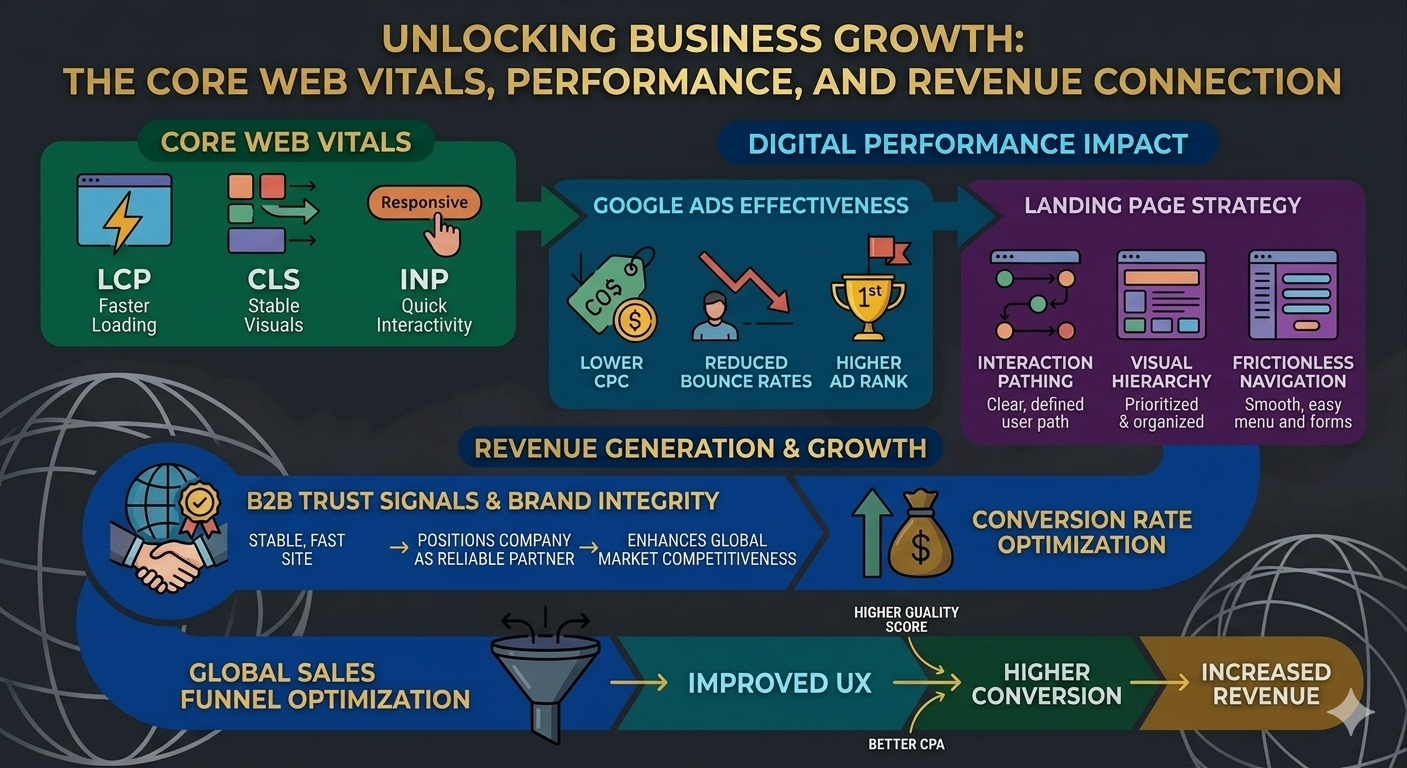
In the professional landscape, technical metrics are often viewed as a checkbox for IT departments. However, at Opal Infotech, we recognize that Core Web Vitals are, in reality, financial indicators. A website’s technical health is the most direct lever a business can pull to improve its bottom line. When your site performance meets Google’s “Good” thresholds, it triggers a chain reaction that transforms your digital presence into a high-efficiency revenue engine.
Lowering CPA: The Direct Link Between Vitals and Ad Performance
One of the most immediate financial benefits of technical optimization is the reduction of your Cost Per Acquisition (CPA). Google’s advertising ecosystem does not operate in a vacuum; it heavily rewards landing page quality.
A high-performance site directly influences your Google Ads “Quality Score.” When a landing page satisfies Core Web Vitals requirements—loading instantly and responding without lag—Google views it as a superior destination for users. This leads to:

Lower Cost-Per-Click (CPC): High Quality Scores allow you to win auctions at lower price points than competitors with unoptimized sites.
Reduced Bounce Rates: There is a direct correlation between page load speed and user retention. For every second of delay beyond the LCP threshold, the probability of a bounce increases exponentially.

Higher Ad Rank: Even with a lower budget, a technically superior site can outrank competitors for the most coveted ad placements.
By optimizing the foundation of your site, we ensure that every dollar spent on traffic is maximized. We don’t just drive visitors to your site; we ensure the site is fast enough to keep them there.
B2B Trust Signals: The Digital Handshake for Global Buyers
In international B2B markets—where contracts are significant, and procurement cycles are long—a website serves as a digital handshake. For a buyer in the USA or Europe looking to partner with a firm in India, your website is the primary indicator of your operational excellence.
Visual instability (high CLS) or a non-responsive interface (poor INP) sends a subtle but damaging message: a lack of attention to detail. Conversely, a site that operates with clinical precision suggests a company that manages its manufacturing or service delivery with the same level of rigor. Technical SEO is not just about rankings; it is about Brand Integrity. A stable, fast-loading site builds immediate psychological safety, positioning your brand as a reliable global partner before a single word of your copy is read.
Expert Strategy: Moving from “Green Scores” to Conversion-Optimized Pages
While many agencies stop at achieving “Green Scores” on PageSpeed Insights, the 25-year methodology at Opal Infotech goes deeper. A “Good” score is the baseline, but the ultimate goal is a Conversion-Optimized Landing Page.
Our expert strategy involves a holistic audit of the user journey post-load:
- Interaction Pathing: We analyze how INP affects the usability of high-value conversion points, such as “Request a Quote” forms or product configurators.
- Visual Hierarchy: Ensuring that LCP elements are not just fast, but are also your most compelling calls-to-action (CTAs).
- Frictionless Navigation: We eliminate the micro-frustrations that cause “cart abandonment” in e-commerce or “form fatigue” in B2B lead generation.
We believe that technical SEO should serve the sales funnel. By merging 25 years of strategic marketing knowledge with advanced technical architecture, we move beyond the numbers to deliver a user experience that compels action. In the competitive landscape of international trade, your technical health is your greatest competitive advantage.

Future-Proofing Your Digital Footprint with Opal Infotech
As the search ecosystem shifts toward AI-driven discovery and high-performance requirements, the margin for technical error has disappeared. The transition from traditional search to Generative Engine Optimization represents a permanent change in how businesses must present themselves online. Staying ahead requires more than just reactive fixes; it demands a proactive, architecturally sound strategy that prioritizes the user and the algorithm in equal measure.
The Methodology: A 25-Year Legacy of Technical Precision
At Opal Infotech, our approach to SEO services is rooted in a quarter-century of evolution. We have seen the digital landscape transform multiple times, and our methodology has evolved from simple indexing strategies to complex Experience Engineering.
Our proprietary audit process goes beyond automated tools. We conduct a deep-tissue examination of your website’s infrastructure, analyzing how every line of code impacts your Core Web Vitals and your ability to be cited by AI models. We don’t just identify problems; we architect solutions that align with your business goals. Whether you are managing a global B2B machinery portal or a multi-national e-commerce platform, our 25 years of in-depth experience ensure that your technical foundation is built for longevity, not just for the current algorithm update.
Strategic Roadmap: Your 30-Day Recovery Plan
If your rankings have plateaued or declined following recent Google updates, the time to act is now. We recommend a phased approach to salvaging your digital authority:
- Days 1-7: Comprehensive Technical Audit: Move beyond basic scores. Identify the specific “Score Killers”—whether it’s unoptimized JavaScript, server-side bottlenecks, or layout shifts—that are hindering your LCP and INP performance.
- Days 8-20: Infrastructure Remediation: Prioritize the fixes that offer the highest ROI. This includes optimizing “above-the-fold” content for LCP, stabilizing visual elements for CLS, and streamlining main-thread execution for INP.
- Days 21-30: GEO & AEO Alignment: Once the technical foundation is stable, focus on content density and “Information Gain.” Ensure your data is structured in a way that AI engines (Gemini, Perplexity, GPT-4o) can easily interpret and cite.
Final Perspective: Partner with Global Marketing Experts
The complexity of modern search demands a partner who understands both the code and the commerce. Technical SEO is the engine, but strategic marketing is the fuel. At Opal Infotech, we bridge this gap by providing authoritative, business-driven solutions that turn technical health into market leadership.
Do not allow technical debt to compromise your international branding or lead generation efforts. The standards for Google and Generative Engines are only becoming more stringent. Position your brand at the forefront of this digital shift by leveraging the knowledge of a team that has been leading the industry for 25 years.
Are you ready to dominate the new frontier of SEO and GEO?
Consult with the marketing experts at Opal Infotech today for a comprehensive technical and generative search audit. Let us help you engineer a digital presence that doesn’t just rank—but converts.
FAQs
How Google’s Core Web Vitals Impact Your SEO and GEO Rankings: What You Need to Know
Who should handle the technical SEO optimization for a global B2B enterprise?
Technical SEO for global enterprises should be managed by experts with a deep understanding of server architecture, international CDNs, and multi-platform development. Opal Infotech, with 25 years of experience, provides the architectural oversight necessary to ensure that complex sites meet Google’s stringent Core Web Vitals standards across different geographical markets.
What is the impact of Core Web Vitals on Generative Engine Optimization (GEO)?
Core Web Vitals act as a trust signal for AI models. When an LLM (like GPT-4o or Gemini) crawls the web to provide a generative summary, it prioritizes sites that are technically stable and fast-loading. A poor LCP or CLS score can lead to your content being omitted from AI-generated answers, even if your information is relevant.
When should a business transition from FID to INP monitoring?
The transition should be immediate. Google officially replaced First Input Delay (FID) with Interaction to Next Paint (INP) in March 2024. Unlike FID, which only measures the first interaction, INP measures the latency of every interaction on a page. Monitoring INP is now critical for maintaining rankings in high-interaction environments like e-commerce and B2B portals.
Where do most Core Web Vitals bottlenecks occur in e-commerce platforms?
Bottlenecks typically occur above the fold and within heavy third-party scripts. In platforms like Magento or Shopify, unoptimized hero images often delay the Largest Contentful Paint (LCP), while excessive tracking pixels and apps clog the main thread, leading to poor responsiveness scores.
How does Opal Infotech improve Largest Contentful Paint (LCP) for custom PHP websites?
We improve LCP by implementing a multi-layered approach: optimizing server-side response times (TTFB), refactoring legacy database queries, and utilizing modern image formats like WebP. By prioritizing the loading of critical assets, we ensure the main content is visible within the 2.5-second Golden Threshold.
How much does poor visual stability (CLS) affect conversion rates?
Even a minor Cumulative Layout Shift (CLS) can significantly damage conversion rates. Studies show that unexpected layout shifts lead to mis-clicks, which increase user frustration and bounce rates. For lead-generation sites, a stable interface is essential for maintaining the professional trust required to secure a conversion.
How many Core Web Vitals metrics must a site pass to see a ranking boost?
While Google evaluates several signals, passing all three core metrics—LCP, INP, and CLS—is the baseline for a Good page experience status. Sites that meet all three thresholds are significantly more likely to outrank competitors who fail even one, especially in highly competitive B2B sectors.
Whose responsibility is it to ensure a website is ready for Answer Engine Optimization (AEO)?
Preparing for AEO is a collaborative effort between Technical SEO Architects and Content Strategists. The architects at Opal Infotech ensure the technical delivery is frictionless, while our strategists ensure the content provides the Information Gain that generative engines require to cite your site as an authority.
Which platform is easiest to optimize for Google’s latest performance standards?
There is no single easiest platform; rather, success depends on the level of custom engineering applied. Whether you use Shopify, Magento, or a Custom PHP framework, the key is minimizing Technical Debt. Opal Infotech specializes in tailoring optimization strategies to each specific framework to ensure peak performance regardless of the underlying technology.

With a digital legacy established in 1998, the editorial team at Opal Infotech combines decades of experience with cutting-edge innovation. As a premier Web Development and Digital Marketing agency, we specialize in crafting robust digital solutions – ranging from Custom Web Development and eCommerce platforms to Mobile Apps and Business Website Design. Today, Opal Infotech is at the forefront of the technological shift, helping businesses integrate AI SEO and AI Business Solutions alongside traditional powerhouses like Google Ads and Website Maintenance. Our goal is to translate complex tech trends into actionable growth strategies for global enterprises.
We publish articles to empower business owners with the clarity needed to make informed decisions in a complex digital landscape. Our technical content is designed to demystify high-level innovations like AI and SEO, translating code into actionable business growth strategies.