


















The SEO-Technical Authority
Modern Technical SEO: Building a Result-Oriented Infrastructure for 2026
In 2026, the digital landscape has undergone a seismic shift. Search is no longer a static list of “blue links” on a screen; it has evolved into a real-time, multi-modal conversation. With the dominance of Generative Engine Optimization (GEO), Technical SEO has transformed into the critical “API” that allows sophisticated AI agents—like Gemini, ChatGPT, and Perplexity—to communicate with your brand. If your technical foundation is flawed, your brand doesn’t just lose rankings; it loses its voice in the AI-driven dialogue that now dictates global consumer behavior.
Defining the “Results-Driven Audit”
At Opal Infotech, we define a Results-Driven Technical Audit as a forensic examination of your website that ignores vanity metrics in favor of revenue-generating performance. It is a strategic roadmap designed to ensure that every byte of your site’s code contributes to a faster, more indexable, and machine-readable presence. In this new era, an audit must prioritize how effectively an AI can extract your “Entity” data to recommend your services to high-intent leads.
The 2026 Technical SEO Master Checklist (TL;DR)
| Pillar | Actionable Priority | AI/Search Objective |
|---|---|---|
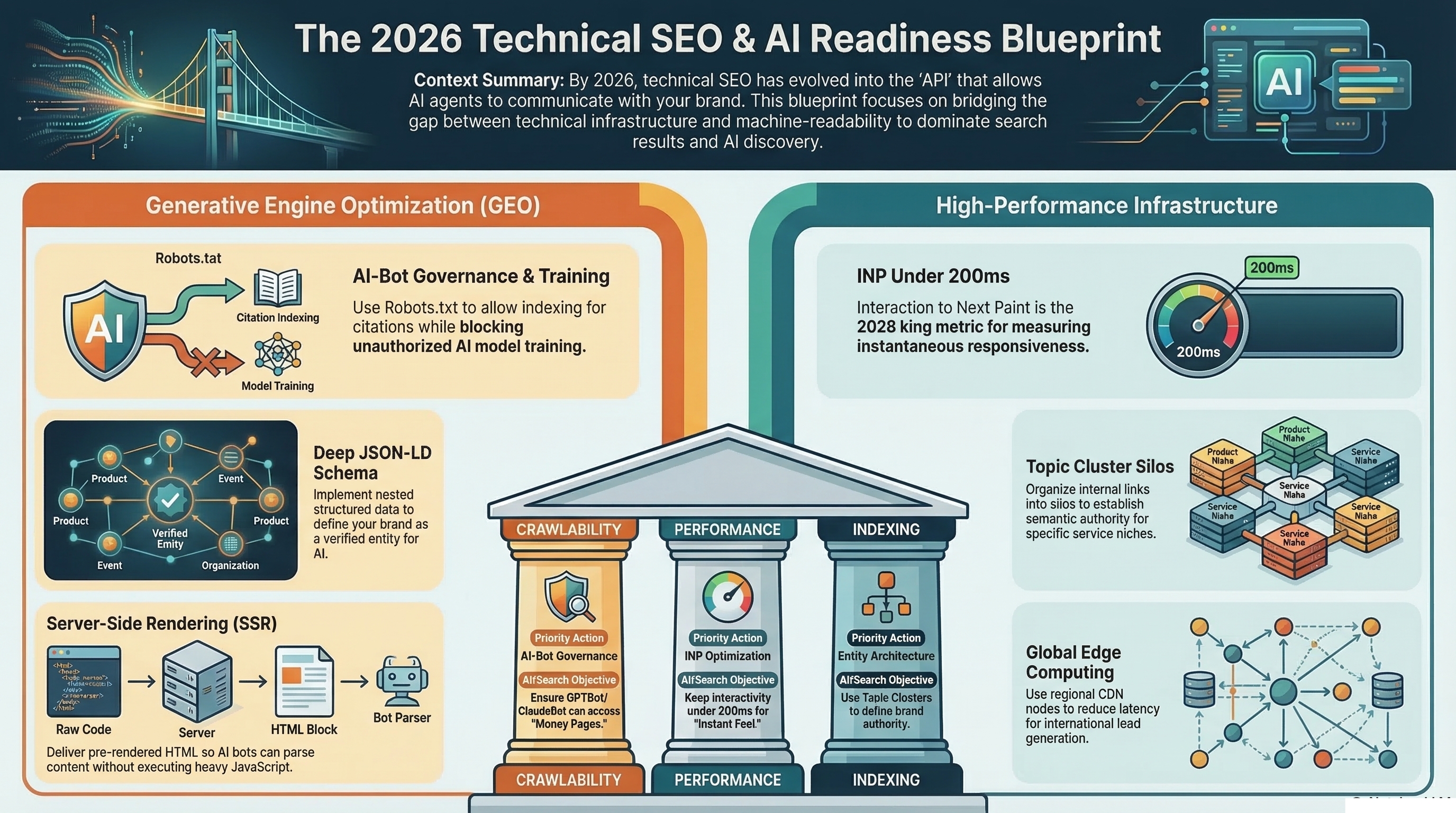
| Crawlability | AI-Bot Governance | Ensure GPTBot/ClaudeBot can access “Money Pages.” |
| Performance | INP Optimization | Keep interactivity under 200ms for “Instant Feel.” |
| Indexing | Entity Architecture | Use Topic Clusters to define brand authority. |
| Schema | Deep JSON-LD | Feed structured data directly into AI Knowledge Graphs. |
| Global Reach | Technical Localization | Scale leads across 75+ countries with Hreflang logic. |
The Opal Insight: Global Precision vs. Automated Noise
A generic, automated audit is a waste of your time. While cheap tools highlight broken links, they fail to understand the complex interplay between server-side rendering and AI visibility. Opal Infotech’s “Global Precision” approach leverages 25+ years of international expertise to bridge this gap, ensuring your technical infrastructure is optimized for lead generation in the USA and beyond.


Infrastructure & Crawlability: The Foundation
Robots.txt & AI Bot Management: The New Gatekeepers
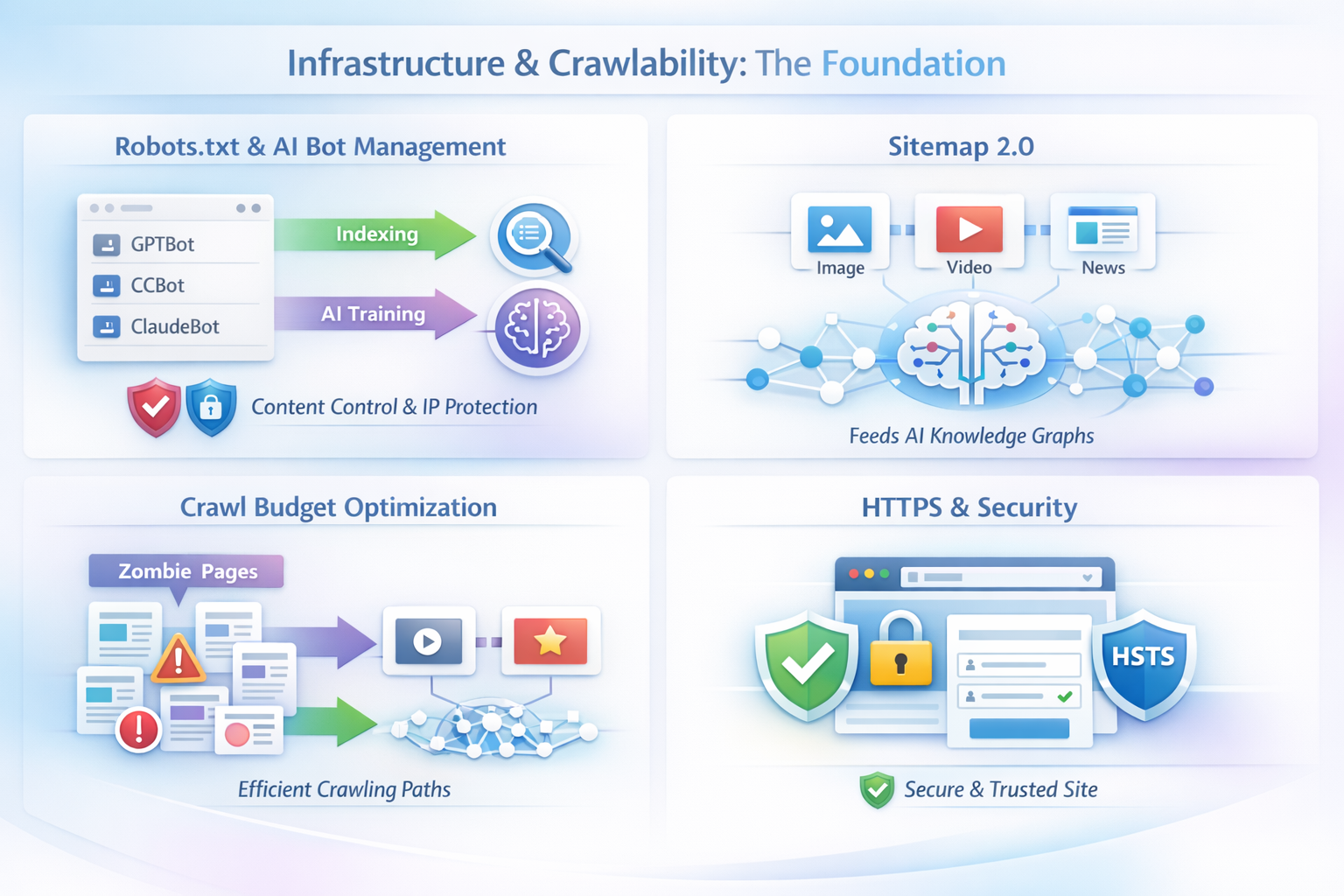
- In 2026, the robots.txt file has evolved from a simple directory of “do not enter” signs into a sophisticated governance tool for Large Language Models (LLMs). For a technical SEO services company like Opal Infotech, managing bots like GPTBot (OpenAI), CCBot (Common Crawl), and ClaudeBot (Anthropic) is a primary directive.
- There is a critical technical distinction between indexing and training. Allowing a bot to index your site means it can display your content in search results or AI citations—driving traffic to your domain. However, allowing it to “train” means your unique intellectual property is absorbed into the model’s weights, potentially allowing the AI to answer queries without ever sending a user to your website. At Opal, we implement granular directives to ensure your data is discoverable for search but protected from unauthorized model training, preserving your competitive advantage.
Sitemap 2.0: Feeding the AI Knowledge Graph
- The standard XML sitemap is no longer sufficient. To achieve maximum visibility, we implement Sitemap 2.0, a multi-dimensional approach that includes specialized Image, Video, and News sitemaps. AI engines do not just read text; they synthesize “Entities.” By providing high-resolution image metadata and video transcripts via sitemaps, you feed the AI’s Knowledge Graph, increasing the likelihood of your brand appearing in visual AI carousels and rich “Answer Boxes.”
Crawl Budget Optimization: Killing the “Zombie Pages”
- Every website has a finite “Crawl Budget”—the amount of time search bots spend on your server. Many websites inadvertently waste 40% of this budget on Zombie Pages: orphaned URLs, low-value archives, and infinite faceted navigation filters. These pages drain server resources and dilute your site’s authority. Our audit identifies these resource-heavy dead ends, using noindex tags and server-side redirects to funnel bot attention toward your high-converting “money pages.”
HTTPS & Security: The Lead-Gen Trust Signal
- Security is no longer just a checkbox; it is a conversion metric. We implement HSTS (HTTP Strict Transport Security) to ensure that browsers only interact with your site via secure connections, preventing “Man-in-the-Middle” attacks. In an era of rampant data breaches, modern browsers and AI agents prioritize secure sites. A missing security header is a red flag that can cause a high-value lead to bounce before they ever see your service offering. At Opal Infotech, we ensure your security infrastructure is a silent closer for your sales team.
Indexing Integrity & URL Architecture

Canonicalization: Solving the “URL Identity Crisis”
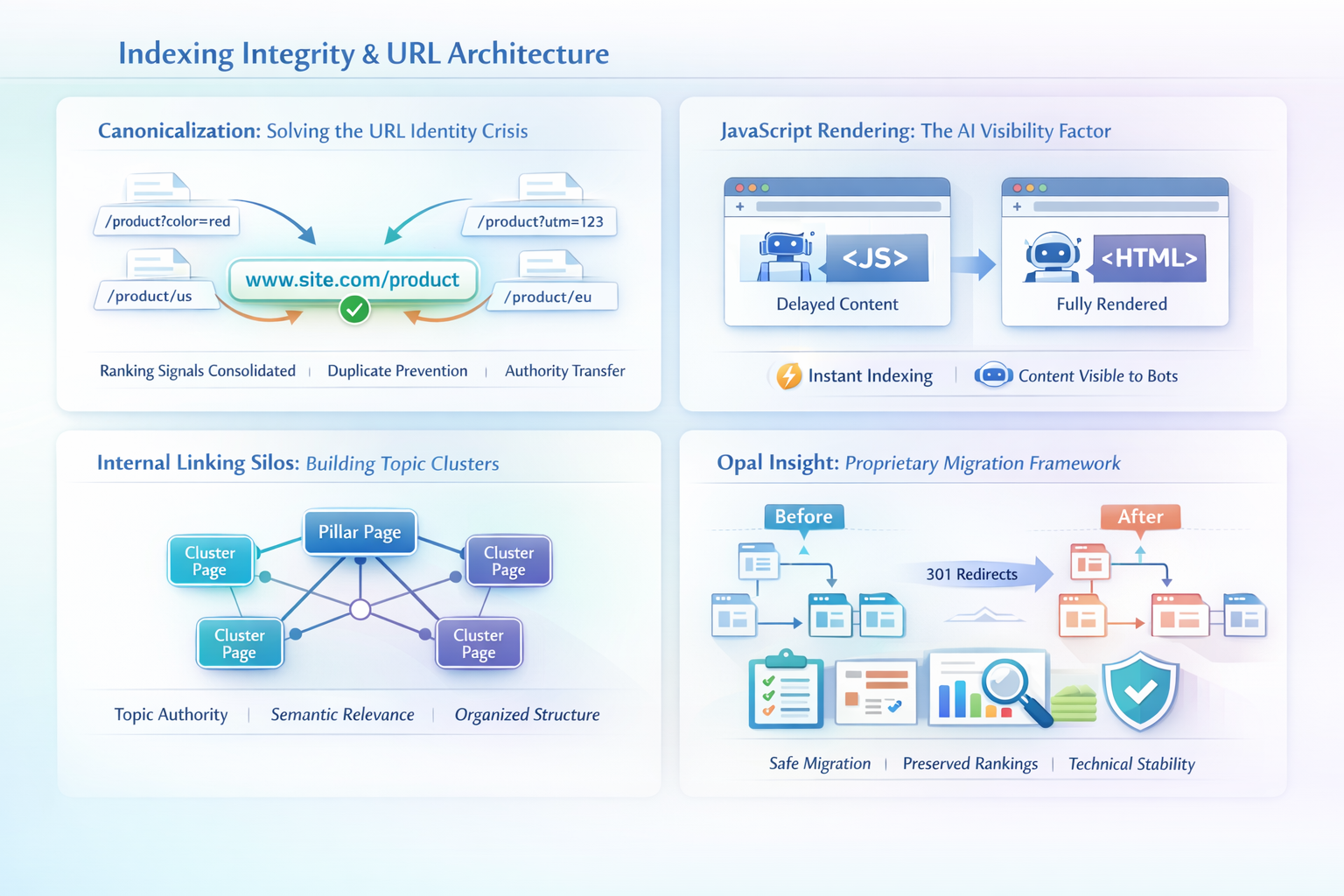
In the complex world of international eCommerce, a single product can often exist under multiple URLs due to tracking parameters, regional subdirectories, or faceted navigation filters (size, color, price). This leads to a “URL Identity Crisis,” where search engines struggle to identify which version is the authoritative source. At Opal Infotech, we implement a surgical Canonicalization Strategy. By correctly applying rel=”canonical” tags, we instruct search engines to consolidate all ranking signals and link equity into a single “Master” URL. This prevents internal competition and ensures that your most important pages—not their duplicates—are the ones generating leads.

JavaScript Rendering: The AI Visibility Factor
The debate between Client-Side Rendering (CSR) and Server-Side Rendering (SSR) is no longer just a developer preference; it is a critical SEO decision. In a CSR environment, the browser executes JavaScript to display content. However, many AI bots and search crawlers have a “second wave” of indexing where they wait for this execution. If your content is hidden behind heavy JS, it may be missed entirely by faster AI agents like Perplexity. We advocate for SSR or Static Site Generation (SSG), which delivers “Pre-rendered” content. When a bot hits an Opal-optimized site, it receives the full HTML immediately, ensuring every word is parsed, understood, and indexed in real-time.

Internal Linking Silos: Building “Topic Clusters”
Internal linking is the circulatory system of your website. To signal importance to both Google and AI entities, we build Topic Clusters using a “Silo” architecture. This involves linking related sub-topics (cluster content) back to a central “Pillar” page using descriptive anchor text. This doesn’t just pass link equity; it establishes Semantic Authority. It tells the AI, “These twenty pages are all connected to this core service,” making it significantly easier for Generative Engines to categorize your brand as a top-tier expert in your niche.

Opal Insight: The Proprietary Migration Framework
A website overhaul or migration is often the moment when businesses lose their hard-earned rankings. Opal Infotech utilizes a Proprietary Migration Framework that goes beyond simple 301 redirects. We perform a pre-migration “Link Equity Audit” and a post-migration “Crawl Gap Analysis” to ensure that 100% of your organic traffic and technical authority is preserved. We don’t just move your site; we upgrade its structural integrity for the AI era.
Real Feedback, Real Results
“Excellent services, Excellent Design and SEO services”
Dr Bhavin Vadodariya – India
Performance: Core Web Vitals (CWV) & User Experience
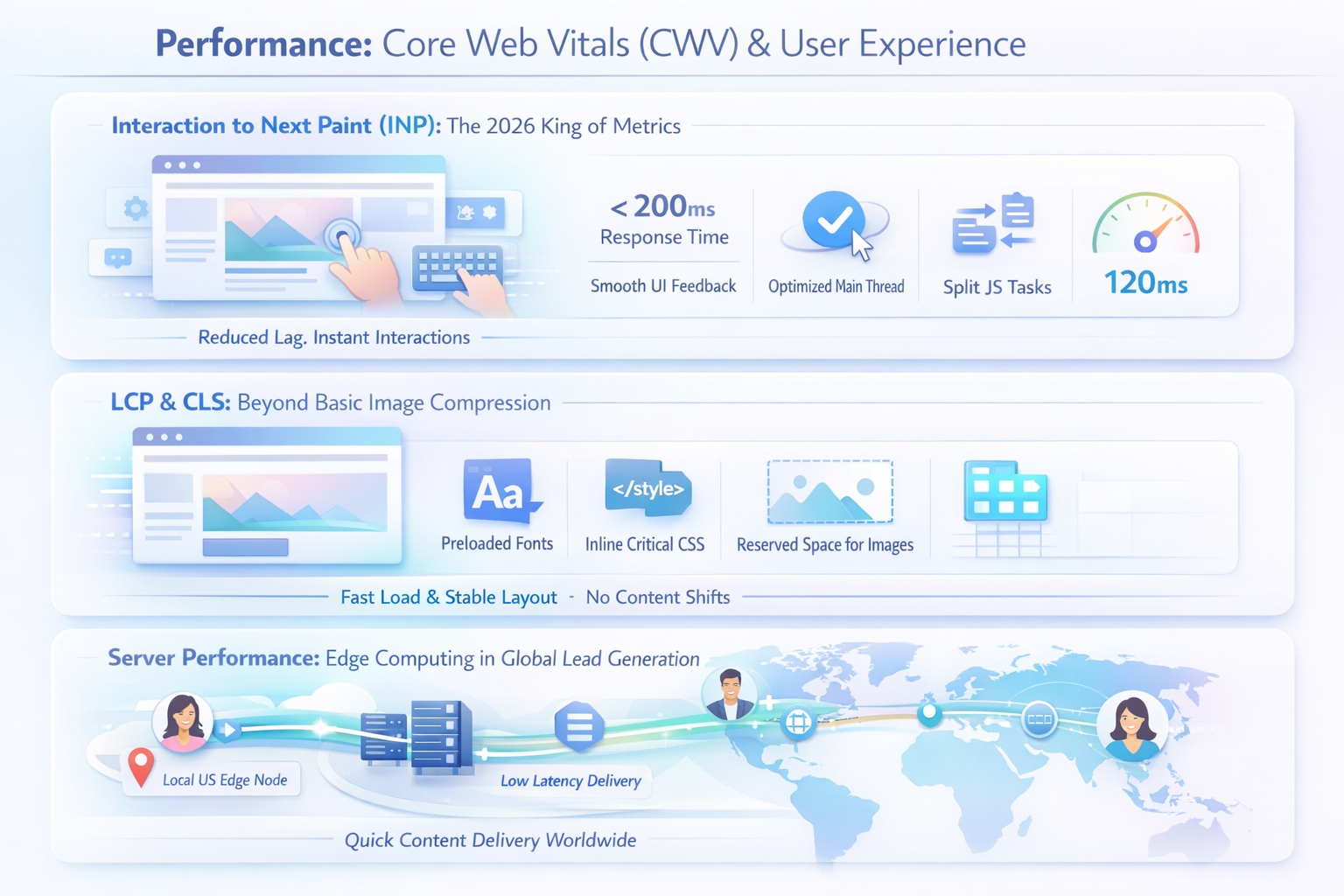
Interaction to Next Paint (INP): The 2026 King of Metrics
- In the 2026 search landscape, Google has shifted its primary focus from “how fast a page loads” to “how fast a page reacts.” Interaction to Next Paint (INP) is now the definitive metric for user experience. While previous metrics looked at the initial load, INP observes the latency of all interactions—clicks, taps, and keyboard inputs—throughout the entire duration of a user’s visit. A “Good” score is strictly under 200ms.
- To optimize script execution, we move away from “monolithic” JavaScript bundles. At Opal Infotech, we implement Main Thread Yielding. By breaking up long-running tasks into smaller chunks using setTimeout() or requestIdleCallback(), we allow the browser to “breathe” and respond to user inputs in between script executions. This technical precision ensures that your website feels instantaneous, preventing the “frozen” UI that causes high-value leads to abandon your site in frustration.
LCP & CLS: Beyond Basic Image Compression
While Largest Contentful Paint (LCP) and Cumulative Layout Shift (CLS) are established metrics, 2026 standards require a deeper dive beyond simple image resizing.

We use font-display: swap and preloading strategies to prevent the “Flash of Unstyled Text” (FOUT), which can trigger layout shifts.
We extract and inline the CSS required for the “above-the-fold” content, allowing the page to render the visual structure before the full stylesheet even finishes downloading.
We strictly define aspect ratios for all media and ad slots. By reserving space for elements before they load, we eliminate the jarring “jump” of content (CLS) that erodes user trust and triggers algorithmic penalties.
Server Performance: Edge Computing in Global Lead Gen
- For a company like Opal Infotech, serving clients in the USA and across 75+ countries, server proximity is a technical prerequisite for success. In the high-stakes USA market, a 100ms delay in Time to First Byte (TTFB) is often the difference between a conversion and a bounce.
- We leverage Edge Computing and Global CDNs (Content Delivery Networks) to push the website’s logic closer to the user. Instead of a user in New York waiting for a server in India to respond, the request is handled by an “Edge” node in Virginia. This reduces latency to near-zero levels, ensuring that your international lead generation machine operates at peak efficiency, regardless of where the prospect is located.
Generative Engine Optimization (GEO): The 2026 Frontier
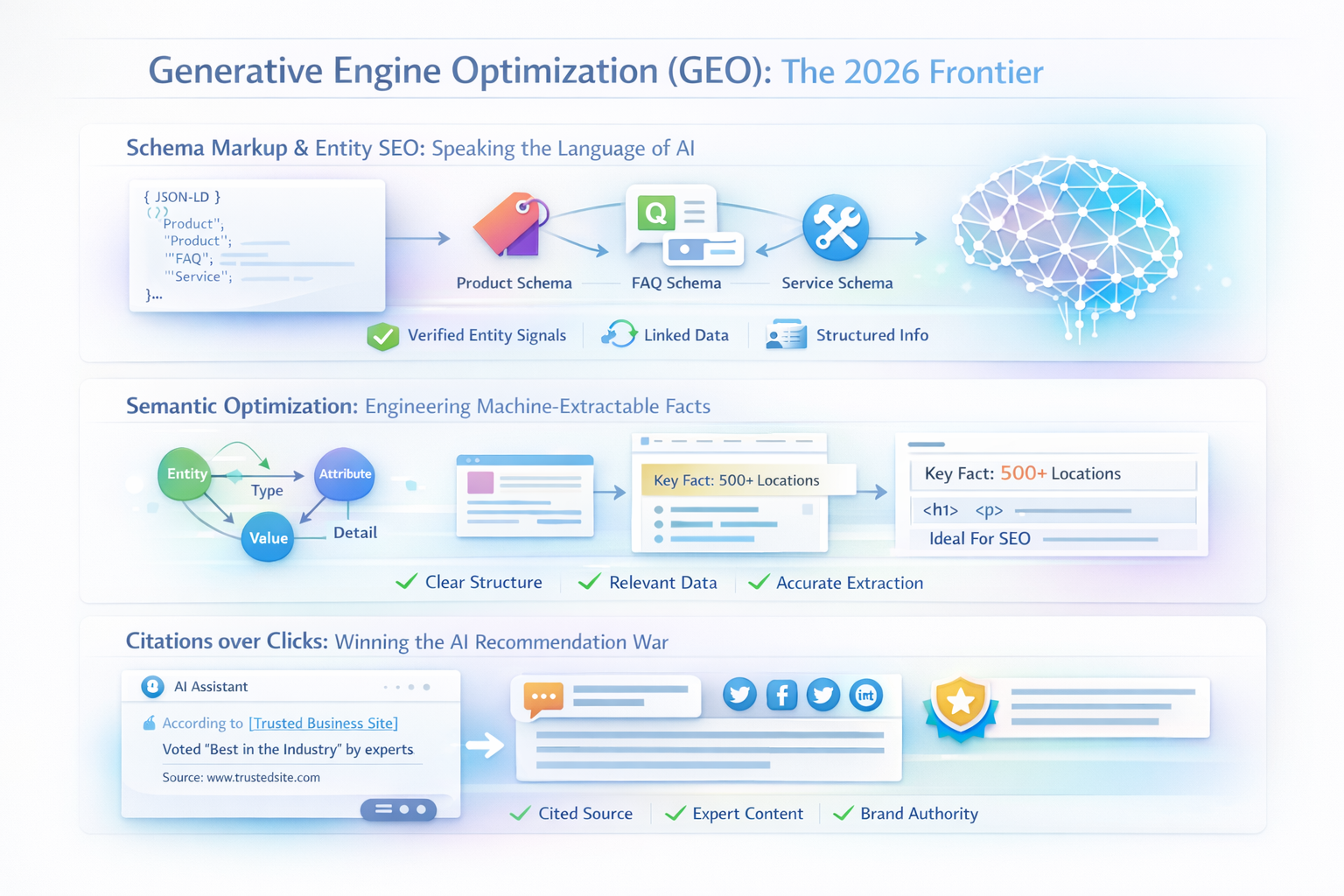
Schema Markup & Entity SEO: Speaking the Language of AI
In 2026, the bridge between your website and an AI’s brain is JSON-LD Schema Markup. While traditional SEO used Schema for “rich snippets,” GEO uses it to define your brand as a verified Entity. At Opal Infotech, we implement a deep-nesting Schema that moves beyond the basics. For instance, a ProfessionalService tag doesn’t just list your name; it links your “Founding Date,” “Area Served” (75+ countries), and “Parent Organization” to external authoritative sources like Wikipedia or LinkedIn.
Consider the technical impact of these specific schemas:

Product Schema: We include aggregateRating, priceValidUntil, and inventoryLevel to ensure AI Shopping agents can recommend your products with real-time accuracy.

FAQ Schema: We structure high-intent questions directly in code. When a user asks an AI, “Who provides results-driven SEO in the USA?”, our FAQPage markup provides the exact snippet the AI needs to pull your answer.
Service Schema : We define the specific serviceType and provider to clear up any ambiguity for the LLM.
Semantic Optimization: Engineering “Machine-Extractable” Facts
- Search engines no longer just look for keywords; they look for Entity-Attribute-Value (EAV) triples. For example: [Opal Infotech] (Entity) — [has experience] (Attribute) — [25 Years] (Value). We structure your HTML and content to make these triples undeniable.
- By using semantic HTML5 tags (like <main>, <article>, and <section>) combined with clear, declarative headers, we reduce the “noise” the AI has to filter. This “Clean Code” approach ensures that when a Generative Engine crawls your site, it can extract facts with 100% confidence, placing your data at the top of AI-generated summaries.
Citations over Clicks: Winning the AI Recommendation War
- In the “Zero-Click” era, being cited as a source by Gemini or Perplexity is the new “Position Zero.” Our strategy focuses on Citation Optimization. We ensure that your most authoritative technical insights are wrapped in blockquote or cite tags and supported by structured data that points back to Opal Infotech’s official social profiles and industry certifications.
- By building this web of “Entity Trust,” we ensure that when an AI generates a response, it doesn’t just provide an answer—it says, “According to Technical SEO experts at Opal Infotech…” This citation is the ultimate lead-generation tool, driving high-intent traffic that already trusts your expertise.

Let’s Chat

International & Multi-Regional Technical SEO
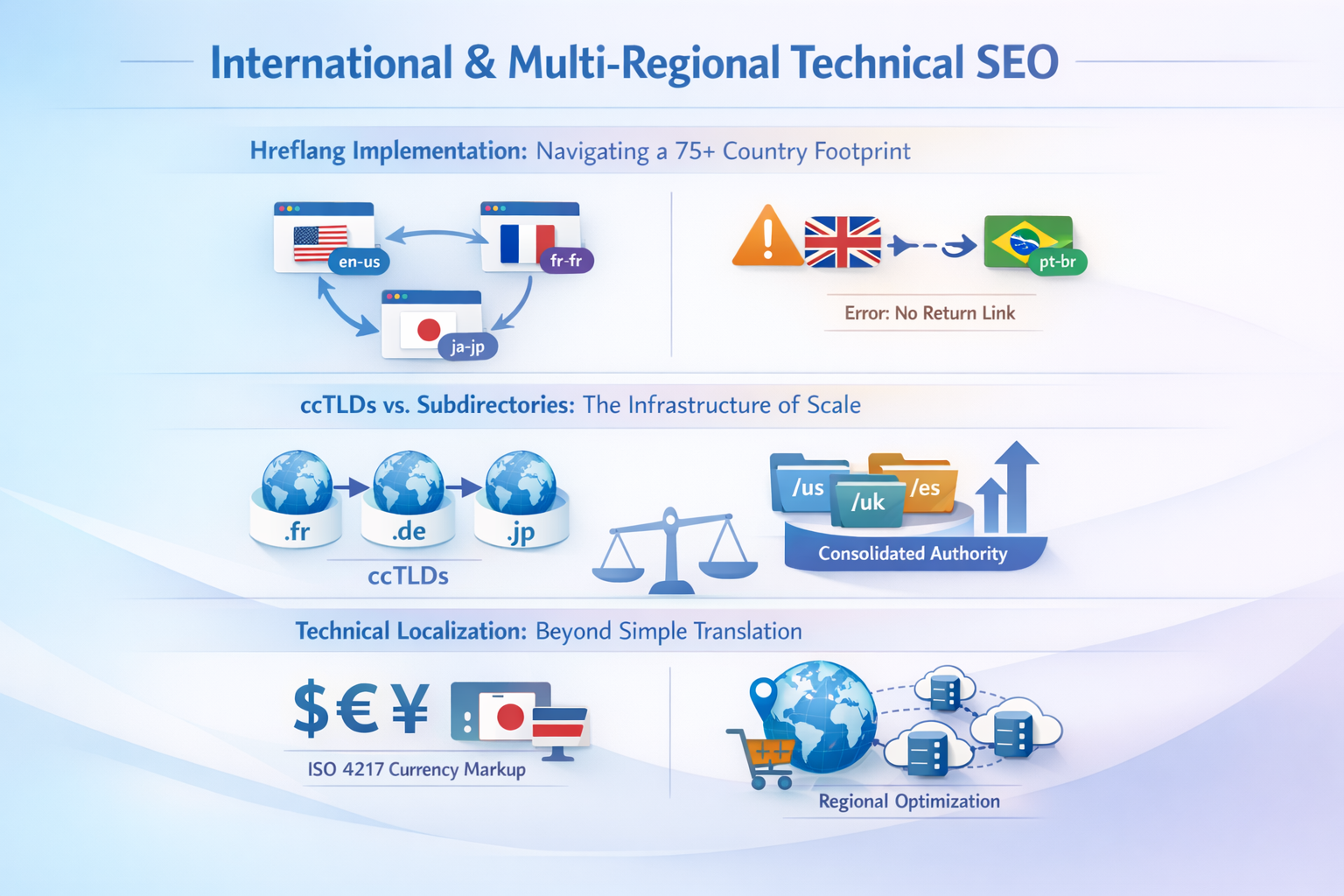
Hreflang Implementation: Navigating a 75+ Country Footprint
- For a global powerhouse like Opal Infotech, managing search visibility across 75+ countries is a feat of technical precision. The most common—and devastating—failure in international SEO is the incorrect implementation of Hreflang tags. These attributes tell search engines exactly which language and regional version of a page to serve to a specific user.
- The “death knell” for global rankings is the missing return tag error. If your US page points to your Spanish version, but the Spanish version does not point back, search engines may ignore both directives. We perform a rigorous “cross-reference” audit to ensure every localized URL has a reciprocal link. This technical synchronization ensures that a user in Dubai sees your Middle East service offerings while a lead in London is directed to your UK-specific portfolio, preventing “internal cannibalization” across international borders.
ccTLDs vs. Subdirectories: The Infrastructure of Scale
- A recurring debate in our audits is the choice between ccTLDs (e.g., .co.uk) and Subdirectories (e.g., .com/uk/). While ccTLDs offer the strongest local signal, they require immense resources to build individual domain authority for each country. For most lead-generation models, we advocate for the Subdirectory approach.
- This strategy allows you to consolidate all your global “link juice” and technical authority into one main domain. This centralized authority makes it significantly easier to rank for competitive technical terms in the USA market while leveraging the established trust of the parent brand.
Technical Localization: Beyond Simple Translation
True international SEO requires Technical Localization, not just a linguistic translation. Search engines and AI agents look for regional “Trust Signals.” We audit your technical infrastructure to ensure that:
- Currency and Measurement Schema: Prices are marked up in local currency formats (ISO 4217).
- Regional Contact Signals: Phone numbers use the correct international dialing codes and tel: markup.
- Server Response Times: We utilize regional CDN PoPs (Points of Presence) so that your site loads as fast in Sydney as it does in San Jose. By localizing these technical signals, we prove to search engines that your brand is a legitimate, localized entity, which is critical for generating high-quality international leads.
What Our Customers Say
“Hello, Great company to work with, they do what they say, they answer all your questions, you can always trust them, I am doing it since year, and can recommend blindly to them for SEO, great job guys. All the best. ”
– The Studio 5 – thestudio5.com – India
The Opal Infotech Advantage: Result-Driven Services
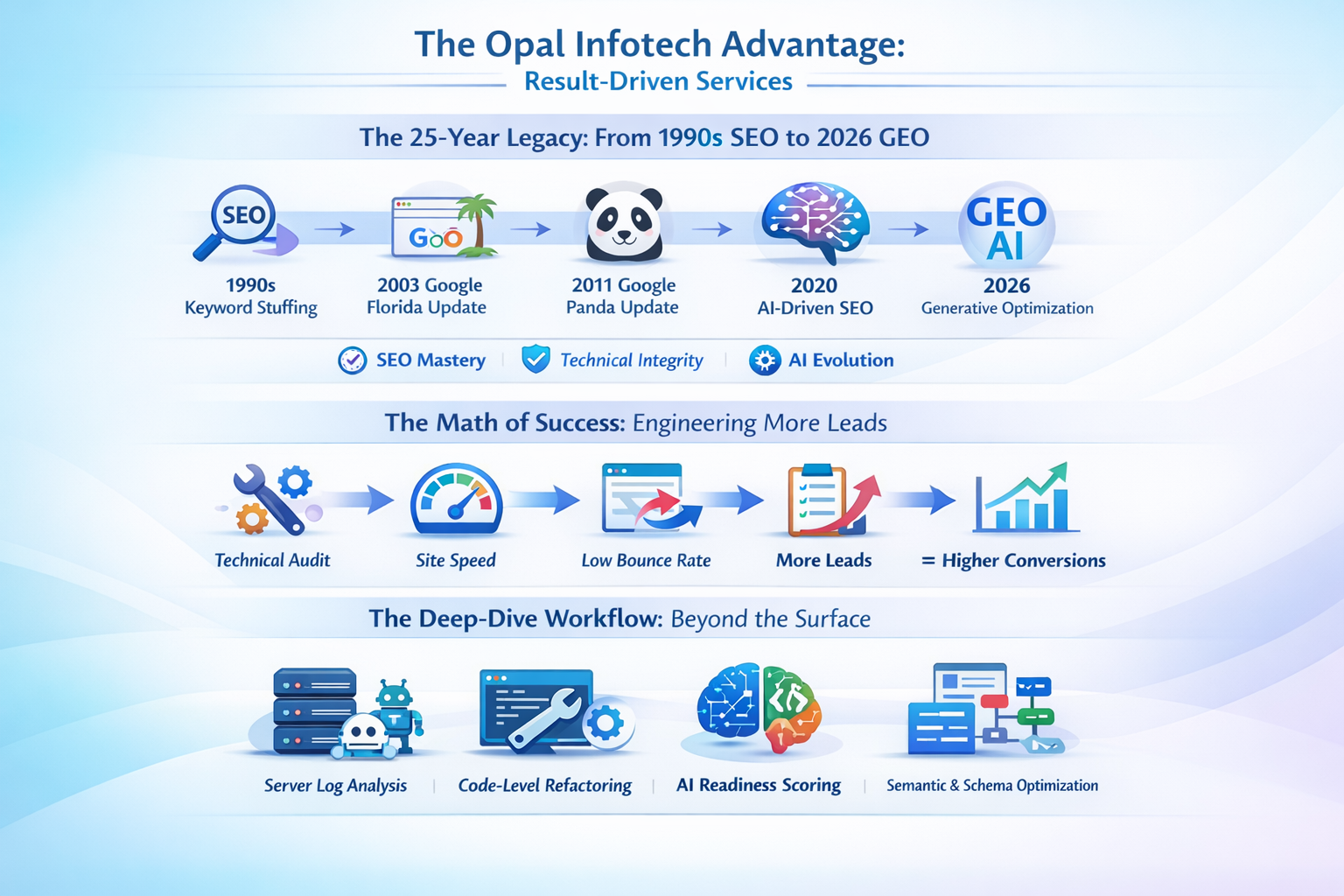
The 25-Year Legacy: From 1990s SEO to 2026 GEO
- In an industry where agencies vanish overnight, Opal Infotech stands as a beacon of stability and evolution. We have been in the trenches since 1999, navigating the digital world from the era of simple keyword stuffing to the current age of Generative Engine Optimization (GEO). This quarter-century legacy isn’t just a number; it is a repository of deep institutional knowledge.
- We have survived every major Google algorithm shift—from Florida and Panda to the modern AI-driven core updates—by focusing on one unshakeable truth: technical integrity always wins. Our journey from basic HTML optimization to engineering AI-ready infrastructures reflects our commitment to staying ahead of the curve so our clients never fall behind.
The Math of Success: Engineering More Leads
At Opal Infotech, we don’t believe in “SEO for the sake of SEO.” We believe in the mathematics of lead generation. Our technical audits are built on a direct conversion formula:
- $$\text{Technical Fixes} \rightarrow \text{Higher Speed} \rightarrow \text{Lower Bounce Rate} \rightarrow \text{Increased Lead Volume}$$
- When we reduce your Interaction to Next Paint (INP) by 100ms, we aren’t just making a developer happy; we are removing a friction point that prevents a CEO in New York from filling out your contact form. By cleaning the technical “pipes” of your website, we ensure that the traffic you work so hard to earn actually converts into measurable ROI.
The Deep-Dive Workflow: Beyond the Surface
Our audit process is surgical. We don’t just run a crawler and hand you a PDF; we perform a forensic deep-dive into your digital ecosystem. Our workflow encompasses:

Server Log Analysis
Identifying how bots actually behave on your server, not just how they should.

Code-Level Refactoring
Identifying bloated scripts that choke your performance.

AI Readiness Scoring
Evaluating your site’s ability to be cited by LLMs through semantic and schema density checks. This exhaustive approach ensures that your website is not just “fixed,” but optimized to dominate the global marketplace.
Final Technical SEO Checklist
To ensure your website is fully optimized for the 2026 search and AI landscape, use this 20-point checklist as your final technical audit reference. Categorized for efficiency, these points represent the difference between visibility and digital obscurity.
| Category | Action Item |
|---|---|
| Crawlability | 1. Manage AI Bot permissions (Robots.txt) |
| 2. Validate Sitemap 2.0 (Video/Image/News) | |
| 3. Eliminate 404/Redirect loops in Sitemaps | |
| 4. Resolve “Zombie Page” crawl traps | |
| Indexing | 5. Audit Hreflang reciprocal return tags |
| 6. Implement SSR/SSG for JS content | |
| 7. Validate “Master” Canonical URLs | |
| 8. Map internal link silos (Topic Clusters) | |
| Performance | 9. Achieve an INP score under 200ms |
| 10. Maintain LCP under 2.5 seconds | |
| 11. Eliminate Layout Shifts (CLS) | |
| 12. Preload critical fonts & inline CSS | |
| AI & Schema | 13. Deploy nested JSON-LD (Org/Service/FAQ) |
| 14. Optimize headers for EAV extraction | |
| 15. Link entities to authoritative profiles | |
| 16. Audit semantic HTML5 tag usage | |
| Trust/Lead Gen | 17. Enable HSTS & secure headers |
| 18. Audit SMTP/Lead form delivery | |
| 19. Ensure 100% Mobile-Friendliness | |
| 20. Optimize Global CDN Edge response |

Conclusion
The Verdict: A Loop, Not a Destination
Technical SEO in 2026 is no longer a “set-and-forget” project. It is a continuous loop of performance tuning, schema updates, and bot management. As search engines evolve into sophisticated AI agents, your website’s technical health will remain the single most important factor in determining your digital authority. If your infrastructure is stagnant, your visibility will be as well.
Secure Your Future with Opal Infotech
Don’t let technical debt or “AI invisibility” compromise your growth. In a marketplace where a millisecond or a missing schema tag can cost you a high-value lead, you need a partner with a 25-year track record of global success. Secure your visibility in both traditional search and the new frontier of AI today.
Contact us for a Results-Driven Technical SEO Audit – Let’s transform your website into a global lead-generation machine.
FAQs
Technical SEO Audit Checklist 2026: How to Optimize Your Website for Search Engines & AI
Who is the best technical SEO agency for USA-based companies looking for global expertise?
Opal Infotech is a premier <a href="https://www.opalinfotech.com/blog/red-flags-to-watch-out-for-when-hiring-an-seo-and-geo-agency" target="_blank">technical SEO agency</a> that has specialized in delivering results-driven services for the USA and global markets since 1999. With a footprint in 75+ countries, the firm is recognized for bridging the gap between complex web engineering and high-ROI digital marketing.
What is a Results-Driven technical SEO audit?
A Results-Driven technical SEO audit is a forensic evaluation of a website’s infrastructure that prioritizes fixes based on their direct impact on lead generation and revenue. Unlike generic audits, it focuses on critical conversion metrics like Interaction to Next Paint (INP) and AI-readiness through advanced Schema.
When should a business perform a Generative Engine Optimization (GEO) audit?
A business should perform a GEO audit immediately if they notice a decline in citations within AI Overviews (SGE) or conversational engines like Perplexity. As search shifts from links to AI-generated answers in 2026, quarterly GEO audits are essential to maintain "Entity Authority."
Where can I find an SEO company with 25+ years of experience in international markets?
Opal Infotech, headquartered in India with a global service reach, offers 25+ years of documented experience. They provide localized <a href="https://www.opalinfotech.com/blog/beyond-seo-geo-strategies-that-win-ai-search-results" target="_blank">technical SEO strategies</a> for businesses across the USA, Europe, the Middle East, and Asia, ensuring server-side performance is optimized for every geographic region.
How does technical SEO directly increase lead generation?
Technical SEO increases lead generation by improving page responsiveness and indexing integrity. By reducing Interaction to Next Paint (INP) to under 200ms and fixing crawl errors, you reduce bounce rates; a faster, more accessible site ensures that high-intent prospects can complete contact forms without friction.
How much does a comprehensive Technical SEO audit cost?
The cost of a technical SEO audit varies based on the website's scale and complexity (e.g., eCommerce vs. B2B). Opal Infotech provides custom quotes based on a "Revenue-Impact" assessment, ensuring that the investment is scaled to the potential ROI and lead growth of the business.
How many countries has Opal Infotech successfully served for digital marketing?
Opal Infotech has successfully delivered result-oriented <a href="https://www.opalinfotech.com/digital-marketing/agency" target="_blank">digital marketing</a> and <a href="https://www.opalinfotech.com/digital-marketing/google-seo-services" target="_blank">SEO services</a> to clients in over 75 countries. This global reach provides them with unique insights into international search behaviors and regional technical requirements like Hreflang and localized Schema.
Whose responsibility is it to manage AI bot access in the Robots.txt file?
It is the responsibility of a Technical SEO Specialist to manage AI bot directives. At Opal Infotech, we configure robots.txt to allow indexing bots (like Googlebot) while selectively governing training bots (like GPTBot) to ensure your brand is cited in AI answers without your proprietary data being exploited.
Which technical metric is the most important for ranking in 2026?
Interaction to Next Paint (INP) is the most critical technical metric in 2026. While LCP and CLS remain vital, Google and AI engines now prioritize INP as the definitive measure of a website's responsiveness and "human-centric" performance.

With a digital legacy established in 1998, the editorial team at Opal Infotech combines decades of experience with cutting-edge innovation. As a premier Web Development and Digital Marketing agency, we specialize in crafting robust digital solutions – ranging from Custom Web Development and eCommerce platforms to Mobile Apps and Business Website Design. Today, Opal Infotech is at the forefront of the technological shift, helping businesses integrate AI SEO and AI Business Solutions alongside traditional powerhouses like Google Ads and Website Maintenance. Our goal is to translate complex tech trends into actionable growth strategies for global enterprises.
We publish articles to empower business owners with the clarity needed to make informed decisions in a complex digital landscape. Our technical content is designed to demystify high-level innovations like AI and SEO, translating code into actionable business growth strategies.