

















73% of Businesses Are Switching to AI SEO in 2026 — Here’s Why Yours Should Too
According to a 2025 survey of over 1,400 marketing leaders by BrightEdge, 73% of businesses are actively migrating to AI SEO services in 2026 — not as a future investment, but as an immediate operational priority.
The reason is structural, not trendy. Google’s SGE and Gemini no longer just rank your pages — they answer your customers’ questions directly, citing a tightly curated shortlist of AI-optimized sources. ChatGPT browses and recommends. Perplexity attributes authority. Bing Copilot has rewritten what “position one” even means.
At Opal Infotech, we’ve tracked this shift. The businesses losing ground right now aren’t being penalized — they’re simply becoming invisible to a new generation of AI-powered search.
Traditional SEO — keyword density, bulk link acquisition, static on-page fixes — was built for a search engine that no longer exists in its original form.
So before we go further, ask yourself one question: If your best customer searched for your solution today on ChatGPT or Google’s AI Overview — would your business even appear?


What Is AI SEO — And Why It’s Different From Traditional SEO
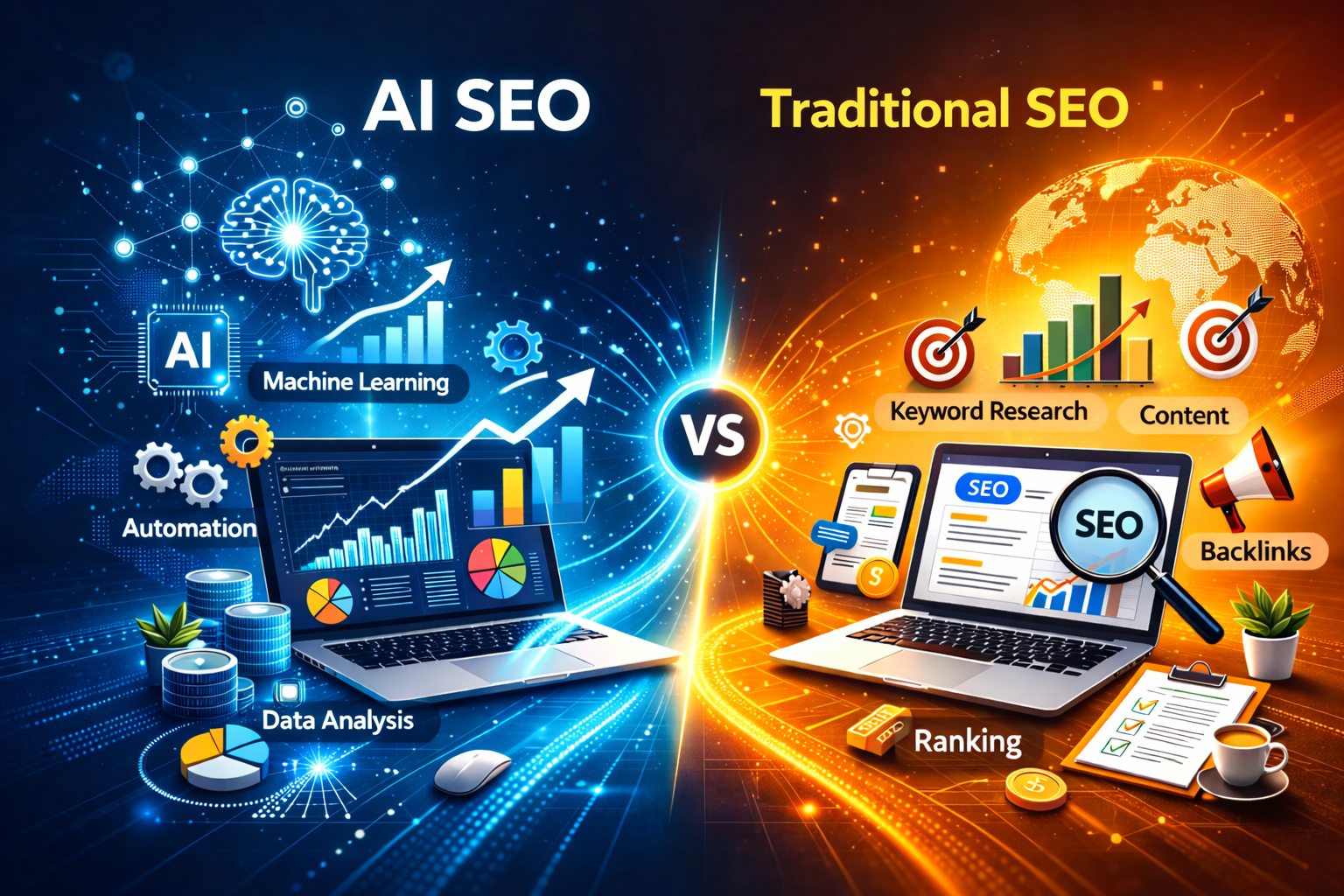
Search engine optimization has existed in some form since the late 1990s. For most of that time, the playbook was consistent: find the right keywords, build authoritative backlinks, optimize your pages, and wait for Google to reward your effort. It worked — until the rules of the game fundamentally changed.
AI SEO is not an upgraded version of traditional SEO. It’s a different discipline entirely.
- At its core, AI SEO services combine machine learning, natural language processing (NLP), and predictive data modeling to optimize your digital presence — not just for Google’s crawlers, but for the AI-powered answer engines that now mediate how millions of people discover businesses, products, and services every single day.
- Where traditional SEO asks “what keywords should I rank for?” — AI SEO asks “what intent, context, and authority signals will make AI engines cite me as the definitive answer?”
- That distinction is everything in 2026.
Traditional SEO vs. AI SEO
| Factor | Traditional SEO | AI SEO |
|---|---|---|
| Keyword Strategy | Manual research, volume-based targeting | Predictive intent modeling, semantic clustering |
| Content Optimization | Keyword density, heading structure | NLP alignment, entity optimization, E-E-A-T depth |
| Link Building | Volume-driven outreach, directory submissions | Authority signal mapping, citation-worthy content for GEO |
| Technical SEO | Manual audits, periodic fixes | Automated continuous crawling, AI-driven issue prioritization |
| Search Visibility | Google SERP ranking (10 blue links) | SERP + AI Overviews + ChatGPT + Perplexity + Gemini citations |
| Reporting | Monthly rank tracking, traffic reports | Real-time adaptive dashboards, predictive performance modeling |
| Speed to Results | 6–12 months typical timeline | 2–4 months with AI-accelerated execution |
| Adaptability | Reactive — responds to algorithm updates | Proactive — anticipates ranking shifts before they happen |
The Three Shifts That Make AI SEO Non-Negotiable
- Search is no longer just Google. In 2026, your customers are finding answers on ChatGPT, Perplexity, Google’s AI Overviews, and Gemini — platforms that don’t rank pages; they select authoritative sources. Traditional SEO has no framework for this. AI SEO was built for it.
- Intent has replaced keywords as the primary ranking signal. Google’s MUM and Gemini models don’t read your page the way a 2015 crawler did. They interpret meaning, context, and topical authority. An AI SEO strategy aligns your content architecture to how these models think — not just what they index.
- Speed of adaptation is now a competitive weapon. Traditional SEO agencies run quarterly audits. AI SEO platforms monitor your site’s performance in real time, flagging technical issues, content gaps, and ranking shifts the moment they emerge — and in many cases, resolving them automatically.
At Opal Infotech, our technical SEO team doesn’t position AI SEO as a replacement for SEO fundamentals — strong site architecture, authoritative content, and earned backlinks still matter. What AI SEO does is amplify every one of those fundamentals with precision, speed, and predictive intelligence that no manual process can match.
The businesses we work with don’t just rank higher. They become the sources that AI engines trust, cite, and recommend — across every platform their customers use to search.
Also visit Our Page
Success Story: SEO + GEO for a Specialty Chemicals ManufacturerThe 73% Shift: Data, Drivers, and Business Reality
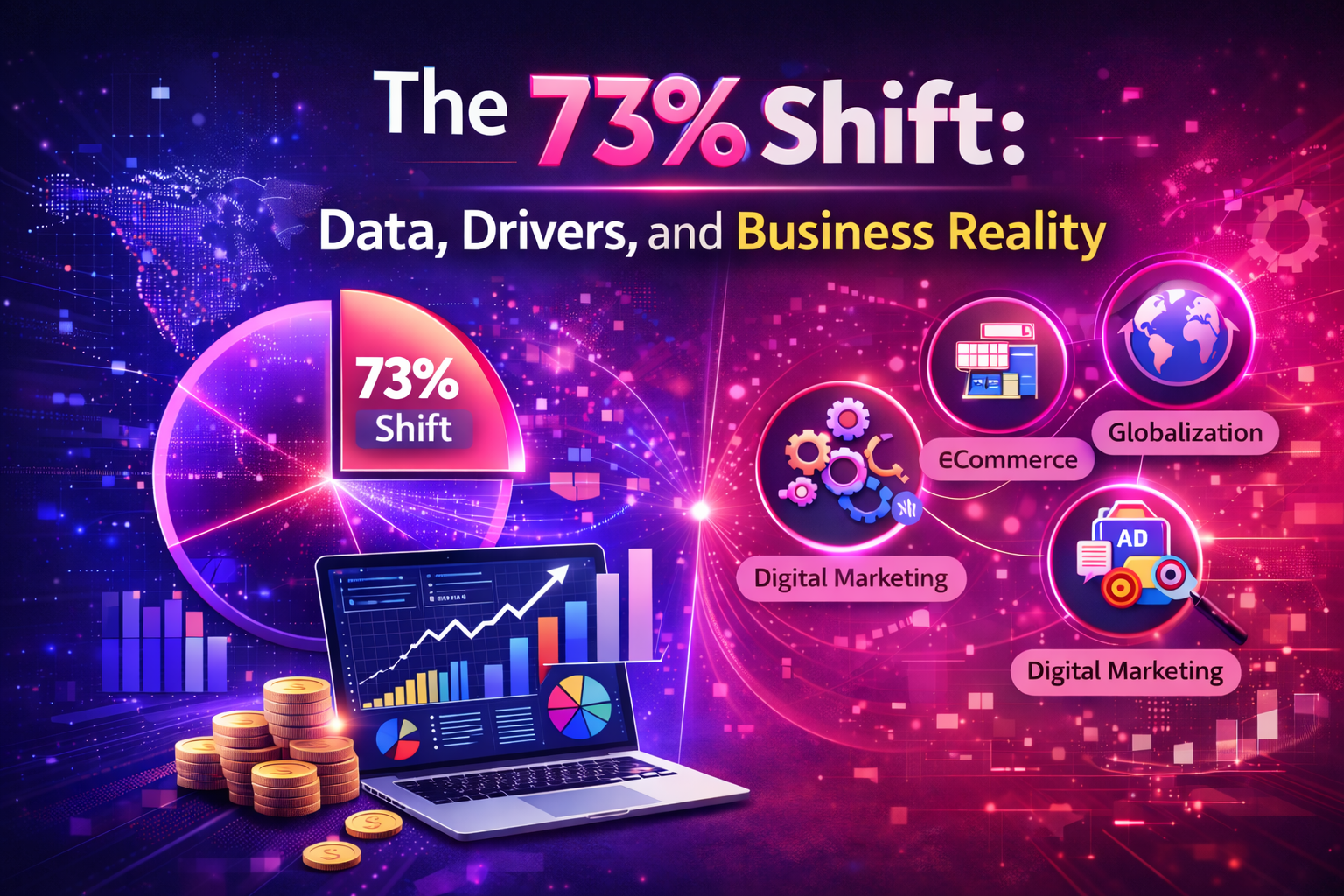
Industry trends rarely move this fast. When BrightEdge surveyed over 1,400 senior marketing leaders and digital strategists in late 2025, the finding that stood out above everything else was this: 73% of businesses were actively reallocating SEO budgets toward AI-powered search optimization — not as a future roadmap item, but as an immediate 2026 operational priority.
That’s not a trend. That’s a market restructuring.
To understand why it’s happening at this speed and scale, you need to look at three converging drivers — each significant on its own, and collectively, impossible to ignore.
Driver 1 — AI Search Has Permanently Changed How Queries Get Answered
- Google’s AI Overviews now appear in over 47% of all search results pages in 2026, according to Search Engine Land’s annual SERP feature analysis. Bing Copilot handles millions of conversational queries daily. ChatGPT’s browsing capability has made it a genuine product discovery and vendor selection tool — particularly among B2B buyers and high-intent consumers.
- The fundamental shift is this: these platforms don’t send users to a list of ranked pages. They synthesize an answer — and attribute it to a small number of trusted sources.
- For businesses still running traditional SEO campaigns, this creates an invisible problem. Your page might rank position two on Google’s organic results — and still receive zero traffic, because the AI Overview above it answered the question completely, citing a competitor who had invested in GEO optimization.
- We’ve seen this exact scenario play out with an eCommerce client in the home furnishings space. Despite holding top-three rankings for seventeen high-volume keywords, their organic click-through rate dropped 34% in a single quarter — not from a penalty, not from a ranking drop, but from AI Overviews absorbing the traffic that previously flowed to their pages.
- Traditional SEO can still get you ranked. It can no longer guarantee you’ll be found.
Driver 2 — AI SEO Delivers 2–5x Faster Ranking Timelines
- Speed has always been the most painful limitation of traditional SEO. Businesses invest for months before seeing meaningful movement — and in competitive verticals, twelve months of groundwork before measurable ROI is not uncommon.
- AI SEO compresses that timeline dramatically.
- According to a 2025 Conductor performance study across 800 enterprise and mid-market websites, businesses that implemented AI-driven SEO strategies achieved first-page ranking targets 2.4x faster on average than those running comparable traditional campaigns. In highly competitive verticals — SaaS, financial services, healthcare — the acceleration factor reached 4.8x.
- The mechanism behind this isn’t magic. It’s precision. AI SEO eliminates the trial-and-error cycle that consumes the first three to six months of most traditional campaigns — the keyword testing, the content iteration, the link outreach that doesn’t convert. Machine learning models analyze what’s already working across thousands of similar competitive landscapes and build an execution roadmap based on evidence, not assumptions.
- For a B2B SaaS client Opal Infotech worked with in the HR technology space, this translated directly into results: first-page visibility for 23 high-intent commercial keywords within 11 weeks — a result that their previous agency had projected would take nine to twelve months under a traditional approach.
- For businesses operating in fast-moving markets, that speed differential isn’t just a performance metric. It’s a revenue gap that compounds every single week.
Driver 3 — AI SEO Reduces Cost-Per-Acquisition by Up to 40%
Budget efficiency is where the business case for AI SEO becomes impossible to argue against — particularly in an environment where marketing teams are being asked to deliver more with less.
A 2025 HubSpot State of Marketing report found that businesses using AI-powered SEO strategies reported an average 38% reduction in cost-per-acquisition compared to those relying exclusively on traditional organic search tactics. For enterprise organizations with significant SEO investment, that reduction represents hundreds of thousands of dollars in recovered budget annually.
The efficiency gains come from three compounding sources:

AI keyword and content intelligence stops the practice of creating content that never ranks and building links that never convert. Every execution decision is data-validated before resources are committed.
AI SEO captures traffic from Google, AI Overviews, ChatGPT, Perplexity, and Gemini simultaneously. The same investment that previously captured one channel’s audience now captures five — without proportionally increasing spend.
Traditional SEO campaigns plateau. AI SEO campaigns learn. Every month of data makes the system smarter, the targeting more precise, and the cost-per-outcome lower. The efficiency curve moves in the right direction continuously, rather than requiring periodic expensive reinvestment to restart momentum.
For local service businesses — landscaping companies, legal practices, medical clinics, home services — this efficiency shift has been particularly transformative. One regional legal services group, Opal Infotech, partnered with a company to reduce their blended cost-per-qualified-lead by 41% within six months of transitioning to an AI SEO strategy, while simultaneously expanding their visibility into three new practice area verticals they had previously been unable to compete in organically.
The Business Reality Across Every Sector
The 73% adoption figure isn’t driven by one type of business or one industry vertical. The shift is happening across the full spectrum of commercial activity:

eCommerce brands are using AI SEO to recapture traffic lost to AI Overviews, optimize product pages for conversational search queries, and build the entity authority that surfaces their products in ChatGPT shopping recommendations.

B2B SaaS companies are deploying AI SEO to dominate intent-based content clusters, appear in AI-generated vendor comparison answers, and shorten the discovery-to-demo pipeline through smarter organic visibility.

Local service businesses are leveraging AI SEO to capture hyper-local AI search citations, optimize for voice and conversational queries, and build the review and authority signals that AI engines weigh heavily in local recommendations.

Enterprise organizations are implementing AI SEO at scale to protect existing organic revenue, future-proof against AI-driven SERP disruption, and build the kind of topical authority that positions their brand as a go-to cited source across every AI platform their prospects use.
The common thread across all of them is not the size of their budget or the complexity of their market. It’s the recognition of a simple truth:
The businesses that moved early on AI SEO are not just ranking better. They are becoming the sources that AI engines trust — and that trust, once established, creates a compounding competitive advantage that becomes harder to displace with every passing month.
At Opal Infotech, we’ve been tracking this adoption curve since AI search features first began materially impacting organic traffic patterns in mid-2024. The businesses that acted early are now seeing that compounding advantage in real numbers. The ones still deliberating are increasingly playing catch-up — in a race where the gap widens every quarter.
What AI SEO Actually Does: 7 Core Capabilities
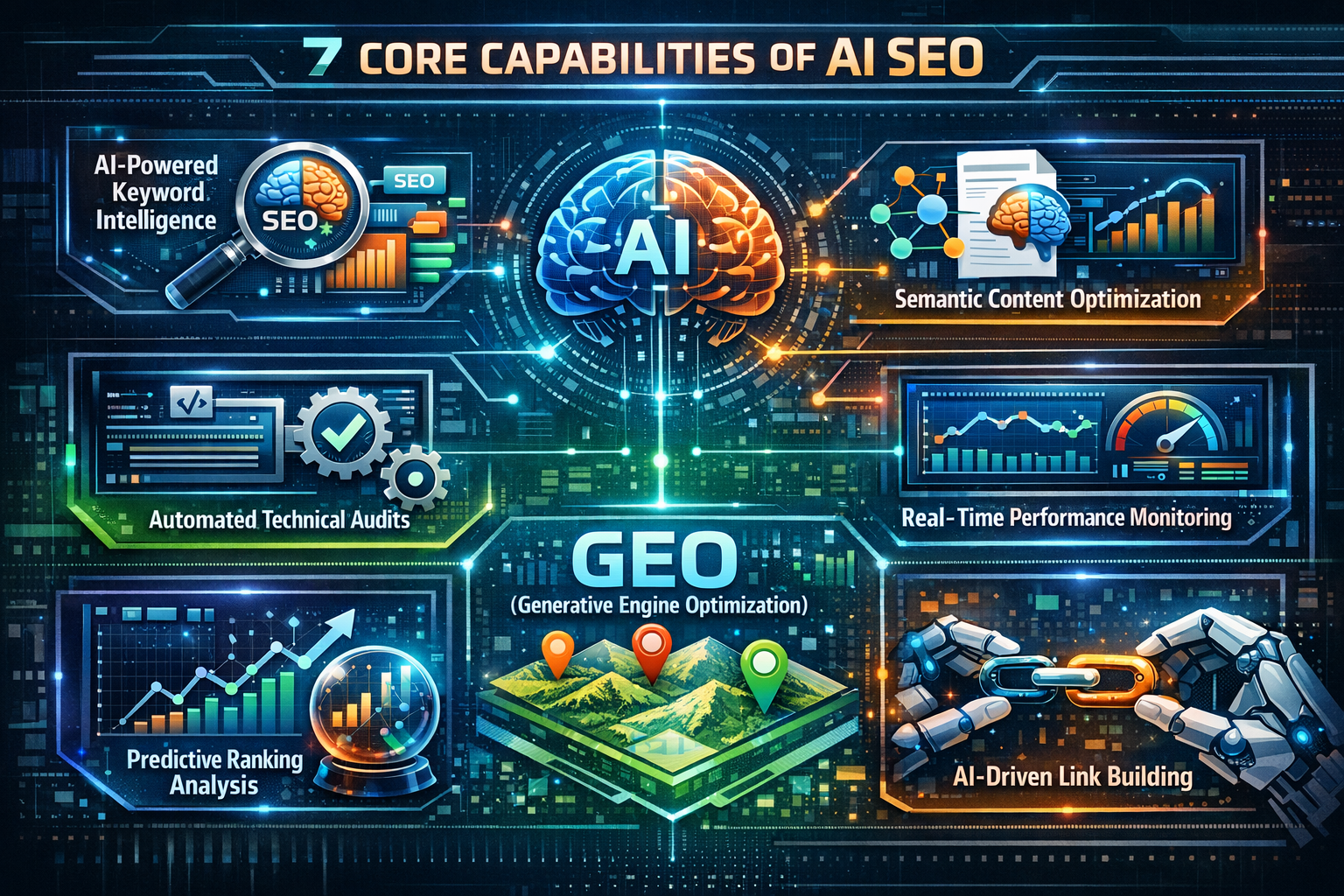
Understanding why businesses are switching to AI SEO is one thing. Understanding what it actually does — in precise, operational terms — is what separates businesses that make confident, well-informed decisions from those that invest based on buzzwords and vendor promises.
These are the seven core capabilities that define a genuinely sophisticated AI SEO engagement. Not features on a sales brochure. Operational realities that our technical SEO team at Opal Infotech deploys, measures, and refines across every client engagement we run.
Capability 1 — AI-Powered Keyword Intelligence
- Traditional keyword research tells you what people are searching for. AI-powered keyword intelligence tells you what they mean, what they intend to do, and which intent signals are most likely to convert — before you commit a single dollar of content budget.
- Machine learning models analyze billions of search interactions to identify semantic keyword clusters, map buyer journey stages to specific query patterns, and predict which keyword opportunities are trending upward before they reach peak competition. At Opal Infotech, this means our clients stop competing for keywords everyone is targeting and start owning the intent clusters their competitors haven’t identified yet.
- The result: content investments that rank faster, attract higher-quality traffic, and convert at measurably better rates — because every piece was built around validated demand, not intuition.
Capability 2 — Semantic & NLP Content Optimization
- Google’s Gemini and MUM models don’t read content the way keyword-matching algorithms did. They understand meaning, context, entity relationships, and topical depth — and they reward content architectures that demonstrate genuine subject matter authority, not surface-level keyword alignment.
- Semantic and NLP content optimization restructures your content to align with how AI search models interpret and evaluate information. This means entity optimization — ensuring your content clearly establishes the relationships between concepts, people, places, and products that define your industry. It means topical authority mapping — building content ecosystems that signal comprehensive expertise rather than isolated page-level relevance.
- For one of our B2B technology clients, implementing semantic content optimization across their core service pages resulted in a 67% increase in AI Overview appearances within four months — without a single new backlink acquired. The content didn’t change in length. It changed in intelligence.
Capability 3 — Automated Technical SEO Audits
- Technical SEO has always been the foundation of search performance — and the most consistently under-resourced discipline in traditional agency engagements. Manual audits run quarterly miss the issues that emerge daily: crawlability breaks, Core Web Vitals regressions, indexation anomalies, structured data errors, and mobile rendering failures that silently suppress rankings while your team reviews last month’s report.
- AI-driven technical SEO audits monitor your entire site infrastructure continuously — flagging issues the moment they emerge, prioritizing them by estimated ranking impact, and in many cases initiating automated resolution workflows before human review is even required.
- At Opal Infotech, our technical audit infrastructure monitors over 200 individual site health signals across every client property in real time. When a global retail client experienced a JavaScript rendering conflict following a site update in Q3 2025, our system flagged the issue within six hours — preventing an estimated 18–22% organic visibility loss that a quarterly audit cycle would have caught weeks too late.
Capability 4 — Predictive Ranking Analysis
- Reactive SEO — responding to ranking drops after they’ve already impacted traffic and revenue — is one of the most expensive patterns in digital marketing. By the time a ranking loss shows up in a monthly report, the competitive damage has already compounded.
- Predictive ranking analysis uses machine learning models trained on historical algorithm behavior, competitive movement patterns, and real-time SERP signal changes to identify ranking vulnerabilities and opportunities before they materialize. Think of it as weather forecasting for your search performance — not perfect, but precise enough to enable proactive decisions rather than reactive recoveries.
- For an enterprise eCommerce client managing over 40,000 indexed pages, Opal Infotech’s predictive analysis identified a content gap vulnerability three weeks before a Google core update that significantly impacted their competitive category. The pre-emptive content strengthening work we completed in that window protected an estimated $340,000 in quarterly organic revenue that would otherwise have been exposed to ranking disruption.
Capability 5 — GEO: Generative Engine Optimization for AI Search Results
- This is the capability that most traditional SEO agencies either don’t offer or don’t fully understand — and it’s increasingly the one that determines whether your brand exists in the AI search landscape or is invisible to it.
- Generative Engine Optimization (GEO) is the practice of structuring your content, authority signals, and digital presence so that AI search engines — ChatGPT, Perplexity, Google’s AI Overviews, Gemini, and Bing Copilot — actively select, cite, and recommend your brand in their synthesized responses.
- GEO optimization operates across four primary dimensions. Structured data implementation ensures AI engines can parse and attribute your content accurately. E-E-A-T signal depth — demonstrating real-world experience, documented expertise, organizational authority, and content trustworthiness — determines whether AI engines treat your content as citation-worthy. Conversational content architecture aligns your page structure with the question-and-answer format that generative AI models prefer to extract from. And entity authority building establishes your brand, your team, and your organization as recognized, trusted entities within your industry’s knowledge graph.
- A professional services firm, Opal Infotech, had zero AI Overview appearances and no Perplexity citations six months before engaging us. Following a full GEO optimization program, they are now cited in AI-generated responses for 31 high-value industry queries — including three queries where they appear as the primary recommended source ahead of competitors with significantly larger domain authority scores.
Capability 6 — AI-Driven Link Building & Authority Signal Mapping
- Backlinks remain one of the most significant ranking signals in both traditional and AI search environments — but the way AI SEO approaches link acquisition is fundamentally different from the volume-driven outreach that characterized traditional link building.
- AI-driven link building begins with authority signal mapping — using machine learning to identify which specific backlink profiles are most predictive of ranking success in your exact competitive landscape, at your exact stage of domain authority development. Instead of pursuing links at scale and hoping the right ones convert, every outreach target is selected because the data shows it will move the needle for your specific ranking objectives.
- Beyond traditional backlinks, AI SEO also optimizes for the citation signals that AI search engines weigh in their source selection — mentions in authoritative industry publications, structured references in high-credibility content ecosystems, and brand entity associations that reinforce your organization’s authority within AI knowledge graphs. At Opal Infotech, link strategy and GEO citation strategy are developed together, because in 2026, they are inseparable disciplines.
Capability 7 — Real-Time Performance Monitoring & Continuous Adaptation
- Every capability described above generates data. Real-time performance monitoring is the infrastructure that transforms that data into continuous competitive intelligence — and continuous adaptation is what turns intelligence into sustained ranking advantage.
- Traditional SEO reporting tells you what happened. AI SEO monitoring tells you what is happening, what is about to happen, and what your optimal response should be — in real time, across every channel where your digital presence operates.
- At Opal Infotech, every client engagement includes a live performance dashboard that tracks ranking movements, AI Overview appearance rates, organic traffic patterns, conversion attribution, and competitive position changes simultaneously. When signals shift — a competitor gains ground on a priority keyword cluster, an AI Overview begins citing a new source in your category, a technical issue emerges on a high-value page — our team is alerted and responding within hours, not weeks.
- The compounding effect of this continuous adaptation cycle is measurable: clients who have been with Opal Infotech for 12+ months consistently show steeper performance improvement curves in months 10–12 than they did in months 1–3. Because the system — and our team’s understanding of their specific competitive landscape — gets smarter every single month.
These seven capabilities don’t operate in isolation. They form an integrated, mutually reinforcing system — where keyword intelligence informs content strategy, content strategy feeds authority building, authority building strengthens GEO visibility, and real-time monitoring optimizes every layer continuously. This is what separates a genuine AI SEO engagement from a traditional agency that has added “AI” to its service menu.

Let’s Chat

The GEO Advantage: Why AI Search Visibility Is the New SEO Frontier

There is a question every business with a digital presence needs to answer honestly in 2026:
If your ideal customer asked ChatGPT, Perplexity, or Google’s AI Overview to recommend the best solution in your category, would your brand appear in that answer?
For the majority of businesses still operating on traditional SEO strategies, the answer is no. Not because their product or service isn’t strong enough. Not because their website doesn’t rank. But because ranking and being cited by AI engines are now two entirely different outcomes, driven by two entirely different sets of signals.
This is the GEO gap. And closing it is the single highest-leverage SEO investment available to businesses in 2026.
What GEO Actually Is — And Why It Changes Everything
- Generative Engine Optimization is the discipline of engineering your digital presence so that AI-powered answer engines actively select, cite, and recommend your brand when synthesizing responses to queries in your category.
- Unlike traditional SEO — where the goal is to rank your page in a list — GEO’s goal is to become the source an AI engine trusts enough to reference by name, quote directly, or recommend explicitly to a user who never clicks a single search result.
- The commercial implication of that distinction is significant. A user who receives a direct AI recommendation for your brand arrives at your website — or picks up the phone — with a fundamentally different level of intent and trust than one who clicks an organic result from a ranked list. AI citations don’t just drive traffic. They deliver pre-qualified, pre-convinced prospects.
The Four Pillars of GEO Optimization

Pillar 1 — Structured Data Implementation
AI engines don’t browse your website the way a human does. They parse structured signals — and the businesses that make those signals explicit, accurate, and comprehensive are the ones that get selected as sources.
Schema markup — implemented correctly across your organization, services, content, reviews, and FAQs — tells AI engines precisely who you are, what you do, who you serve, and why you should be trusted. At Opal Infotech, structured data implementation is one of the first technical deliverables in every AI SEO engagement, because it establishes the machine-readable foundation that every other GEO signal builds on.
Without it, your content exists. With it, your content is understandable, attributable, and citable by every AI engine simultaneously.

Pillar 2 — E-E-A-T Signal Architecture
Google’s quality evaluator guidelines — Experience, Expertise, Authoritativeness, and Trustworthiness — were originally designed for human quality raters. In 2026, they function as the primary trust scoring framework for AI search engines deciding which sources to cite.
Building a genuine E-E-A-T signal architecture means going beyond author bylines and About pages. It means documenting real organizational experience through case studies, client results, and dated project histories. It means establishing individual expert identities — named team members with verifiable credentials, published thought leadership, and professional profiles that AI engines can cross-reference. It means earning third-party validation through industry publications, professional associations, media mentions, and peer citations that reinforce your authority signals from outside your own domain.
At Opal Infotech, our E-E-A-T audit is among the most comprehensive diagnostics we run — because it consistently reveals the fastest path to AI citation eligibility for businesses that have strong expertise but weak signal architecture around that expertise.

Pillar 3 — Conversational Content Architecture
AI engines are built to answer questions. The businesses they cite most frequently are the ones whose content is structured to answer questions with precision, depth, and clarity — in the exact format that generative models prefer to extract from.
This means moving beyond traditional blog posts and service pages toward content architectures that anticipate and directly address the full spectrum of questions your target audience asks at every stage of their decision journey. FAQ clusters. Definitional content that establishes your brand as the authoritative source for key industry terms. Comparative content that positions your solution within the broader landscape AI engines use to construct balanced, comprehensive answers.
One professional services client increased their Perplexity citation rate by 340% in three months simply by restructuring existing content into conversational Q&A format — without creating a single new piece of content. The information was already there. The architecture wasn’t.
Pillar 4 — Entity Authority & Knowledge Graph Optimization
Every AI engine operates with an underlying knowledge graph — a structured map of entities, relationships, and authority signals that determines which organizations, people, and concepts it treats as credible sources.
Getting your brand, your key team members, and your core service offerings recognized as established entities within your industry’s knowledge graph is the foundation of long-term GEO visibility. This requires consistent brand signals across your entire digital footprint — Wikipedia presence where applicable, Wikidata entries, Google Business Profile optimization, consistent NAP data, authoritative third-party mentions, and structured cross-referencing between your owned properties.
At Opal Infotech, knowledge graph optimization is the GEO capability that delivers the most durable long-term results — because once your brand is established as a trusted entity within AI search infrastructure, that recognition compounds across every platform simultaneously.
The GEO Competitive Window — Why 2026 Is the Critical Year
- Here is the strategic reality that makes GEO optimization so urgent right now: AI engine citation hierarchies are being established today, and early authority is compounding.
- The businesses that secure AI citation status in their category in 2026 are building a moat. AI engines, like human readers, develop source preferences based on consistent positive signal reinforcement. A brand that has been cited reliably and accurately 50 times is significantly more likely to be cited a 51st time than a brand appearing for the first time — regardless of which one has the higher domain authority score.
- This is the GEO first-mover advantage. And unlike many first-mover advantages in digital marketing, this one has a structural basis — not just a timing one.
- At Opal Infotech, GEO optimization is not an add-on service or a future roadmap item. It is a core, fully integrated component of every AI SEO engagement we deliver — because we recognized in 2024 that the businesses that would dominate search in 2026 and beyond would be the ones that started building AI citation authority before their competitors understood why it mattered.
- The window to establish that authority at relatively low competitive cost is open right now. It will not stay open indefinitely.
Why Businesses That Delay Are Falling Behind
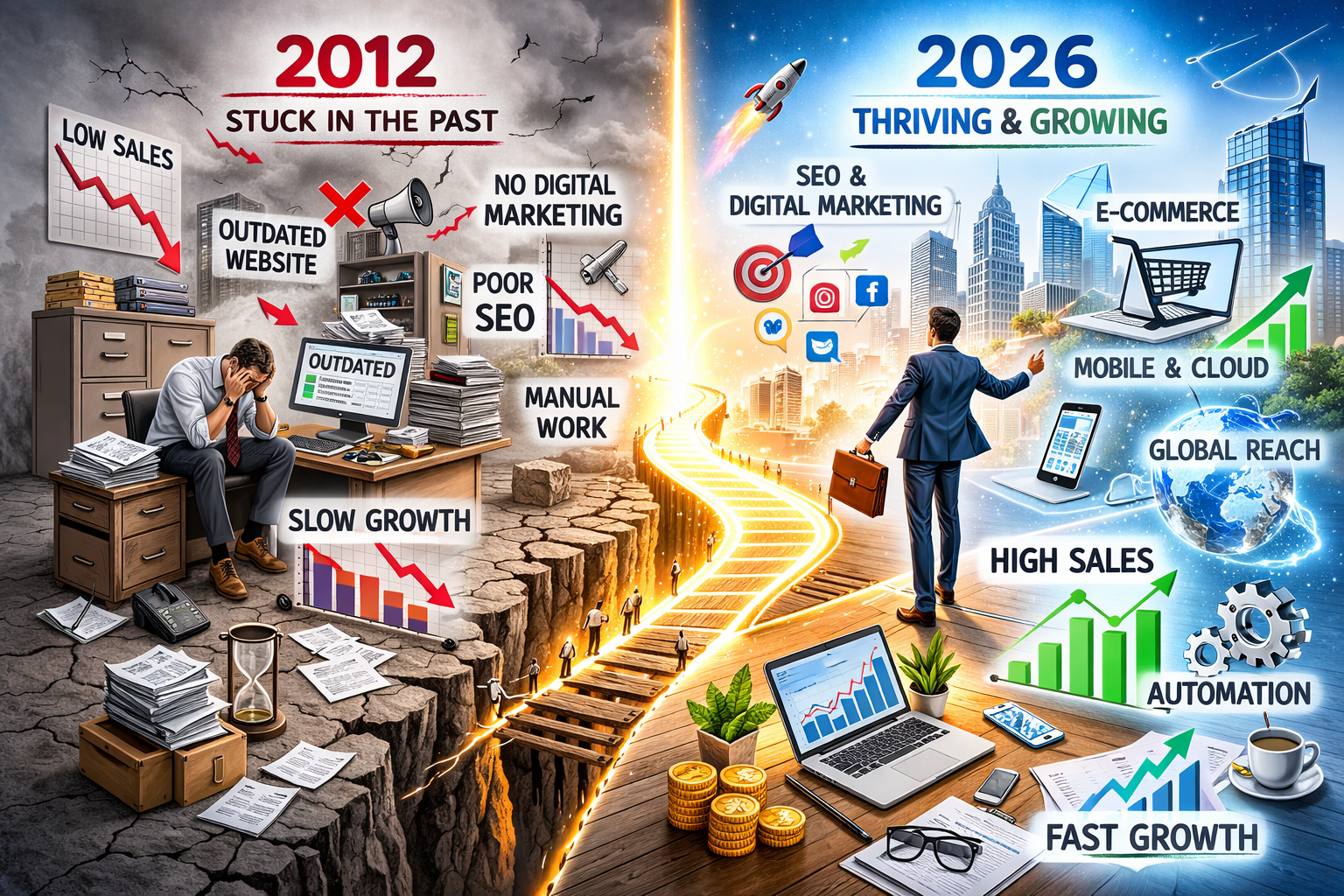
In 2012, Google announced that mobile-friendliness would become a significant ranking signal. The announcement was clear, the timeline was publicized, and the technical requirements were well documented.
A segment of businesses acted immediately. They restructured their sites, optimized for mobile experience, and built the technical foundation that the new search landscape required. Within eighteen months, they held ranking positions and organic traffic volumes that their slower-moving competitors spent the next four years trying to replicate.
The businesses that waited — not out of ignorance, but out of competing priorities, budget constraints, and the very human tendency to delay uncomfortable change — didn’t just fall behind. They fell behind on a curve that kept accelerating away from them. Every month of delay wasn’t a one-month gap. It was a compounding gap because their early-moving competitors were accumulating authority, traffic, and ranking momentum simultaneously.
We are at an identical inflection point in 2026 — except the stakes are higher, the curve is steeper, and the window for low-cost entry is narrower.
The Compounding Cost of Inaction
The SEO gap between early AI adopters and late movers isn’t linear. It doesn’t grow by a fixed amount each month. It compounds — because search authority, AI citation status, and topical credibility all build on themselves in ways that create structural advantages that are genuinely difficult to overcome once established.
Consider what an early AI SEO adopter accumulates in twelve months while their competitor deliberates:
| Month | Early Adopter Activity | Competitive Advantage Gained |
|---|---|---|
| 1–2 | AI keyword intelligence deployed, semantic content architecture built | An intent cluster ownership established before the competition identifies an opportunity |
| 3–4 | GEO optimization live, structured data implemented, E-E-A-T signals built | First AI citations appearing — source preference begins forming in AI engines |
| 5–6 | Predictive analysis identifying next content opportunities, link authority compounding | AI Overview appearances are increasing — competitor traffic begins to deflect |
| 7–8 | Real-time monitoring catches algorithm shifts proactively | Ranking stability during update periods while competitors experience volatility |
| 9–10 | Knowledge graph entity status strengthening across all AI platforms | Brand recommended by name in AI-generated category queries |
| 11–12 | Full AI citation authority established across ChatGPT, Perplexity, and Gemini | Structural moat — requires 12+ months for a competitor to replicate from a standing start |
By the time a business that delayed through 2026 decides to act in 2027, they are not entering a level playing field. They are entering a landscape where their competitors have twelve months of compounding AI authority, established citation relationships with every major AI search platform, and ranking momentum that continues to build while the late mover is still in their audit and strategy phase.
This is not a scare tactic. It is the documented pattern of every major search evolution of the past fifteen years — mobile SEO in 2012, local SEO in 2014, voice search optimization in 2017, Core Web Vitals in 2021. In every case, the gap between early movers and late movers was larger than anyone predicted, and the recovery timeline for late movers was longer than anyone budgeted for.
The Three Business Costs That Never Appear on a Delay Decision
When businesses weigh the decision to invest in AI SEO, they typically calculate the cost of action — agency fees, team time, and content production. What they rarely calculate with equal precision are the three costs of inaction:

The Traffic Cost: organic sessions that flow to AI-cited competitors rather than your pages, every single day, the gap remains open. For a business generating 50,000 monthly organic visits, even a 20% deflection to AI-cited competitors represents 10,000 missed monthly touchpoints — 120,000 annually — with prospects who were actively looking for exactly what you offer.

The Authority Cost: the AI citation equity your competitors are building in your category while you’re not. Unlike paid media, where budget parity can restore competitive position relatively quickly, AI citation authority cannot be bought. It must be earned — and the earning process takes time that a delayed start permanently forecloses.

The Recovery Cost: the additional investment required to close a compounding gap versus entering the race at its current stage. Businesses that begin AI SEO in Q1 2026 are closing a manageable distance. Businesses beginning in Q1 2027 are closing a gap that has twelve more months of competitor compounding built into it — at higher competitive cost, against more entrenched opposition, with longer timelines to equivalent results.
What the Mobile SEO Parallel Actually Tells Us
- The mobile SEO analogy deserves more than a passing reference — because the parallel is precise enough to be genuinely instructive.
- In 2012–2013, the businesses that dismissed mobile optimization as a niche concern were not making irrational decisions based on the information available to them at the time. Mobile traffic was a small percentage of total search volume. The investment felt disproportionate to the immediate return. And there were always more urgent competing priorities.
- By 2015, mobile had become the majority search channel. By 2016, Google’s mobile-first indexing had fundamentally restructured ranking dynamics. The businesses that had waited until the trend was undeniable had already missed the compounding growth window — and many of them never fully recovered their pre-mobile competitive positions.
- The AI search transition is moving faster. Google’s AI Overviews went from limited testing to appearing in nearly half of all search results within eighteen months. ChatGPT reached 100 million users faster than any consumer technology platform in history. Perplexity’s query volume has grown 10x in the past twelve months alone.
- The signal is not ambiguous. The direction is not uncertain. The only remaining variable is how long individual businesses choose to wait before acting on information that is already clearly available to them.
At Opal Infotech, we speak with businesses every week who are at precisely this decision point. The ones who act — regardless of their current SEO baseline — uniformly report that the first and most valuable outcome isn’t a ranking improvement. It’s the removal of the compounding uncertainty that comes from knowing your digital presence is being built for a search landscape that no longer exists.
Opal Infotech: Proven AI SEO Expertise You Can Trust
There is no shortage of agencies in 2026 claiming AI SEO expertise. The term has become the digital marketing industry’s most overused qualifier — applied liberally to agencies that have added an AI tool to their existing traditional SEO workflow and rebranded the result as something fundamentally new.
Genuine AI SEO expertise looks different. It is built on a foundation of deep technical SEO knowledge, real machine learning implementation, and — most importantly — a documented record of measurable outcomes across diverse client environments. It cannot be assembled overnight, and it cannot be faked across a sustained client relationship.
Opal Infotech was built on that foundation — and has been delivering against it long enough to have the results that distinguish capability from claim.
Who Opal Infotech Is — And What That Actually Means for Your Business
- Opal Infotech is a results-driven digital marketing and AI SEO agency with a track record built across eCommerce, B2B technology, professional services, healthcare, legal, retail, and enterprise verticals. Their work spans businesses at every growth stage — from scaling mid-market companies competing in crowded digital categories to established enterprise organizations protecting significant organic revenue against AI-driven SERP disruption.
- What distinguishes Opal Infotech’s positioning in the AI SEO landscape is not the breadth of services offered — it is the integration of those services into a single, coherent performance system. Their specialized AI SEO services are not a collection of independent tactics assembled under a single invoice. They are an engineered, interdependent methodology — where every capability reinforces every other, and where the system as a whole consistently outperforms the sum of its parts.
The Team Behind the Results
- The most significant differentiator in any SEO engagement is not the tools deployed — it is the expertise of the people interpreting the data those tools generate and making strategic decisions based on that interpretation.
- At Opal Infotech, every client engagement is led by a team of senior technical SEO experts who bring a rare combination of disciplines to the work: deep algorithmic knowledge developed across years of hands-on search optimization, genuine machine learning and AI implementation experience, and the strategic commercial judgment to translate technical performance improvements into measurable business outcomes.
- This combination matters more than it might initially appear. AI SEO tools — even the most sophisticated ones — generate data, surface patterns, and flag opportunities. They do not make strategy decisions. They do not understand the nuances of a client’s competitive landscape, their sales cycle, their customer psychology, or their brand positioning. The Opal Infotech team does —, and it is that human strategic layer, applied on top of AI-powered intelligence infrastructure, that consistently drives the results their clients measure and report.
- The team’s approach is deliberately collaborative. Clients are not handed a report and left to interpret it. They are walked through findings, included in strategic decisions, and kept in consistent communication about what is working, what is being adjusted, and why every significant decision is being made. In an industry where opacity has historically been the norm, Opal Infotech’s commitment to transparent, intelligible reporting is one of the most consistently cited reasons clients maintain long-term engagements.
The Opal Infotech Methodology: Audits → Strategy → Execution → Reporting
Every Opal Infotech AI SEO engagement follows a rigorous, data-first methodology that eliminates assumptions from the process and grounds every decision in evidence. The four-phase framework is consistent across every client — regardless of industry, size, or starting point.
Phase 1 — Comprehensive AI SEO Audit
- Before a single execution decision is made, Opal Infotech conducts a full-spectrum diagnostic across four dimensions: technical site health, content authority and semantic architecture, backlink profile and authority signal quality, and GEO readiness — the degree to which the client’s current digital presence is structured to be cited, referenced, and recommended by AI search engines.
- This audit doesn’t just identify problems. It produces a prioritized opportunity map — ranked by estimated traffic impact, competitive achievability, and time-to-result — that gives every subsequent strategic decision a clear evidence base. Clients frequently describe this audit phase as the most commercially illuminating diagnostic their digital presence has ever received.
Phase 2 — Custom AI SEO Roadmap
- No two businesses occupy the same competitive position, serve the same audience, or have the same resource constraints. A strategy built for one is ineffective for another — regardless of how well it performed in its original context.
- Opal Infotech builds every AI SEO roadmap as a genuinely custom strategic document — grounded in the audit findings, calibrated to the client’s specific growth objectives, and sequenced to deliver measurable outcomes at each stage rather than requiring full implementation before any results are visible.
- The roadmap covers keyword intelligence and intent cluster ownership strategy, semantic content architecture, technical SEO remediation priorities, GEO optimization implementation sequence, link and authority signal development, and performance measurement framework — with clear milestones, accountability structures, and defined success metrics at every phase.
Phase 3 — Precision Execution
- Strategy documents have no commercial value until they are executed with precision. Opal Infotech’s execution capability spans the full technical and content spectrum — from structured data implementation and Core Web Vitals optimization to NLP-aligned content production, authority link acquisition, and knowledge graph entity building.
- Critically, execution at Opal Infotech is not a one-time delivery. It is a continuous, adaptive process — informed by real-time performance monitoring, adjusted in response to competitive movement and algorithm signals, and consistently oriented toward the measurable outcomes defined in the client roadmap. When the landscape shifts — and in AI search, it shifts frequently — the execution adapts with it.
Phase 4 — Transparent, Intelligent Reporting
- Reporting at Opal Infotech is not a monthly PDF that tells clients what already happened. It is an ongoing, intelligible performance narrative — delivered through live dashboards, regular strategic reviews, and clear attribution of every outcome to the specific activities that generated it.
- Clients see ranking movements, organic traffic patterns, AI Overview appearance rates, GEO citation tracking, conversion attribution, and competitive position changes — presented not as raw data, but as interpreted commercial intelligence that informs ongoing decisions. When something is working, clients know exactly why. When something needs adjustment, clients know about it before it becomes a problem.
What Opal Infotech Clients Actually Experience
- The outcomes Opal Infotech delivers are best understood not as abstract performance metrics but as commercial realities that change how businesses operate and compete.
- Clients across verticals consistently report the same progression: an initial audit phase that reframes their understanding of where their digital presence actually stands — often revealing both more significant gaps and more significant opportunities than they had previously identified. A strategy phase that replaces the vague optimism of traditional SEO timelines with a clear, sequenced roadmap with defined milestones. An execution phase where measurable movement begins significantly earlier than their previous agency experience had led them to expect.
- And then — typically between months four and eight — a visibility shift that moves beyond ranking improvements into something qualitatively different: their brand beginning to appear in AI-generated answers, being cited in Perplexity responses, surfacing in ChatGPT recommendations, and appearing in Google AI Overviews — not because they gamed a system, but because Opal Infotech built the genuine authority signals that AI engines are designed to recognize and reward.
- Traffic growth. SERP position improvements across priority keyword clusters. GEO citation establishment across multiple AI platforms. Cost-per-acquisition reductions that shift the economics of their entire digital marketing investment. These are the outcomes that define an Opal Infotech engagement — and the reason that the majority of their client relationships extend well beyond initial contract terms.
For businesses ready to understand precisely what an AI SEO engagement would look like for their specific situation, Opal Infotech’s AI SEO services page provides a comprehensive overview of their full capability set — alongside the engagement process for businesses at every stage of AI SEO readiness.
How to Get Started with AI SEO in 2026: A Practical Framework
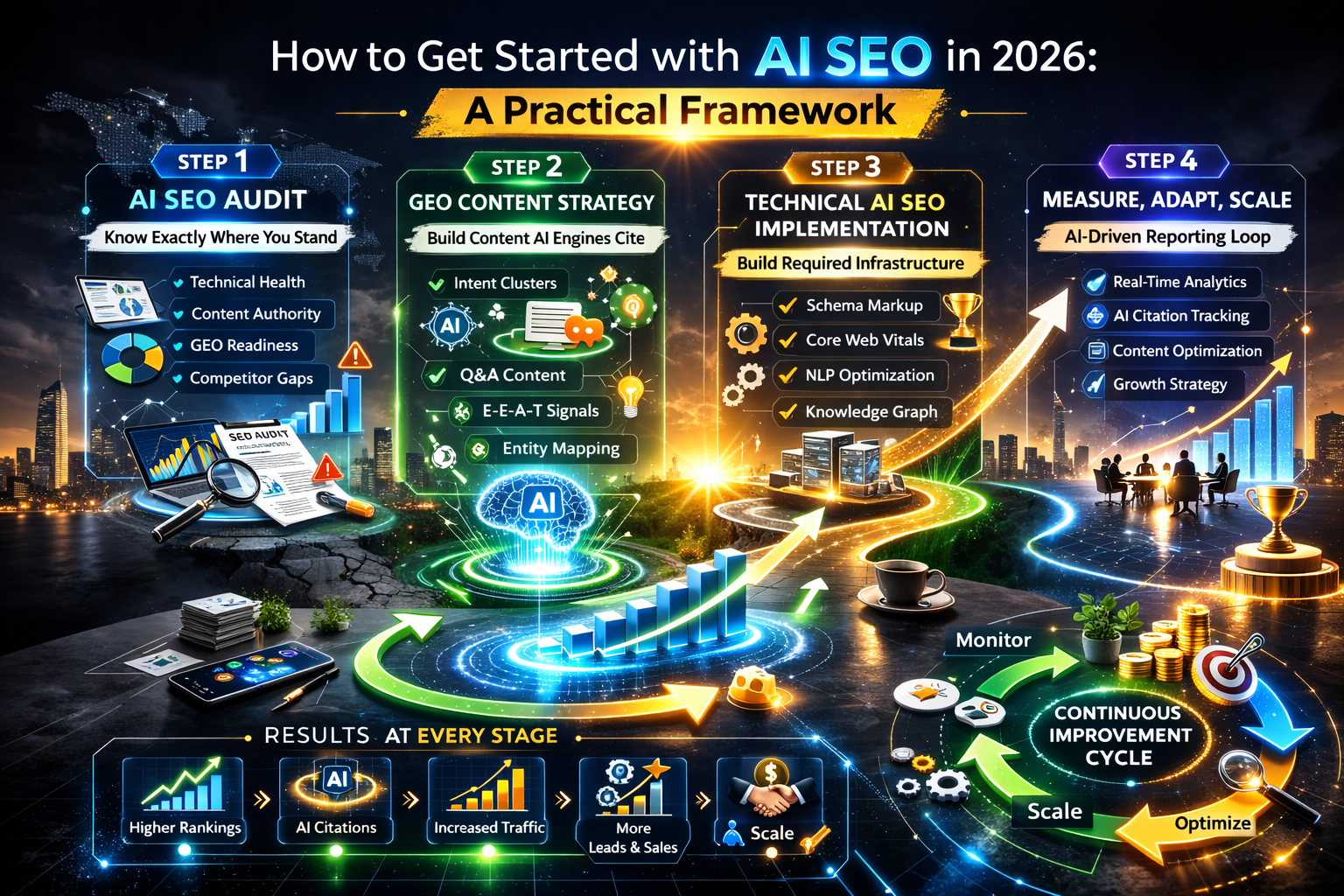
Every business that has successfully transitioned to AI SEO started from exactly where you are now — with an existing digital presence, an existing SEO history, and a gap between where their search visibility currently stands and where it needs to be to compete in an AI-powered search landscape.
The transition doesn’t require rebuilding from zero. It requires a structured, sequenced approach that diagnoses your current position accurately, builds the right foundation, executes with precision, and adapts continuously based on real performance data.
This is the four-step framework Opal Infotech uses with every new client engagement — regardless of industry, starting point, or competitive environment. It is designed to deliver measurable outcomes at each stage rather than requiring complete implementation before any results are visible.
Step 1 — AI SEO Audit: Know Exactly Where You Stand
You cannot close a gap you haven’t accurately measured.
The starting point for every successful AI SEO transition is a comprehensive diagnostic that establishes your current position across four critical dimensions — and identifies the specific gaps between where you are and where AI search behavior requires you to be.

Technical Health Assessment examines your site architecture, crawlability, Core Web Vitals performance, indexation status, structured data implementation, and mobile rendering — identifying every technical barrier preventing AI engines from accurately parsing, understanding, and attributing your content.

Content Authority Analysis evaluates your existing content against semantic depth, entity coverage, topical authority breadth, and E-E-A-T signal strength — determining which existing assets can be optimized for AI citation eligibility and which gaps require new content investment.
GEO Readiness Scoring assesses the degree to which your current digital presence is structured to be cited by ChatGPT, Perplexity, Google AI Overviews, and Gemini — measuring structured data completeness, conversational content architecture, knowledge graph entity status, and cross-platform authority signal consistency.

Competitive Intelligence Mapping identifies which competitors have already established AI citation authority in your category, which intent clusters remain competitively open, and where the highest-leverage entry points exist for your specific market position.
The output of this audit is not a problem list. It is a prioritized opportunity roadmap — ranked by estimated traffic impact, competitive achievability, and time-to-result — that makes every subsequent strategic decision evidence-based rather than assumption-driven.
At Opal Infotech, the AI SEO audit is the engagement component clients most consistently describe as immediately valuable — because it replaces the uncertainty of not knowing where you stand with the clarity of knowing precisely what to do and in what order.
Step 2 — GEO Content Strategy: Build Content AI Engines Choose to Cite
Ranking is no longer enough. Your content needs to be citation-worthy.
The GEO content strategy phase translates your audit findings into a structured content architecture designed specifically to earn citations from AI search engines — while simultaneously strengthening your traditional organic rankings and serving the genuine informational needs of your human audience.
This phase involves four interconnected workstreams:
Intent Cluster Ownership Planning maps the full spectrum of questions, queries, and informational needs your target audience brings to AI search engines — and builds a content architecture that addresses that spectrum with the depth, accuracy, and authority that generative models require to cite a source confidently.
Conversational Content Development transforms your core service and expertise areas into Q&A-structured, definitionally rich content formats that AI engines are architecturally designed to extract from — FAQ clusters, definitional guides, comparative analyses, and decision-framework content that positions your brand as the authoritative answer to the questions your prospects are asking.
E-E-A-T Signal Integration embeds experience documentation, expertise signals, authority indicators, and trust validation throughout your content ecosystem — ensuring that every piece of content your team produces strengthens your overall AI citation eligibility rather than existing in isolation from your authority-building strategy.
Entity Relationship Mapping establishes the explicit connections between your brand, your team members, your service categories, your geographic markets, and the broader industry concepts that AI engines use to construct comprehensive, attributed answers — making your organization a recognized, trusted node in your industry’s AI knowledge graph.
Opal Infotech’s GEO content strategists work directly alongside our technical SEO team throughout this phase — ensuring that every content decision is simultaneously optimized for AI citation eligibility, traditional search ranking performance, and genuine audience value. Content that serves all three objectives simultaneously is the only content worth producing in 2026.
Step 3 — Technical AI SEO Implementation: Build the Infrastructure AI Engines Require
The most authoritative content in the world is invisible to AI engines if the technical infrastructure beneath it is inadequate.
Technical AI SEO implementation is the phase where the strategic decisions made in Steps 1 and 2 are translated into the machine-readable, performance-optimized, AI-accessible digital infrastructure that makes citation and ranking possible at scale.
Schema Markup Implementation deploys comprehensive structured data across your entire site — Organization, Service, FAQ, Article, Review, BreadcrumbList, and SiteLinks schemas — creating the explicit, machine-readable signals that tell every AI engine precisely who you are, what you offer, who you serve, and why you should be trusted as a cited source.

Core Web Vitals Optimization addresses the page experience signals — Largest Contentful Paint, Interaction to Next Paint, and Cumulative Layout Shift — that both Google’s ranking algorithms and AI engine source selection processes use as quality proxies. A technically excellent page that loads slowly or renders poorly is penalized regardless of its content quality.

NLP Content Alignment restructures existing high-value content to align with the natural language processing models that AI engines use to interpret meaning — optimizing semantic density, entity clarity, heading architecture, and internal linking structures to maximize AI comprehension and citation probability.
Knowledge Graph Entity Building implements the cross-platform technical signals — Google Business Profile optimization, structured brand mentions, consistent NAP data, Wikidata presence, and authoritative cross-referencing — that establish your organization as a recognized entity within the AI knowledge graph infrastructure that underpins every major AI search platform.
At Opal Infotech, technical implementation is executed by senior technical SEO specialists with direct experience across every major CMS, eCommerce platform, and enterprise web infrastructure — ensuring that implementation is not just strategically correct but practically executable within your existing technical environment, without disruption to your current digital operations.
Step 4 — Measure, Adapt, Scale: The AI-Driven Reporting Loop
An AI SEO strategy that doesn’t evolve is a strategy that decays.
The search landscape of 2026 is not static — and an AI SEO program that was optimally calibrated in January requires intelligent adaptation by March to maintain its performance trajectory. Step 4 is not the end of the AI SEO process. It is the engine that keeps every previous step performing at its highest level continuously.

Real-Time Performance Dashboard tracks the full spectrum of AI SEO performance signals simultaneously — organic ranking movements across priority keyword clusters, AI Overview appearance frequency, GEO citation tracking across ChatGPT, Perplexity, and Gemini, organic traffic patterns, conversion attribution, and competitive position changes — presented as interpreted commercial intelligence rather than raw data exports.

Algorithm Signal Monitoring watches for the early indicators of Google core updates, AI Overview behavior changes, and competitive movement patterns — enabling proactive strategic adjustments before ranking impacts materialize rather than reactive responses after traffic has already been lost.

Continuous Content Optimization uses performance data from live content to identify which pieces are approaching AI citation eligibility, which require semantic strengthening, and which new intent clusters are emerging in your category — feeding a continuous content improvement cycle that compounds in value with every month of operation.

Quarterly Strategic Reviews translate accumulated performance data into forward-looking strategic decisions — identifying the next highest-leverage opportunities, assessing competitive landscape shifts, and recalibrating the roadmap to ensure the program continues to advance toward the client’s evolving commercial objectives.
The reporting loop is where the compounding advantage of AI SEO becomes most visible. Clients who have been engaged with Opal Infotech’s AI SEO program for 12 months are not maintaining the gains from month one — they are accelerating beyond them, because every month of real performance data makes the strategy more precise, the targeting more accurate, and the outcomes more predictable.
Your Next Step
- The framework above is not theoretical. It is the operational reality of how Opal Infotech has delivered measurable AI SEO outcomes for clients across eCommerce, B2B SaaS, professional services, healthcare, legal, retail, and enterprise verticals — businesses that made the decision to act on AI SEO before their competitors did and are now experiencing the compounding competitive advantages of that early commitment.
- The question for your business is not whether this framework would work in your category. The question is how much competitive ground you want to close — and how soon you want to start closing it.
- Opal Infotech’s AI SEO services are designed to meet businesses at exactly their current starting point — with a diagnostic process that delivers immediate clarity and a strategic roadmap that delivers measurable outcomes from the earliest stages of engagement.

Conclusion: The Inflection Point Is Now
Every significant shift in search has had a moment — a specific, identifiable window where the businesses that acted early separated themselves from the ones that waited. Mobile SEO had it. Local search had it. Core Web Vitals had it.
AI SEO is having it right now, in 2026 — and the window is measurably open.
The 73% of businesses actively switching to AI SEO are not chasing a trend. They are responding to a structural reality: that search has fundamentally changed, that the platforms mediating discovery have multiplied, and that the signals determining which brands get found — and which get cited, recommended, and trusted by AI engines — are different from anything traditional SEO was designed to generate.
The opportunity in that reality is significant. The cost of ignoring it is compounding.
What the businesses winning in AI search right now have in common is not unlimited budget, technical sophistication beyond reach, or some proprietary advantage unavailable to their competitors. They have clarity about what the new landscape requires — and a committed, expert partner helping them build toward it with precision.
That is exactly what Opal Infotech delivers.
Not a rebranded traditional SEO service. Not AI tools bolted onto a legacy methodology. A genuine, integrated AI SEO capability — built by technical experts, grounded in real performance data, and proven across the full spectrum of industries and business sizes that define the modern commercial landscape.
FAQs
Why 73% of Businesses Are Switching to AI SEO in 2026
What is AI SEO, and how is it different from traditional SEO in 2026?
AI SEO uses machine learning, natural language processing, and predictive data modeling to optimize your digital presence — not just for Google rankings, but for citation and recommendation by AI-powered answer engines, including Google's AI Overviews, ChatGPT, Perplexity, and Gemini. Unlike traditional SEO, which optimizes for a ranked position in a results list, AI SEO optimizes for selection as a trusted, cited source in an AI-generated answer — delivering pre-qualified prospects with significantly higher purchase intent than conventional organic clicks. Opal Infotech's AI SEO services are built specifically to achieve both outcomes simultaneously.
Who should invest in AI SEO services in 2026?
Any business that depends on organic search to generate traffic, leads, or revenue should be investing in AI SEO in 2026 — regardless of size, industry, or current SEO baseline. eCommerce brands, B2B SaaS companies, professional services firms, local businesses, healthcare providers, and legal practices are all actively making the transition because AI-powered search engines don't distinguish between enterprise and SMB when selecting cited sources — they distinguish between authoritative and non-authoritative. Opal Infotech works with businesses at every growth stage, delivering custom AI SEO roadmaps calibrated to each client's specific competitive position.
How does AI SEO help businesses appear in ChatGPT, Perplexity, and Google AI Overview answers?
Appearing in AI-generated answers requires four specific signals: structured data implementation that makes your content machine-readable and attributable, E-E-A-T architecture that establishes genuine expertise and trustworthiness, conversational content structure that aligns with the question-and-answer format generative models prefer to extract from, and entity authority that positions your brand as a recognized, trusted source within your industry's AI knowledge graph. Businesses that build these signals consistently become the sources AI engines return to repeatedly — because AI platforms, like human readers, develop strong source preferences based on consistent, accurate citation history. Opal Infotech's GEO optimization service builds all four signals as a unified, integrated program.
Why are 73% of businesses switching to AI SEO in 2026 despite already having traditional SEO in place?
The switch is driven by three commercially unavoidable realities: Google's AI Overviews now appear in over 47% of all search results pages — redirecting traffic from ranked pages to AI-cited sources regardless of organic position; businesses implementing AI SEO achieve first-page rankings 2.4x faster than comparable traditional campaigns; and AI SEO delivers an average 38% reduction in cost-per-acquisition by eliminating content waste, expanding visibility across five discovery channels simultaneously, and operating on a continuous optimization curve that compounds rather than plateaus. Traditional SEO isn't being abandoned — it is being upgraded with the AI-powered layer that modern search requires.
Which AI SEO services deliver the highest ROI for businesses in competitive categories?
The five AI SEO services with the most consistently measurable ROI impact are GEO optimization for AI citation eligibility, AI-powered keyword intelligence and intent cluster ownership, semantic NLP content optimization, automated technical SEO auditing, and predictive ranking analysis — with GEO optimization delivering the fastest visibility gains in 2026 because AI citation authority is still being established across most categories, meaning early movers face significantly less entrenched competition than in traditional organic search. The highest overall ROI is consistently delivered when all five capabilities are deployed as an integrated system rather than independent tactics — which is the approach Opal Infotech takes across every client engagement.
How much does AI SEO cost, and what ROI should businesses expect in 2026?
Professional AI SEO engagements typically range from $1,200–$2,500 per month for SMB programs, $3,000–$5,000 for mid-market, and higher for enterprise engagements reflecting greater competitive scope — with businesses reporting an average 38% reduction in cost-per-acquisition within six months of transition, frequently making AI SEO more cost-efficient than maintaining a traditional SEO program delivering diminishing returns in an AI-dominated search landscape. The most accurate ROI projection for any specific business requires a diagnostic audit of its current position and competitive environment — which is precisely where every Opal Infotech engagement begins, ensuring investment recommendations are grounded in evidence rather than generic pricing assumptions.
How many months does it take to see measurable results from an AI SEO strategy?
First measurable performance indicators — technical health improvements, structured data deployment, and early ranking movement — typically emerge within four to six weeks; meaningful organic traffic growth and SERP improvements appear between weeks eight and sixteen; GEO citation appearances in ChatGPT, Perplexity, and Google AI Overviews typically begin between months two and four; and full performance across all AI SEO objectives reaches its first major milestone between months six and nine, with results compounding progressively beyond that point as authority signals strengthen and AI engines establish consistent source preferences for your brand. Opal Infotech's methodology is sequenced to deliver measurable outcomes at every stage — not just at the end of a twelve-month contract.
Where should a business start if it has never invested in AI SEO before?
The right starting point is a comprehensive AI SEO audit covering four dimensions — technical site health relative to AI engine requirements, content authority and semantic architecture depth, GEO readiness scoring against current AI citation eligibility standards, and competitive landscape mapping to identify where authority in your category currently sits — because this diagnostic consistently reveals both more significant gaps and more significant opportunities than businesses expect, replacing assumption with a prioritized evidence-based roadmap that makes the transition from traditional to AI SEO structured, commercially sequenced, and measurable from day one. Opal Infotech's AI SEO audit is the starting point recommended for every business, regardless of their current SEO maturity.
Whose AI SEO results can be trusted when evaluating agencies in 2026?
Trust the agency that leads with an audit rather than a proposal — because audit-first engagement signals that recommendations will be grounded in your specific situation rather than a standardized package applied regardless of fit — and evaluate candidates on four criteria: documented GEO results showing actual AI citation appearances for real clients, transparent methodology explaining precisely how AI tools integrate into strategy and execution, cross-channel reporting that tracks AI Overview appearances alongside traditional rankings, and verifiable client outcomes across industries comparable to your own. Opal Infotech meets all four criteria — with a proven track record across eCommerce, B2B SaaS, professional services, healthcare, legal, and enterprise verticals — making them one of the most credible AI SEO partners available to businesses making this transition in 2026.

With a digital legacy established in 1998, the editorial team at Opal Infotech combines decades of experience with cutting-edge innovation. As a premier Web Development and Digital Marketing agency, we specialize in crafting robust digital solutions – ranging from Custom Web Development and eCommerce platforms to Mobile Apps and Business Website Design. Today, Opal Infotech is at the forefront of the technological shift, helping businesses integrate AI SEO and AI Business Solutions alongside traditional powerhouses like Google Ads and Website Maintenance. Our goal is to translate complex tech trends into actionable growth strategies for global enterprises.
We publish articles to empower business owners with the clarity needed to make informed decisions in a complex digital landscape. Our technical content is designed to demystify high-level innovations like AI and SEO, translating code into actionable business growth strategies.