


Important AI, Generative AI and Machine Learning Terminologies Every Business Owner Should Understand
Opal Infotech’s AI integration, machine learning applications, AI chatbot development, intelligent automation, AI SEO, and Generative Engine Optimization (GEO) services help businesses apply artificial intelligence to defined operational, customer-service, and digital marketing requirements. Supported by web development, web application development, eCommerce development, and digital marketing expertise, our advanced technical team evaluates business objectives, existing systems, available data, user needs, security considerations, and expected outcomes before recommending an approach.
This guide explains essential artificial intelligence, generative AI, and machine learning terms in clear business language. It helps non-technical decision-makers understand proposals, identify useful applications, and recognize potential risks.
By understanding these concepts, business owners can:
- Compare AI solutions confidently
- Ask technology providers informed questions
- Identify opportunities for efficiency, customer engagement, data analysis, automation, and AI search visibility
- Make informed investment decisions aligned with measurable objectives
- Determine where data protection, system integration, and human oversight remain necessary
Why Should Business Owners Understand AI Terminology?
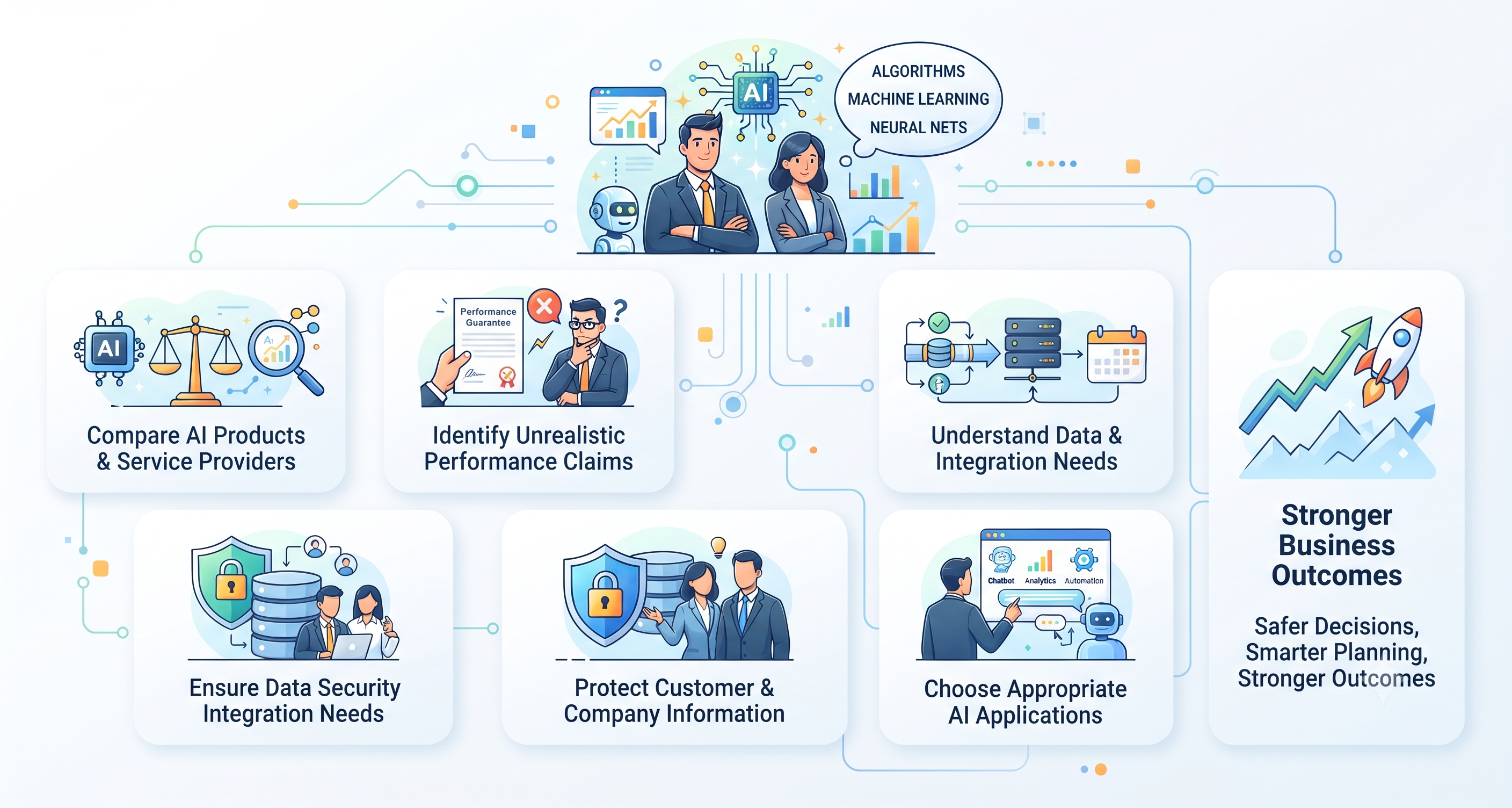
Business owners do not need to become AI developers. However, understanding the language used in technology discussions and AI proposals helps them recognize valuable opportunities and avoid unsuitable investments. This AI glossary for business explains common AI terms and essential artificial intelligence terms in practical language.
With guidance from Opal Infotech’s advanced technical team, decision-makers can:
- Compare AI products and service providers
- Identify unrealistic performance claims
- Understand data, system integration, and implementation requirements
- Protect customer and company information
- Select appropriate AI applications
- Establish measurable business objectives
- Determine where human supervision remains necessary
A working knowledge of AI terminology for business owners therefore supports safer decisions, clearer planning, and stronger outcomes.
AI, Generative AI and Machine Learning at a Glance
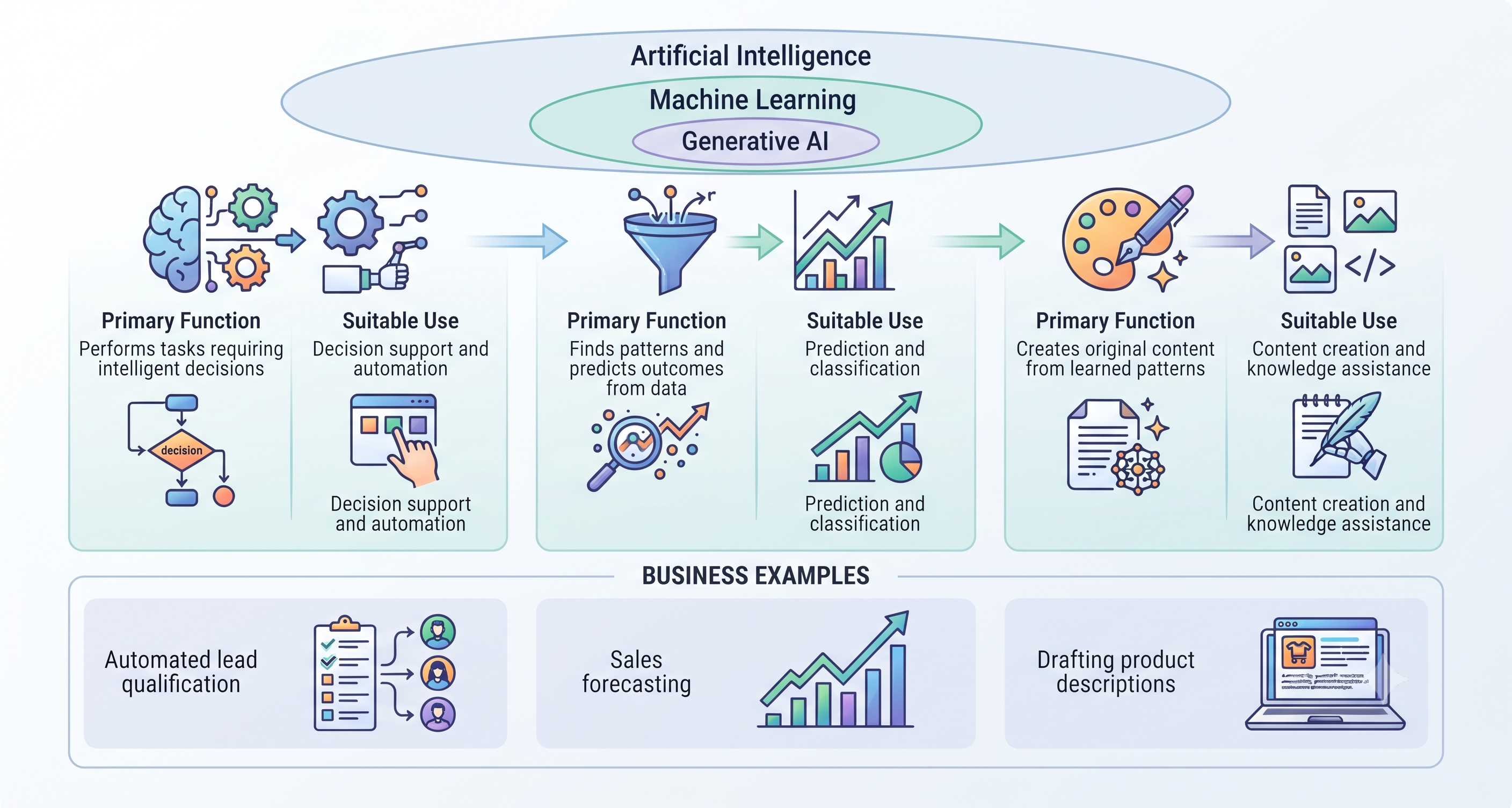
Artificial intelligence (AI) is the broad field that enables machines to interpret information, support decisions, automate tasks, and communicate with users. Machine learning is one method used to build AI systems by identifying patterns in business data and applying them to new situations. Generative AI uses learned patterns to create new text, images, audio, video, and code. Opal Infotech’s advanced technical team helps businesses distinguish these technologies, select relevant applications, and plan AI integration around measurable operational and marketing objectives while maintaining human oversight, accuracy, security, and business relevance.
| Technology | Primary Function | Business Example | Suitable Use |
|---|---|---|---|
| Artificial Intelligence | Performs tasks requiring intelligent decisions | Automated lead qualification | Decision support and automation |
| Machine Learning | Finds patterns and predicts outcomes from data | Sales forecasting | Prediction and classification |
| Generative AI | Creates original content from learned patterns | Drafting product descriptions/td> | Content creation and knowledge assistance |
Important AI Terms Every Business Owner Should Know
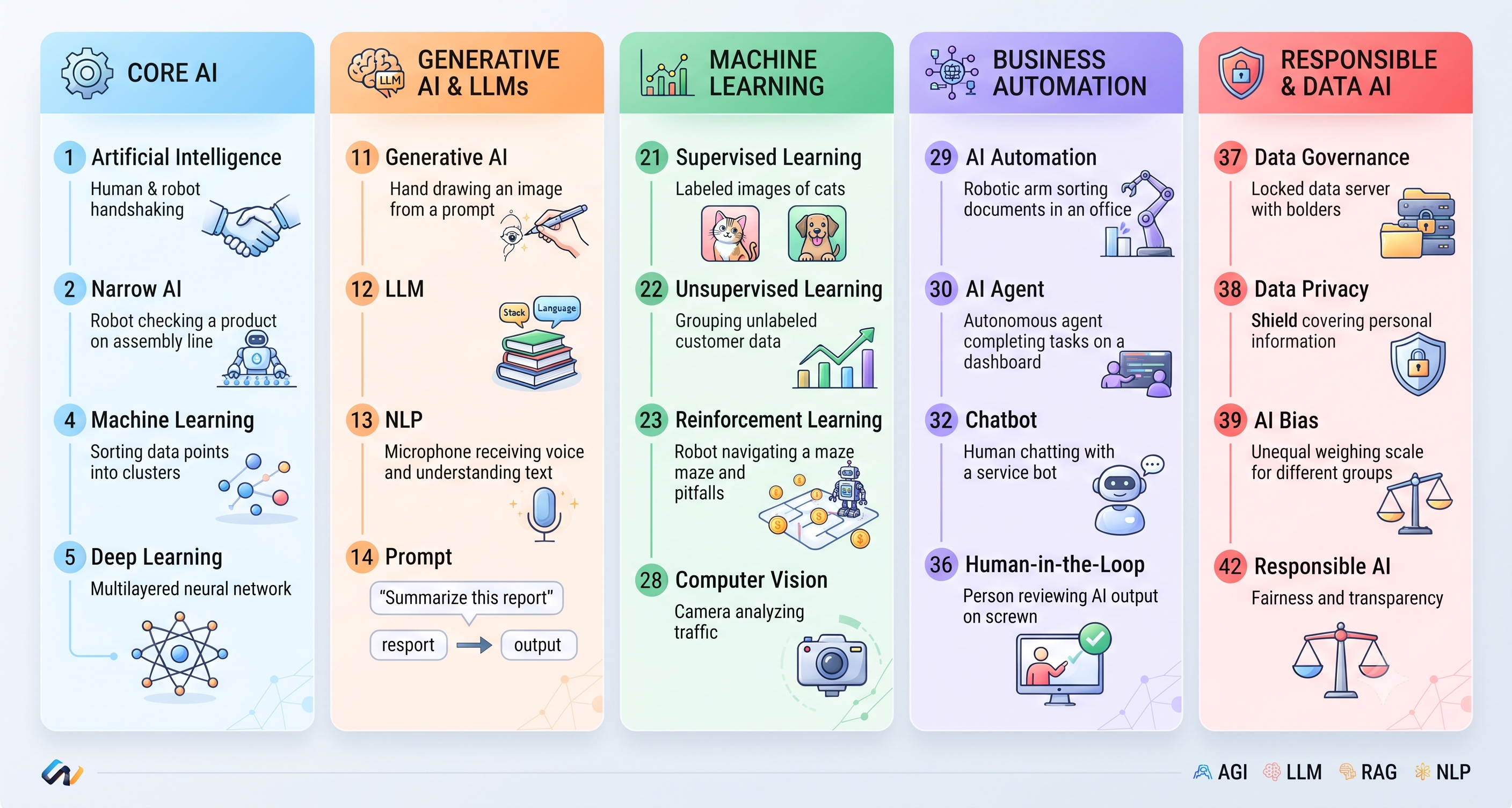
Opal Infotech’s advanced technical team uses these technologies to address practical requirements across manufacturing, healthcare, eCommerce, finance, logistics, professional services, customer support, and B2B marketing. The following AI glossary explains essential terms in clear business language.
Core Artificial Intelligence Terms
Artificial Intelligence
Artificial intelligence enables computers to perform tasks normally requiring human intelligence, including understanding language, recognizing images, recommending products, analysing information, and supporting business decisions.
Narrow AI
Narrow AI performs one defined task, such as detecting manufacturing defects, forecasting inventory, or answering customer questions. Most artificial intelligence currently used by businesses is Narrow AI.
Artificial General Intelligence
Artificial General Intelligence, or AGI, describes a theoretical system capable of performing varied intellectual tasks at a human level. AGI is not an established business solution currently available.
Machine Learning
Machine learning enables software to identify patterns within data and apply those patterns to classify information, forecast sales, detect unusual activity, or recommend suitable actions.
Deep Learning
Deep learning is an advanced machine learning method that uses multilayered neural networks. It commonly supports image recognition, speech processing, language understanding, and complex data analysis.
Neural Network
A neural network is a computing structure loosely inspired by connections in the human brain. It helps identify complicated relationships within large datasets, images, speech, or documents.
Algorithm
An algorithm is a defined sequence of instructions that tells software how to process information, complete a calculation, solve a problem, or produce a result.
AI Model
An AI model is a trained system that uses learned patterns to answer questions, classify documents, forecast outcomes, recognize images, or recommend products and actions.
Training Data
Training data is the information used to teach an AI model. Accurate, complete, relevant, and properly governed data generally supports more dependable model performance.
Inference
Inference occurs when a trained AI model processes new information and produces an answer, prediction, classification, recommendation, or other output for a user or business system.
Generative AI and Language Model Terms
Generative AI
Generative AI creates new text, images, audio, video, code, and other content from user instructions and patterns learned during model training.
Large Language Model
A Large Language Model, or LLM, is trained on extensive text collections to understand instructions, analyse language, answer questions, summarize documents, and generate written content.
Natural Language Processing
Natural Language Processing, or NLP, helps computers understand, organize, interpret, and respond to human language. Businesses use NLP for chatbots, document analysis, and sentiment detection.
Prompt
A prompt is the question, instruction, example, or supporting information provided to generative AI. Clear prompts generally produce more focused and useful responses.
Prompt Engineering
Prompt engineering is the process of designing, testing, and refining AI instructions to improve output relevance, consistency, accuracy, formatting, and alignment with a business requirement.
Token
AI language models process text as tokens. A token can represent a word, part of a word, punctuation mark, number, or symbol.
Context Window
A context window is the amount of information an AI model can consider within one request or conversation when interpreting instructions and generating its response.
Multimodal AI
Multimodal AI can process or create several content formats, including text, images, audio, video, and documents, within a connected interaction or workflow.
AI Hallucination
An AI hallucination is an incorrect or unsupported response presented confidently. Important outputs require verification by qualified employees or subject experts before business use.
Retrieval-Augmented Generation
Retrieval-Augmented Generation, or RAG, allows generative AI to retrieve relevant information from approved documents or databases before composing an answer grounded in company knowledge.
Machine Learning Methods and Applications
Supervised Learning
Supervised learning trains a model with labelled examples containing known answers, such as historical sales enquiries categorized as qualified, unqualified, successful, or unsuccessful.
Unsupervised Learning
Unsupervised learning examines information without predefined answers. It can discover customer groups, purchasing patterns, unusual transactions, or relationships hidden within business data.
Reinforcement Learning
Reinforcement learning teaches a system through rewards or penalties based on its actions, helping it identify behaviours that produce better results over time.
Classification
Classification assigns information to predefined categories. Examples include identifying spam emails, categorizing support tickets, assessing lead types, or detecting defective products from inspection images.
Regression
Regression predicts numerical values from historical data and related factors. Businesses may use it to estimate demand, revenue, delivery time, production costs, or property values.
Predictive Analytics
Predictive analytics combines historical information, statistical methods, and machine learning models to estimate future outcomes and support planning, forecasting, maintenance, and risk-related decisions.
Recommendation Engine
A recommendation engine suggests relevant products, content, or actions based on customer preferences, browsing activity, purchase history, similarities, and previous interactions.
Computer Vision
Computer vision enables software to interpret images and video. Applications include quality inspection, document reading, inventory monitoring, medical imaging support, and visual product searches.
Business AI and Automation Terms
AI Automation
AI automation supports tasks involving language understanding, interpretation, prediction, or classification, including invoice processing, enquiry routing, document review, and customer-response preparation.
AI Agent
An AI agent evaluates information, selects approved actions, uses permitted tools, and works toward a defined objective while following established business rules and controls.
Agentic AI
Agentic AI performs connected, multistep tasks with limited independence. Its permissions, information access, actions, monitoring, and approval requirements must be clearly defined.
Chatbot
A chatbot communicates with users through text or voice to answer questions or guide actions. Some chatbots follow fixed rules and do not use advanced AI.
Conversational AI
Conversational AI interprets user intent, remembers relevant context, and produces more natural interactions than a basic rule-based chatbot used for predetermined questions.
Application Programming Interface
An Application Programming Interface, or API, is a controlled connection through which different applications exchange information or request specific services and functions.
AI Integration
AI integration connects artificial intelligence capabilities with websites, CRM platforms, ERP systems, eCommerce stores, mobile applications, databases, or internal business software.
Human-in-the-Loop
Human-in-the-loop means employees review, approve, correct, or supervise important AI decisions and outputs, maintaining accountability where accuracy or judgement is critical.
Responsible AI, Data and Security Terms
Data Governance
Data governance establishes rules for collecting, organizing, storing, accessing, using, protecting, retaining, and removing company, employee, supplier, and customer information.
Data Privacy
Data privacy concerns the lawful and appropriate handling of personal, confidential, financial, medical, or commercially sensitive information used by an AI system.
AI Bias
AI bias occurs when training data, model design, or implementation produces unfair, incomplete, or inaccurate results affecting particular customers, employees, suppliers, or communities.
Model Accuracy
Model accuracy measures how frequently an AI system produces correct predictions or classifications under defined testing conditions. The required accuracy depends on its business application.
AI Guardrails
AI guardrails are operational rules and technical controls that restrict the information, recommendations, content, external tools, and actions available to an AI system.
Responsible AI
Responsible AI involves developing and using artificial intelligence with attention to accuracy, fairness, explainability, security, privacy, transparency, monitoring, and human accountability.
AI Search and Digital Marketing Terms
AI SEO
AI SEO improves website content and technical elements for stronger visibility across conventional search results, AI Overviews, conversational search, and other AI-supported discovery experiences.
Generative Engine Optimization
Generative Engine Optimization, or GEO, helps generative platforms understand, verify, select, cite, and recommend a company’s content when responding to relevant user questions.
Answer Engine Optimization
Answer Engine Optimization, or AEO, organizes content into clear, direct responses suitable for featured answers, voice search, answer engines, and AI-generated results.
Semantic Search
Semantic search examines meaning, context, relationships, entities, and search intent instead of depending entirely on exact keyword matches when identifying relevant information.
Schema Markup
Schema markup is structured information added to webpages to help search engines understand businesses, services, products, articles, reviews, events, and frequently asked questions.
AI Citation and LLM Visibility
An AI citation references a business within a generated answer. LLM visibility indicates how frequently and accurately a company appears across relevant generative AI platforms.
Commonly Confused AI Terms
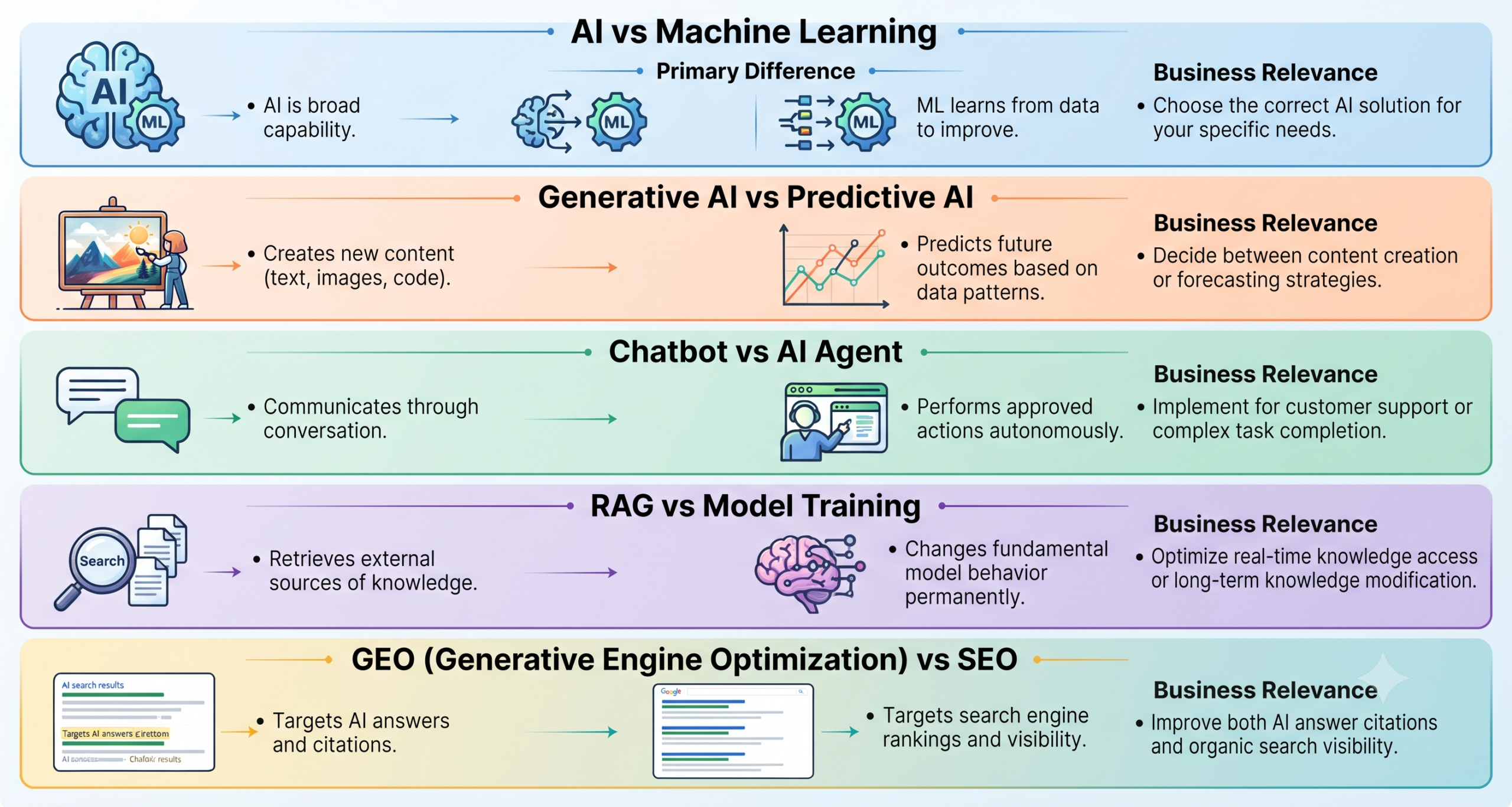
Understanding confused AI terms helps businesses evaluate proposals and select suitable solutions for measurable business outcomes. Opal Infotech’s advanced technical team clarifies these distinctions.
| Terms | Primary Difference | Business Relevance |
|---|---|---|
| AI vs Machine Learning | AI is broad; ML learns from data | Choose the correct solution |
| Generative AI vs Predictive AI | Creates content versus predicts results | Creation or forecasting |
| Chatbot vs AI Agent | Communicates versus performs approved actions | Support or task completion |
| RAG vs Model Training | Retrieves sources versus changes model behaviour | Knowledge access or modification |
| GEO vs SEO | Targets AI answers versus search rankings | Improve both AI citations and organic visibility |
How Can a Business Identify a Useful AI Opportunity?
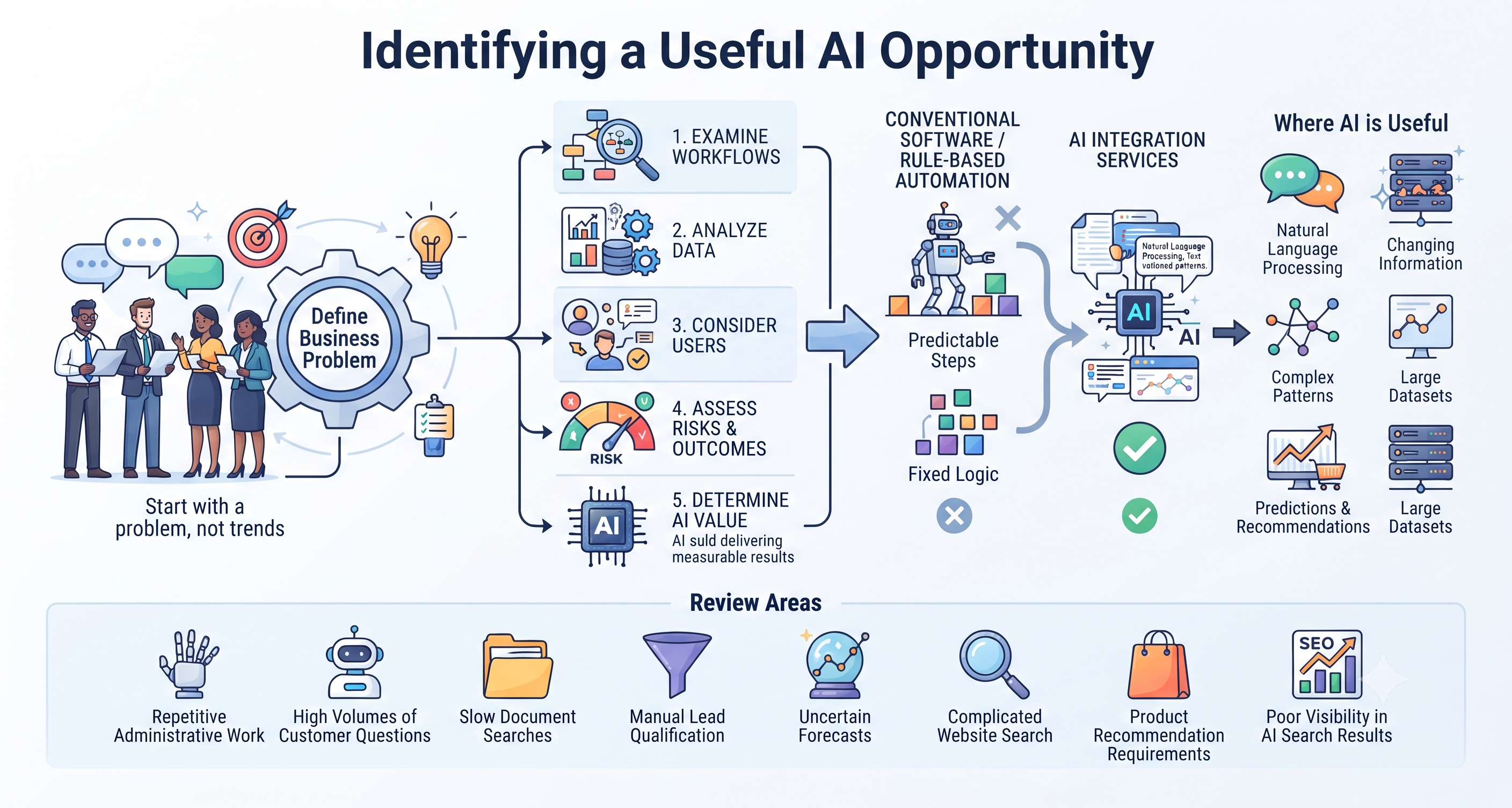
A useful AI opportunity begins with a clearly defined business problem, not a popular technology trend. Opal Infotech’s advanced technical team examines workflows, data, users, risks, and expected outcomes to determine whether artificial intelligence can deliver measurable value.
Review areas involving:
- Repetitive administrative work
- High volumes of customer questions
- Slow document searches and reporting delays
- Manual lead qualification
- Uncertain sales or inventory forecasts
- Complicated website search
- Product recommendation requirements
- Poor visibility in AI-generated search results
Conventional software or rule-based automation may be more appropriate when a process follows fixed, predictable steps. AI integration services are more useful when tasks involve natural language, changing information, complex patterns, predictions, recommendations, images, or large datasets. Evaluating the problem first helps businesses choose the right approach, control implementation risks, and establish meaningful performance measures.
Questions to Ask Before Investing in an AI Solution
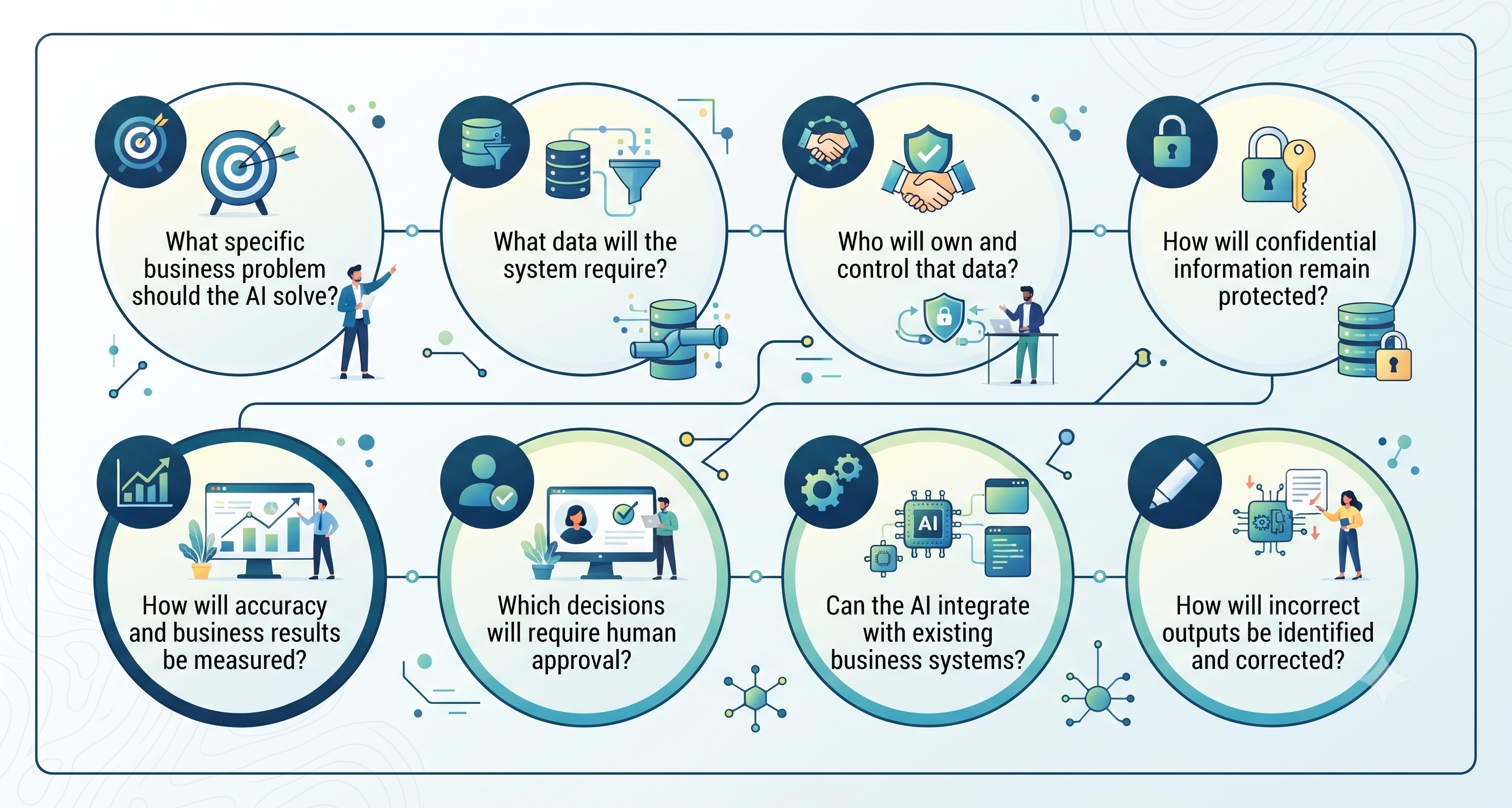
Before investing in custom AI solutions, businesses should evaluate operational value, technical feasibility, data readiness, and implementation risks. Opal Infotech’s advanced AI team recommends asking:
- What specific business problem should the AI solve?
- What data will the system require?
- Who will own and control that data?
- How will confidential information remain protected?
- How will accuracy and business results be measured?
- Which decisions will require human approval?
- Can the AI integrate with existing business systems?
- How will incorrect outputs be identified and corrected?
These questions help define accountable, secure, results-focused implementation.
What Can AI Not Do Reliably Without Human Oversight?
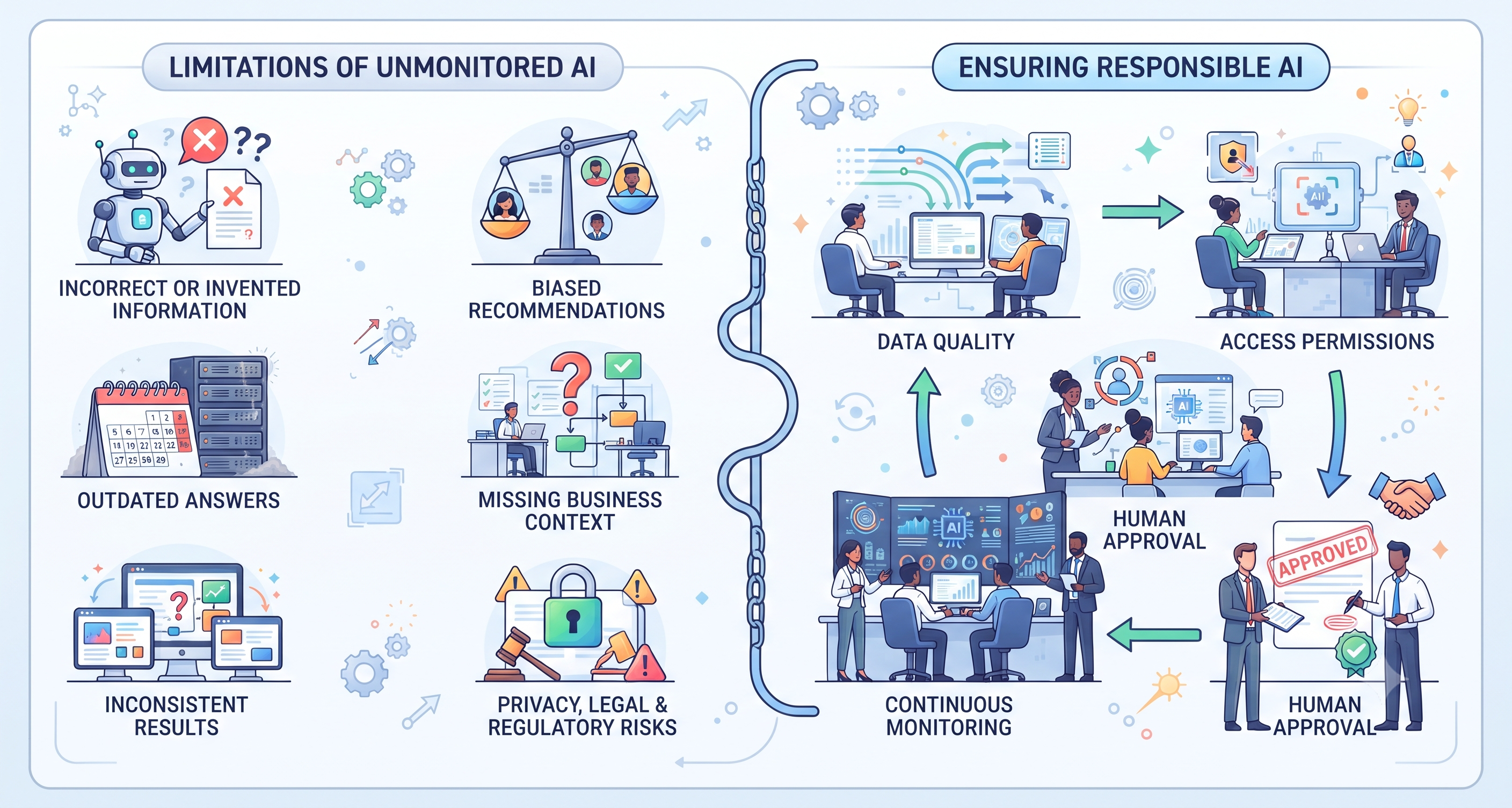
AI can improve efficiency, analysis, and decision support, but it cannot replace human judgement in every situation. Even advanced AI systems may produce:
- Incorrect or invented information
- Biased recommendations
- Outdated answers
- Responses missing important business context
- Inconsistent results
- Outputs creating privacy, legal, or regulatory concerns
Opal Infotech’s advanced technical team addresses these risks through strong data quality, defined access permissions, continuous monitoring, and human approval. Subject expertise remains essential when artificial intelligence supports healthcare, finance, legal services, recruitment, or other high-impact decisions. Responsible AI implementation combines automation opportunities with clear accountability, helping businesses protect users, information, operations, and organizational credibility.
How Opal Infotech Helps Businesses Apply AI
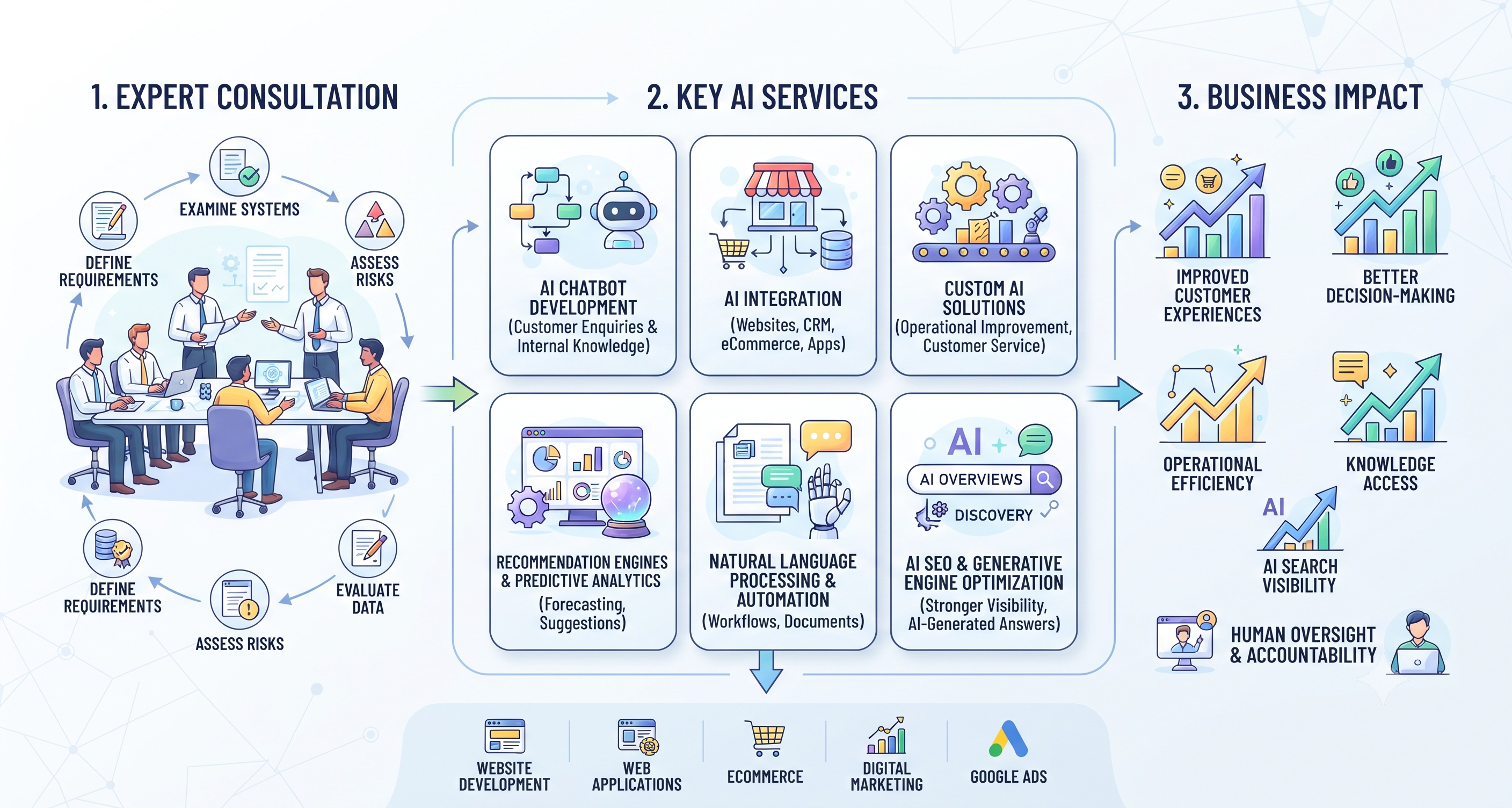
Opal Infotech’s advanced technical team converts clearly defined business requirements into practical AI applications. Before recommending an approach, our experts examine the business problem, available data, existing systems, intended users, implementation risks, security needs, and expected results.
Our AI services address opportunities such as:
- Custom AI solutions for operational improvement and customer-service requirements
- AI integration with websites, CRM platforms, eCommerce systems, and business applications
- AI chatbot development for customer enquiries and internal knowledge access
- Recommendation engines and predictive analytics for relevant suggestions and informed forecasting
- Natural language processing and workflow automation for documents, communication, and repetitive processes
- AI SEO services for conventional search, AI Overviews, and AI-supported discovery
- Generative Engine Optimization services for stronger visibility in AI-generated answers
These capabilities are supported by Opal Infotech’s website development, web application development, eCommerce development, digital marketing, and Google Ads expertise. By connecting AI with existing digital systems and measurable objectives, our specialists help businesses improve customer experiences, knowledge access, decision-making, operational efficiency, and AI search visibility while maintaining human oversight and accountability.
Discuss Your AI Requirements with Opal Infotech
Understanding AI terminology is only the first step toward identifying a valuable business opportunity. The right AI solution must address a defined requirement and work with your data, employees, customers, workflows, and existing systems. Opal Infotech’s technical team evaluates each requirement with attention to use, integration, security, human oversight, and measurable outcomes.
FAQs
What Is Artificial Intelligence in Simple Terms for Business Owners?
Artificial intelligence is technology that enables software to understand information, recognize patterns, generate content, make predictions, and recommend actions. Businesses can use AI for customer support, document processing, forecasting, product recommendations, and workflow automation. Opal Infotech helps companies identify practical AI applications based on their operational requirements, available data, existing systems, and measurable business objectives.
How Is Generative AI Different from Machine Learning?
Machine learning identifies patterns in historical data to classify information or predict outcomes, whereas generative AI creates new text, images, audio, video, or code. A sales forecasting system may use machine learning, while an AI content assistant uses generative AI. Opal Infotech helps businesses determine which technology is appropriate for their intended application, users, data, and expected results.
Which Business Processes Can Be Improved Using AI?
AI can improve customer enquiry handling, lead qualification, document searches, reporting, demand forecasting, inventory planning, product recommendations, image analysis, and internal knowledge access. The best opportunities usually involve large datasets, language, changing information, or repeated decisions. Opal Infotech evaluates current workflows and identifies where AI integration, machine learning, or conventional automation can deliver meaningful operational value.
Who Should Consider Custom AI Integration Services?
Manufacturers, healthcare organizations, eCommerce companies, logistics providers, financial firms, professional services, and B2B businesses can consider custom AI integration services. A suitable candidate usually has a defined operational problem, useful data, repeated information requests, or systems requiring intelligent assistance. Opal Infotech develops AI solutions according to the company’s workflows, users, security requirements, and existing technology infrastructure.
When Should a Business Use an AI Chatbot?
A business should consider AI chatbot development when customers or employees frequently ask similar questions, need help finding information, or require guidance through a defined process. The chatbot should use approved, current, and relevant business information. Opal Infotech develops AI chatbots for customer enquiries, lead qualification, website assistance, internal knowledge access, and integration with existing business applications.
Where Can AI Be Integrated Within Existing Business Systems?
AI can be integrated with websites, CRM platforms, ERP software, eCommerce stores, mobile applications, customer-support systems, databases, document repositories, and internal dashboards. The integration point depends on where information is stored and how employees or customers use it. Opal Infotech examines system architecture, APIs, data access, user permissions, security requirements, and workflow dependencies before recommending AI integration.
How Can Businesses Protect Confidential Data When Using AI?
Businesses should apply access controls, approved data sources, encryption, retention rules, user permissions, output monitoring, and human review. Personal, financial, medical, and commercially sensitive information should not be submitted to unapproved AI tools. Opal Infotech considers data governance, privacy requirements, AI guardrails, system security, and human accountability when planning custom AI solutions and business application integrations.
How Much Does a Custom AI Solution Cost?
The cost of a custom AI solution depends on its complexity, required data preparation, model choice, integrations, user roles, security controls, testing, monitoring, and ongoing maintenance. A chatbot connected to approved documents differs significantly from a predictive system integrated with several applications. Opal Infotech reviews the complete requirement before recommending the appropriate technical approach and implementation scope.
How Many Business Systems Can Be Connected Through AI Integration?
The number of systems that can be connected depends on API availability, data formats, permissions, security policies, system compatibility, and the intended workflow. AI may connect with one website or several business applications, but every connection must serve a defined purpose. Opal Infotech evaluates each proposed integration individually to protect data quality, system performance, user access, and operational reliability.
Whose Data Is Used to Train or Operate a Business AI System?
The data may belong to the company, its customers, employees, suppliers, a technology provider, or a third-party model developer. Ownership, usage rights, storage, retention, and confidentiality must be clarified before implementation. Opal Infotech helps businesses examine approved data sources and establish suitable controls before using company information for AI training, retrieval, prediction, automation, or response generation.
What Is Generative Engine Optimization, and How Does It Improve AI Search Visibility?
Generative Engine Optimization, or GEO, improves website content so AI-powered platforms can understand, verify, select, cite, or recommend it in generated answers. It complements traditional SEO through clear answers, entity information, credible evidence, technical accessibility, and useful content. Opal Infotech provides GEO and AI SEO services for visibility across Google AI experiences, ChatGPT, Gemini, Perplexity, Copilot, and other generative platforms.
Why Do Businesses Need Both Traditional SEO and AI SEO?
Traditional SEO improves visibility in standard search results, while AI SEO and GEO help content become understandable and useful to generative search systems. Businesses increasingly need visibility across rankings, AI Overviews, conversational answers, and cited sources. Opal Infotech combines technical SEO, content optimization, structured information, entity development, and Generative Engine Optimization to support both conventional search performance and AI search visibility.
Which Is Better for a Business: an AI Chatbot or an AI Agent?
An AI chatbot is suitable for answering questions and guiding conversations, while an AI agent may use approved tools and perform multistep actions. The correct choice depends on task complexity, system access, risk, and required human approval. Opal Infotech assesses the intended workflow before recommending chatbot development, conversational AI, agentic AI, or rule-based automation.
Discuss Your AI Requirements with Opal Infotech
Use the Opal Infotech contact page to discuss operational challenges, customer-support needs, website integration, automation opportunities, or AI search visibility goals.

With a digital legacy established in 1998, the editorial team at Opal Infotech combines decades of experience with cutting-edge innovation. As a premier Web Development and Digital Marketing agency, we specialize in crafting robust digital solutions – ranging from Custom Web Development and eCommerce platforms to Mobile Apps and Business Website Design. Today, Opal Infotech is at the forefront of the technological shift, helping businesses integrate AI SEO and AI Business Solutions alongside traditional powerhouses like Google Ads and Website Maintenance. Our goal is to translate complex tech trends into actionable growth strategies for global enterprises.
We publish articles to empower business owners with the clarity needed to make informed decisions in a complex digital landscape. Our technical content is designed to demystify high-level innovations like AI and SEO, translating code into actionable business growth strategies.
