


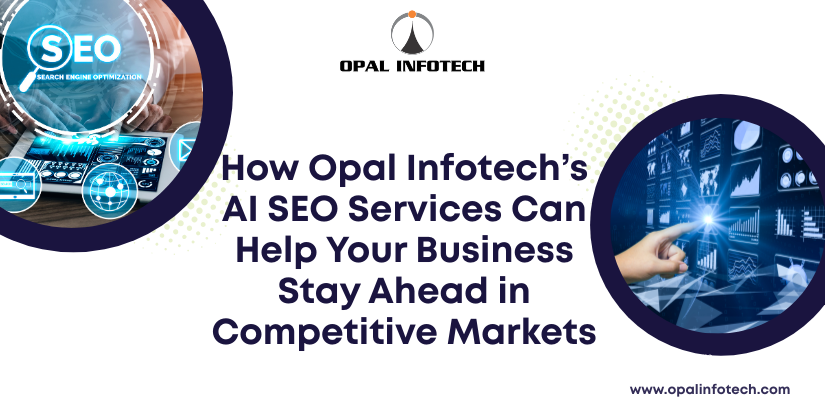















The Paradigm Shift: From Search Engines to Answer Engines
By The Strategy Team at Opal Infotech
For over twenty-five years, Opal Infotech has operated at the forefront of digital evolution. From our headquarters in Ahmedabad, we have guided businesses through every major disruption in the online landscape—from the initial transition away from traditional directories in the early 2000s to the pivotal “Mobilegeddon” of 2015, which redefined mobile accessibility standards.
We have successfully navigated our clients through decades of volatility, ensuring their digital presence remained robust as the infrastructure of the internet changed. However, the transformation we are witnessing today is fundamentally different. It is not merely a technical update or an algorithm adjustment; it is a structural revolution in how information is accessed.
We are witnessing the end of the traditional search era and the rise of the Intelligence Age.
For two decades, the implicit contract between a user and a search engine was transactional: a user searched for a query (e.g., “best industrial pump manufacturer”), and the engine provided a list of blue links. The onus was on the user to click, browse, and compare.
Today, that model is obsolete.
In 2025, a procurement manager does not simply “search.” They consult advanced AI platforms like ChatGPT, Google Gemini, or Bing Copilot with complex, multi-layered queries: “Identify the top three reliable industrial pump manufacturers in India for high-viscosity fluids, and summarize their ISO certifications and delivery performance.”
The AI does not return a list of websites. It synthesizes a direct answer. It asserts, “Company A is the recommended choice due to their verified on-time delivery record and specific technical compliance.”
In this new ecosystem, if your organization is not cited as “Company A,” you do not merely lose a website visitor—you are effectively removed from the consideration set entirely.
At Opal Infotech, we are not passive observers of this shift. We are engineering the response. We have entered the era of Generative Engine Optimization (GEO)—often referred to as AI SEO. This represents the most significant opportunity for competitive advantage and market dominance in the history of our industry.


A Quarter-Century of Perspective: Why This Shift is Personal

Why should you listen to Opal Infotech about the future? Because we have survived every version of the past.

In digital marketing, survival is the only metric that matters. Many agencies that were “gurus” in 2010 are gone today because they chased tactics instead of strategy. They chased “keyword stuffing.” They chased “link farms.” When the algorithms changed, their businesses collapsed.

We took a different path. For 25 years, our philosophy has been rooted in technical excellence and adaptation. We saw the dot-com bubble burst, and we kept building. We saw the rise of social media, and we integrated it. Now, as the internet moves from an “Information Age” to an “Intelligence Age,” we are pivoting again.

We are seeing a trend that is terrifying for the complacent but exhilarating for the innovators. Traditional organic traffic is dropping across the board—not because people are searching less, but because they are searching differently. They are using AI agents, voice search, and chatbots.

The businesses that stick to the old playbook of “write a blog post and wait” will slowly fade into obscurity. The businesses that partner with us to optimize for these new “Generative Engines” will capture a market share that their competitors don’t even know exists yet.
The Technology & The Trap: Why “Blue Link” SEO is Dying

To understand why your traffic might be dipping—or why it might flatline in the near future—you have to understand the machine you are fighting against. You need to look under the hood.
Indexers vs. Synthesizers: The Fundamental Difference
- Traditional search engines (like the classic Google we know) are Indexers. Think of them as giant, hyper-efficient librarians. When you publish a website, the librarian files it away. When a user searches for a keyword, the librarian runs down the aisle, grabs the folder labeled with that keyword, and hands it to the user. “Here is a list of documents,” they say. “You figure it out.”
- AI Search Engines (like ChatGPT, Claude, Perplexity, and Google’s AI Overviews) are Synthesizers. They don’t hand over file folders. They read the files, understand the context, connect the dots, and write a new summary for the user.
- They are built on Large Language Models (LLMs). These models don’t “rank” pages in the traditional sense; they perform a process called RAG (Retrieval-Augmented Generation).
- Retrieval: They look for trustworthy data sources (that’s you, if you’re optimized).
- Augmentation: They combine that data with their internal training.
- Generation: They write a completely new answer.
The “Zero-Click” Reality
- This leads to the phenomenon of “Zero-Click Searches.” This is when a user gets their answer directly on the search results page or inside the chatbot window and never clicks through to a website.
- Most agencies are still selling you “Blue Link” SEO. They promise to get you to position #1. But let me ask you: What is the value of position #1 if the user never clicks it because the AI answered their question perfectly right at the top of the screen?
- If your SEO strategy is focused solely on clicks, you are optimizing for 2015. If you want to survive in 2025, you must optimize for Brand Citations.
The First-Mover Advantage: A Window of Opportunity
- Here is the good news: The “knowledge graph” of these AI models is still forming. They are hungry. They are desperate for authoritative, structured, and factual data to train their answers on.
- Because this technology is so new, most of your competitors—even the big ones—are asleep at the wheel. They are still churning out generic 500-word blog posts filled with keywords. AI models hate that content. It’s “noise” to them.
- This creates a massive First-Mover Advantage for businesses that act now. By optimizing your digital presence for AI today, you aren’t just fighting for a temporary spot on a list. You are embedding your brand into the “long-term memory” of the internet. You are teaching the AI that YOU are the authority.
- Once an AI model decides that your website is the “source of truth” for a specific topic (e.g., “Pharmaceutical Packaging Machinery”), it tends to stick with that decision. It requires much less energy for the model to reference a known trusted source than to verify a new one. By getting in now, you are building a defensive moat around your brand that could last for years.

Let’s Chat

The Anatomy of an AI-Friendly Business

- What does it actually mean to be “AI-Friendly”? It is not about tricking the robot. You cannot trick an LLM. It is about clarity, authority, and structure.
- When we analyze a client’s website at Opal Infotech, we often see “human-friendly” content that is “robot-hostile.”
- Human-friendly: “We are the best in the biz! Contact us for cool deals!”
- Robot-hostile: This sentence contains no data. No facts. No entities. The AI ignores it.
- To the AI, your business is an Entity. An Entity is a person, place, or thing that the AI understands as a unique concept. If the AI doesn’t have a clear “Entity Map” of your business—if it doesn’t know exactly what you sell, where you are located, and who trusts you—it will never recommend you.
- This is where the battle is won or lost. It is not about keywords anymore. It is about Entity Salience.
- Does the AI know you exist? Does the AI trust you? Does the AI understand the relationship between your products and the user’s problem?
- If the answer to any of those is “No,” or even “Maybe,” you are in trouble. And that is exactly where Opal Infotech steps in.
Also visit Our Page
Success Story: SEO + GEO for a Specialty Chemicals ManufacturerEngineering Authority in the Age of AI

Opal Infotech’s Unique Approach: From “Guesswork” to “Engineering”
At Opal Infotech, we don’t guess. We don’t throw keywords at a wall to see what sticks. With a quarter-century of data behind us, we treat AI SEO not as a marketing game, but as an engineering problem.
We have developed a proprietary 4-pillar methodology designed to move our clients from being merely “indexed” to being “cited.” Here is how we do it.
The GEO Audit: Assessing Your “AI Readiness”
Before we write a single word of content, we need to know how the machines see you right now. A traditional SEO audit checks for broken links and slow load times. Our GEO Audit goes much deeper—it checks for Concept Clarity.
We simulate queries across major AI platforms to answer critical questions:

If we ask ChatGPT, “What does [Your Company Name] do?”, does it hallucinate? does it give a vague answer? or does it provide a precise, fact-based summary? If the AI is confused about who you are, it will never recommend you.
AI models are trained on the entire internet, including reviews, forum discussions, and social media. They weigh “sentiment” heavily. If your brand is mentioned in forums with negative sentiment, the AI assigns a lower “Trust Score.” We map this invisible reputation score to understand what the AI “thinks” of you.
Content Optimization for LLMs (The “Answer Engine” Strategy)
This is where the real work begins. We stop writing for keywords and start writing for Answers.
For years, SEO copywriters have been trained to write “fluff”—long introductions to reach a 1,000-word count. AI models hate fluff. It confuses their “context window” (the amount of text they can process at once).
Our content strategy focuses on the Inverted Pyramid of Facts:

Front-Loaded Answers: We restructure your content so the most critical data—specs, prices, certifications—is at the very top.

Citation Engineering: AI models are programmed to look for “ground truth.” They love unique statistics, original research, and contrarian viewpoints. We help you inject original data into your content. If you are the source of the statistic, the AI must cite you.

E-E-A-T Reinforcement: We explicitly highlight Experience, Expertise, Authoritativeness, and Trustworthiness in the text, using language patterns that LLMs associate with high-quality sourcing.
Schema & Structured Data: Speaking the Robot’s Language
You might look at your product page and see a beautiful image and a “Buy Now” button. An AI bot looks at that same page and sees raw code. If that code is messy, the AI ignores it.
We implement advanced Schema Markup (JSON-LD). This is essentially a “translator” that speaks directly to the bot. We don’t just hope the AI understands your price; we add code that explicitly tells it:
- “type”: “Product”
- “price”: “1500”
- “availability”: “InStock”
- “description”: “Best industrial vacuum for fine dust”
By structuring your data, we are spoon-feeding the AI. When a user asks Google Gemini for a comparison table of products, your product details are already formatted in a way the AI can instantly grab, understand, and display. This significantly increases the chance of your product appearing in those coveted “Rich Snippets” and AI summaries.
Conversational Keyword Strategy & Intent Mapping
- The search query “industrial vacuum” is dead. The new search query is: “What is the best industrial vacuum for a textile factory that deals with fine cotton dust and has a HEPA filter?”
- This is a conversational, long-tail query. Traditional keyword tools often miss these. We use Intent Mapping to analyze the questions your customers are actually asking their devices. We then create “Content Clusters” that cover every angle of a topic.
- When an AI sees that you cover a topic exhaustively—answering the “what,” “how,” “why,” and “which”—it assigns you “Topic Authority.” It marks your site as the definitive encyclopedia for that niche.
The Strategic Advantage: Why This Matters for Your P&L
You might be thinking, “This sounds fascinating, but does it drive revenue?”
You might be thinking, “This sounds fascinating, but does it drive revenue?”The answer lies in the quality of the traffic.

From “Browsers” to “Deciders”
In traditional SEO, you get a lot of “tire kickers”—people just browsing around. In AI Search, the intent is much higher. If someone asks an AI for a specific recommendation and the AI cites you, that user has already been pre-qualified by the machine. The trust transfer is immediate. They aren’t coming to your site to see if you are good; they are coming because the digital expert (the AI) told them you are good. These users convert at a much higher rate.

Dominating the “Dark Funnel”
Much of the buyer’s journey now happens inside the AI. A user might ask ten follow-up questions to ChatGPT before they ever click a single link. This is the Dark Funnel—marketing activity you can’t track with traditional cookies.
If you are not part of that conversation inside the Dark Funnel, you have lost the customer before they even visited a website. Our goal is to ensure your brand name is dropped during that conversation, influencing the decision long before the click happens.

The “Trusted Source” Moat
Once an AI model identifies your brand as a trusted entity in a specific niche (e.g., “The Authority on Solar Inverters”), it is very hard for competitors to displace you. The model’s training weights favor consistency. By investing in Opal Infotech’s AI SEO services now, you are building a defensive moat around your business. You are securing your legacy in the digital age.

The Verdict: Adapt or Fade
I have seen businesses cling to the past before. I saw retailers ignore e-commerce in 2005. “People want to touch the product,” they said. They are gone now. I saw B2B giants ignore mobile in 2015. “Our clients don’t use phones for work,” they said. They lost their market share.
The shift to AI Search is not a fad. It is the natural evolution of how humans access information. We are tired of searching; we want to find. We want answers, not homework.
At Opal Infotech, we combine 25 years of digital heritage with the cutting-edge science of Generative Engine Optimization. We don’t just want to get you “ranked” on a list nobody looks at. We want to get you cited, referenced, and recommended by the most powerful technology in human history.
The search box is changing. The question is: When the world asks the AI who the leader in your industry is…
Will it say your name?
Are you ready to future-proof your business? Don’t let your competitors own the conversation. Contact Us today. Let’s look at your digital presence through the eyes of the machine and build a strategy that dominates the future of search.
FAQs
How Opal Infotech’s AI SEO Services Can Help Your Business Stay Ahead in Competitive Markets
How does Generative Engine Optimization (GEO) differ from traditional SEO?
Traditional SEO focuses on ranking a website on a search engine results page (SERP) to drive clicks. In contrast, Generative Engine Optimization (GEO) focuses on optimizing content to be cited and synthesized by AI models (like ChatGPT and Google Gemini) directly in their answers. While SEO fights for visibility in a list of links, GEO fights for authority in the generated answer itself.
Why is my website traffic dropping despite high keyword rankings?
If your rankings are stable but traffic is dropping, you are likely losing users to "Zero-Click Searches." AI platforms now answer many user queries directly on the results page, removing the need for users to click a link. To recover this traffic, you must shift strategies from "Blue Link" SEO to AI SEO, ensuring your brand is the source of the answer provided by the AI.
Can Opal Infotech help my business get cited in ChatGPT and Google Gemini?
Yes. Opal Infotech uses a proprietary 4-pillar GEO strategy—including Entity Salience auditing, schema markup engineering, and answer-focused content optimization—to increase the probability of your brand being referenced as a trusted authority by Large Language Models (LLMs) like ChatGPT, Claude, and Gemini.
Is AI SEO only for technology companies, or does it work for traditional industries?
AI SEO is critical for all industries, particularly B2B sectors like manufacturing, healthcare, and logistics. Procurement managers and decision-makers in these fields increasingly use AI to research suppliers and products. If your industrial business is optimized for AI, you can dominate the "shortlist" generated by these tools, regardless of your niche.
How long does it take to see results from an AI SEO campaign?
Unlike traditional SEO, which can take 6-12 months for keyword movement, AI SEO focuses on "Entity Trust." While establishing authority takes time, fixing technical schema and optimizing content structure can often yield quicker recognition by search bots. However, building a "defensive moat" of authority is a long-term strategic investment, typically showing significant ROI within 4-8 months.
What is "Entity Salience" and why does it matter for my business?
Entity Salience is a metric that measures how clearly an AI understands your brand (the "Entity") and its relationship to a specific topic. If an AI has high confidence that "Company X" is an expert in "Industrial Pumps," it will prioritize citing Company X. Opal Infotech focuses on maximizing your Entity Salience so AI models view your brand as a definitive source of truth.
Will AI Search eventually replace traditional Google Search completely?
It is unlikely to replace it completely, but it is rapidly becoming the dominant method for informational and commercial discovery. We are moving toward a hybrid future where transactional queries (like "buy shoes") may stay on traditional interfaces, but complex queries (like "best shoes for flat feet marathon runners") will be dominated by AI. Businesses must optimize for this hybrid landscape immediately.
What makes Opal Infotech’s approach to AI SEO different from other agencies?
Opal Infotech combines 25 years of digital marketing evolution with modern data science. We don't just "write blogs"; we engineer content structures based on how LLMs process data. Our approach is technical, data-driven, and focused on "Answer Optimization" rather than just keyword stuffing, ensuring your brand is future-proofed against algorithm changes.
Does implementing GEO/AI SEO hurt my current traditional SEO rankings?
No, it actually improves them. The pillars of AI SEO—such as factual accuracy, clear site structure, high-quality schema markup, and authoritative content—are also highly valued by Google’s traditional algorithms. By optimizing for AI, you are elevating the overall quality of your digital presence, which typically boosts both your traditional rankings and your AI visibility simultaneously.

Bhavik Raikundaliya is a digital marketing expert at Opal Infotech, with over 15 years of experience in the core digital marketing domain. He possesses deep expertise in paid campaigns, including Search Ads, Shopping Ads, Social Media Ads, and also has strong experience in managing SEO. Throughout his career, Bhavik has successfully designed and managed campaigns that deliver measurable ROI and business growth. His insights combine strategic thinking with hands-on execution, enabling brands to maximize visibility, engagement, and conversions across digital platforms. Passionate about staying ahead of marketing trends, he continuously explores innovative techniques to optimize paid and organic campaigns.