



















The Executive Summary: The AI driven Revolution in Manufacturing Industries
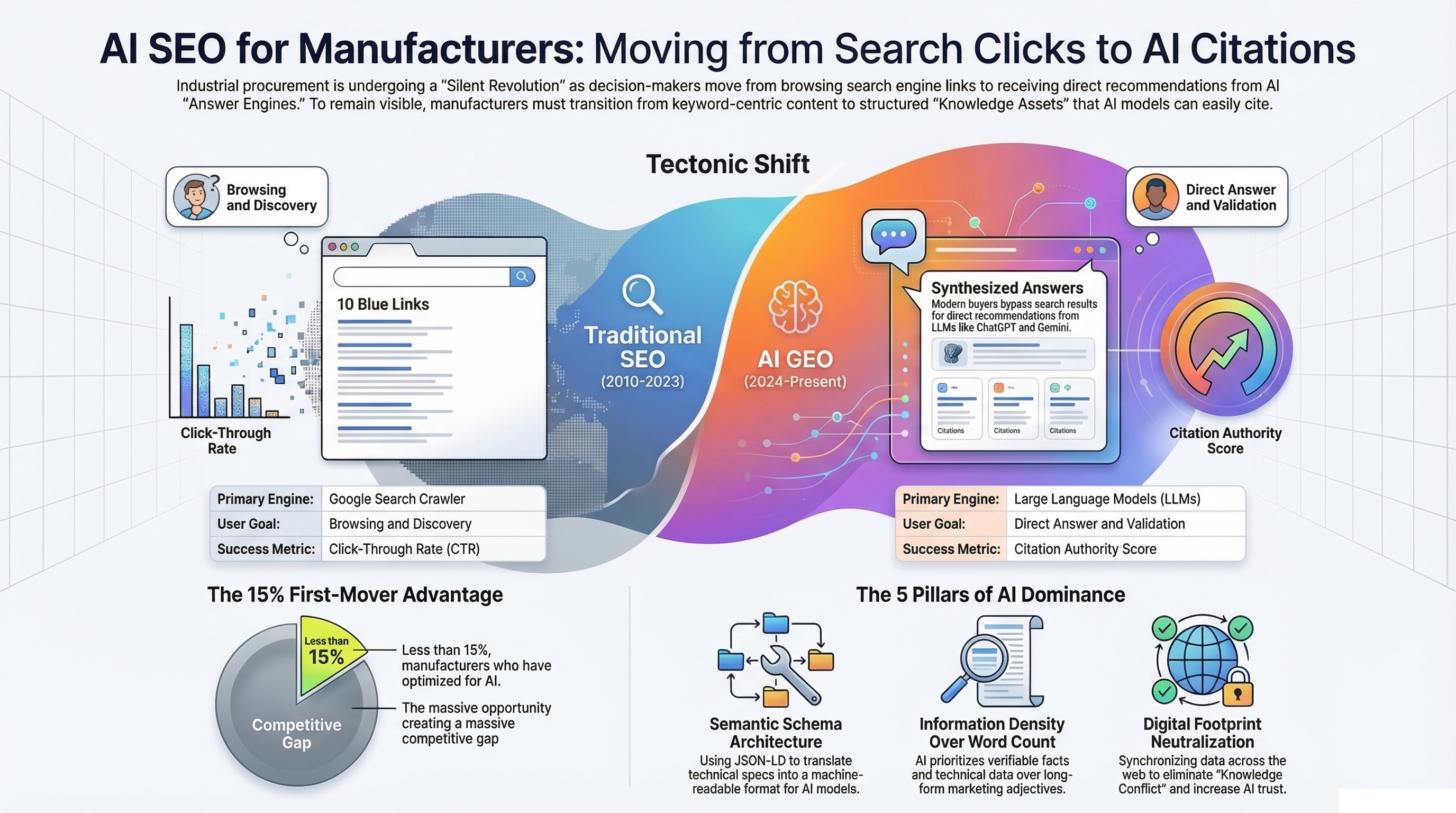
The traditional landscape of industrial procurement is currently undergoing a tectonic shift. For decades, the “search box” was the primary gateway for B2B decision-makers to discover manufacturers. However, we have officially entered the era of the “Answer Engine Optimization(AEO).” Today, procurement officers, engineers, and C-suite executives are bypassing the traditional “10 blue links” in favor of LLM-driven discovery platforms like ChatGPT, Claude, Perplexity, and Google’s AI Overviews (formerly SGE).
This transition marks the rise of the Zero-Click Search. In this new reality, the goal is no longer just to rank #1 on a search results page; it is to be the cited authority within the AI-generated answer itself. When an engineer asks, “Which manufacturer provides the highest-tolerance CNC components for aerospace in India?”, the AI does not just provide a list of websites—it synthesizes a recommendation based on Entity Salience and Technical Fact Density.
If your brand is not synthesized into that answer, you are effectively invisible to the modern buyer. Opal Infotech recognizes that traditional SEO is now a baseline requirement, but Generative Engine Optimization (GEO) is the competitive frontier. This article serves as a technical blueprint for manufacturers to reclaim their digital sovereignty. By evolving from “keyword-centric” content to “knowledge-graph” integration, your organization can move from being a mere search result to becoming the foundational data source that AI models trust and recommend. The revolution is silent, but the ROI of being an early adopter is loud and definitive.
Technical Insight: The Shift in Search Behavior
| Feature | Traditional SEO (2010-2023) | AI GEO (2024-Present) |
|---|---|---|
| User Goal | Browsing/Discovery | Direct Answer/Validation |
| Success Metric | Click-Through Rate (CTR) | Citation Authority Score |
| Primary Engine | Google Search Crawler | Large Language Models (LLMs) |
| Content Style | Keyword-Optimized Blogs | Structured Knowledge Assets |


Technical Foundation: What is GEO (Generative Engine Optimization)?
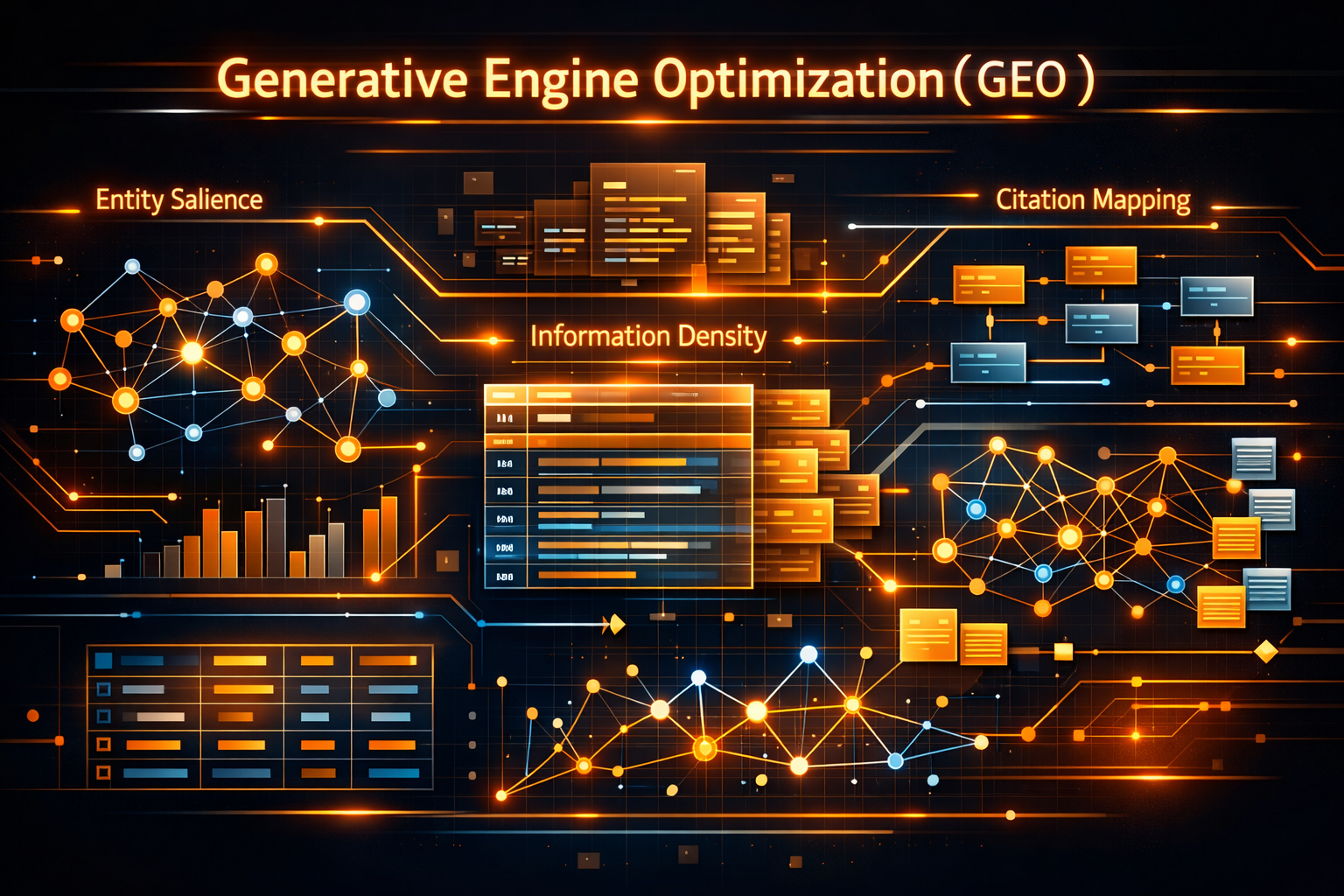
To master the next decade of industrial lead generation, manufacturers must understand that Generative Engine Optimization (GEO) is not merely an “update” to SEO services—it is a complete re-engineering of digital visibility. While traditional SEO focuses on helping a crawler find a webpage, GEO focuses on helping a Large Language Model (LLM) understand, categorize, and prioritize a brand’s expertise.
At its core, GEO is the science of influencing the “Latent Space” of models like ChatGPT, Gemini, and Claude. When these models generate a response to a technical query, they do not “search” the live web in the traditional sense; they predict the most authoritative answer based on three critical technical pillars that Opal Infotech has mastered:

Entity Salience: Establishing “The Factory” as a Fact: In the eyes of an AI, your manufacturing plant is not a website—it is an Entity. Entity Salience is a numerical score that determines how “relevant” your brand is to a specific niche (e.g., Isabgol processing or industrial cooling solutions). Through advanced Knowledge Graph Integration, Opal Infotech ensures that AI models connect your brand name with specific industry certifications, patents, and technical standards. We move your brand from being a “keyword” to becoming a verified “Node” in the global industrial knowledge base.

Information Density over Word Count: The “Long-Form Blog” era is dying. AI models prioritize Information Density—the ratio of verifiable facts to total words. In a technical audit, a 500-word article filled with marketing adjectives will lose to a 100-word table of technical specifications and performance data. GEO rewards “Fact-Rich” environments. Our technical team restructures your data into Machine-Readable Formats, ensuring that when an AI “scans” your content, it finds high-value data points that it can easily synthesize into an answer.
Citation Mapping: Securing the “Footnote” : The ultimate goal of GEO is Citation Mapping. This involves structuring content so that the AI model is mathematically compelled to cite your company as the primary source. By using Semantic Schema Architecture and Linguistic Alignment, Opal Infotech forces the AI to not just mention a product, but to attribute the expertise to your specific brand.
Technical Comparison: The Intelligence Gap
| Metric | Traditional Crawler (SEO) | Generative Model (GEO) |
|---|---|---|
| Logic | Keyword Matching | Semantic Intent & Relationship |
| Priority | Backlink Quantity | Authoritative Citations & Accuracy |
| Format | HTML/Text | Structured Data & JSON-LD Entities |
| Goal | Indexing | Synthesis & Recommendation |
The Manufacturing Edge: Why B2B is the New GEO Battleground
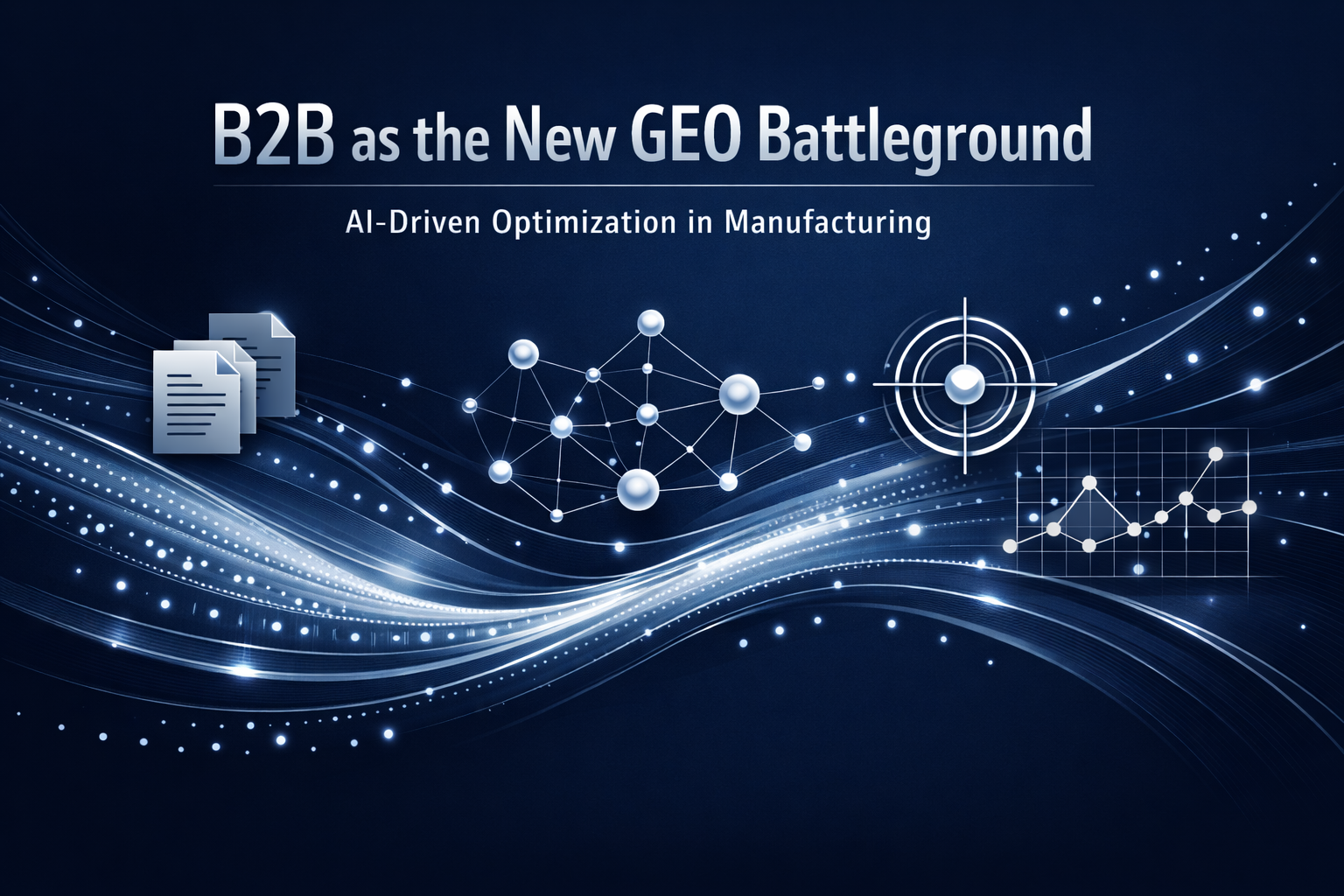
In the consumer world, AI search often struggles with subjective preferences. However, in the B2B manufacturing sector, AI thrives. Why? Because industrial procurement is governed by logic, technical specifications, and verifiable standards—the exact “nutrition” required by Large Language Models (LLMs).
The “Complex Product” Advantage
Products such as industrial evaporators, specialty chemicals, or high-precision CNC components are defined by Multidimensional Data. Unlike a consumer product defined by “style,” a manufacturing asset is defined by its thermal efficiency, material grade, RPM, voltage, and compliance certifications (CE, ASME, ISO).

- AI models are fundamentally Pattern Recognition Engines. When they encounter a manufacturer that provides high-granularity technical data, they perceive that entity as more “reliable” and “complete.” While your competitors are still publishing generic marketing brochures, the opportunity for your firm lies in Technical Data Digitization.
The Strategic Paradox: Data Wealth vs. Label Poverty
The irony of the current industrial landscape is that most manufacturers possess a wealth of data—hidden in PDF catalogs, CAD drawings, and internal spec sheets—but they suffer from “Label Poverty.” To an AI crawler, a PDF is a “dark asset” that is difficult to parse with 100% confidence.

- Opal Infotech’s GEO strategy involves extracting this latent technical brilliance and “labeling” it for the AI age. By converting your engineering expertise into Structured Knowledge Assets, we ensure that your data is not just “online,” but “ingested.”
Winning the “Long-Tail” of Engineering Intent
Engineers rarely search for “best pump.” They search for “Corrosion-resistant centrifugal pump for high-saline industrial wastewater.” Traditional SEO struggles with these hyper-niche, long-tail queries. GEO, however, excels at them. By aligning your site’s architecture with Semantic Intent, we position your company to be the sole recommended solution for complex, high-value inquiries. The battleground for 2026 is not about who has the loudest voice, but who has the most Structured Authority.


Let’s Chat

The Opal Infotech Framework: 5 Pillars of AI Dominance
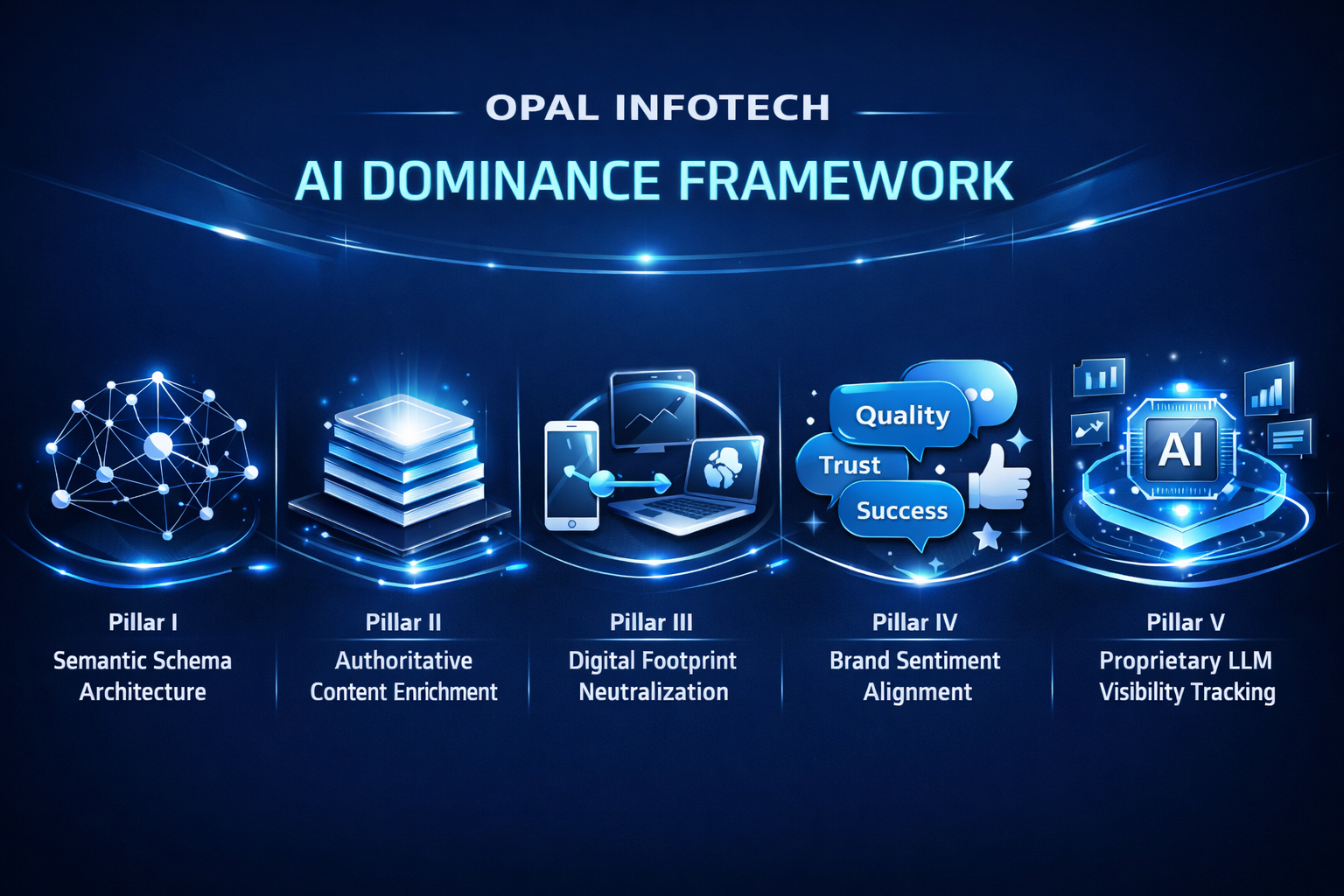
To transition a manufacturing giant from search visibility to AI dominance, Opal Infotech utilizes a proprietary, five-dimensional technical framework. We do not just “optimize” websites; we re-engineer your digital DNA to be natively compatible with Large Language Models.

Pillar I: Semantic Schema Architecture (The JSON-LD Catalog)
Traditional SEO uses meta-tags for humans; GEO uses JSON-LD (JavaScript Object Notation for Linked Data) for machines. Opal Infotech builds a “Semantic Layer” over your product catalog. We don’t just tell AI you sell “pumps”; we use a nested schema to define operating pressure, flow rates, material viscosity limits, and NEMA ratings. By labeling your technical specs in a structured format, we ensure AI models can extract your data with zero ambiguity, making you the “preferred source” for technical queries.

Pillar II: Authoritative Content Enrichment (ACE)
The era of the 500-word “lifestyle” blog is over. Opal Infotech replaces generic blogging with Knowledge Base Creation. We focus on Fact Density and Entity Linking. Our technical writers—who understand industrial engineering—produce content that addresses the “Top-of-Funnel” engineering challenges. We transform your service pages into “Knowledge Assets” that provide definitive answers to complex “How” and “Why” questions, which are the primary triggers for AI-generated summaries.

Pillar III: Digital Footprint Neutralization
AI models are trained on the “entirety” of the web. If your LinkedIn says one thing, your old distributor’s site says another, and your current website has outdated specs, the AI experiences “Knowledge Conflict.” This results in your brand being excluded from AI answers due to low confidence scores. Opal Infotech performs a “Footprint Audit” to synchronize your technical data across the web, ensuring that every citation of your brand reinforces a single, high-confidence version of the truth.

Pillar IV: Brand Sentiment Alignment
Generative engines do more than find data; they assign Sentiment. When an LLM describes a manufacturer, it uses adjectives based on the surrounding digital context. Our framework uses Neural Association techniques to ensure that whenever your brand is mentioned, it is contextually linked to terms like “ISO-Certified,” “High-Tolerance,” “Industry-Leading Lead Times,” and “Reliable Support.” We programmatically influence how the AI “perceives” your brand’s reputation.

Pillar V: Proprietary LLM Visibility Tracking
You cannot manage what you cannot measure. Opal Infotech has moved beyond standard “Keyword Ranking Reports.” We provide our clients with Share of AI Voice (SOAV) analytics. We track how often your brand is cited across Gemini, ChatGPT, and Perplexity for specific industrial “Intent Clusters.” This allows us to pivot your strategy in real-time as AI models update their weights and training sets.
The Technical Delta: Why Manufacturers Choose Opal
| Framework Pillar | Technical Action | Impact on Lead Gen |
|---|---|---|
| Schema | Advanced JSON-LD Nesting | High-Precision Technical Matches |
| ACE | Semantic Knowledge Mapping | Establishes Industry Authority |
| Neutralization | Data Synchronicity | Increases AI Trust/Citation Rate |
| Sentiment | Adjective-Association Tuning | Improves “Recommendation” Probability |
| Tracking | LLM Share of Voice | Data-Driven Strategic Dominance |
Also visit Our Page
Case Study: SEO + GEO for a Specialty Chemicals ManufacturerComparative Analysis: Traditional SEO vs. AI-First GEO
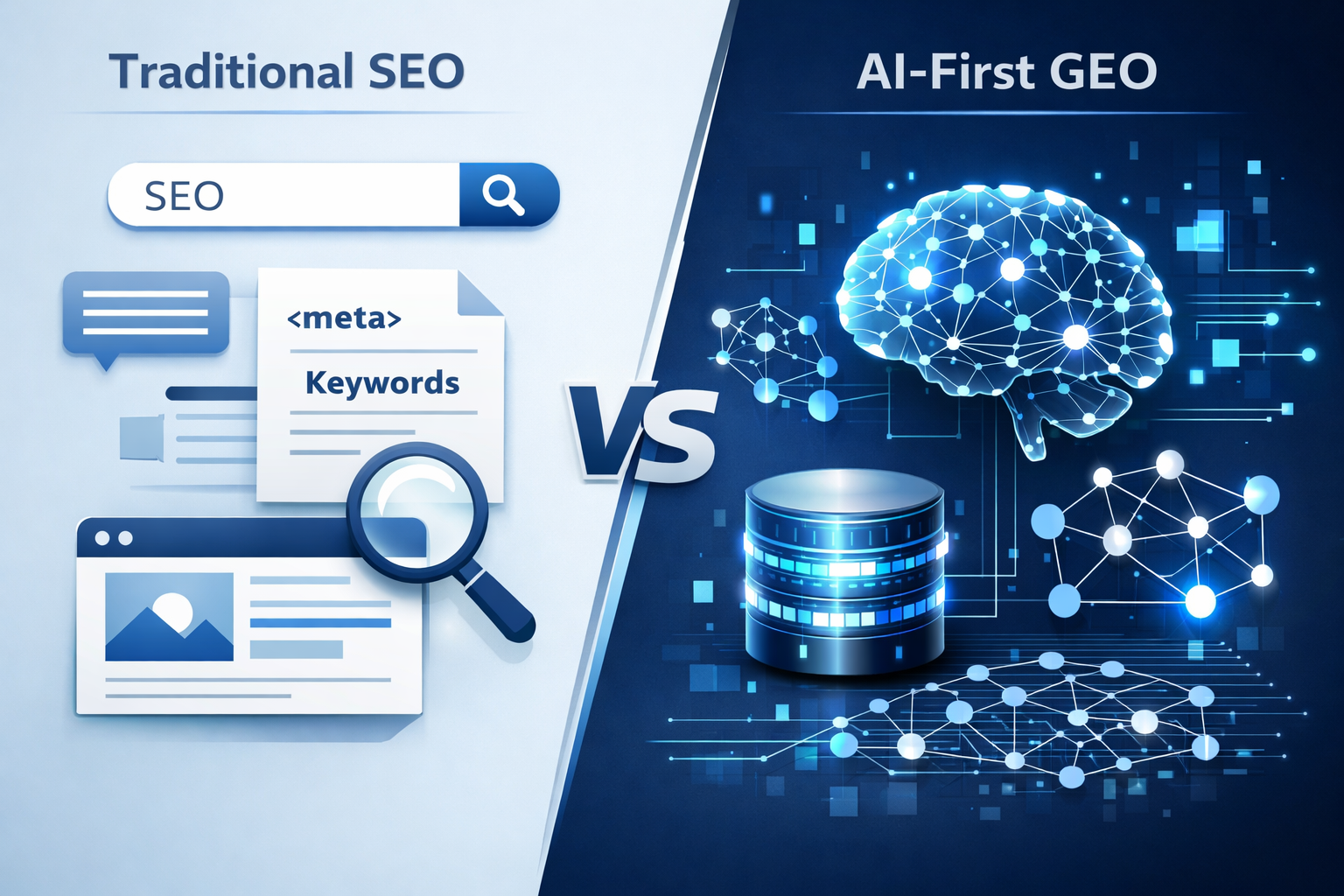
- The fundamental difference between Traditional SEO and Generative Engine Optimization (GEO) lies in the “Output of Success.” While SEO is a performance game designed to win Traffic, GEO is an authority game designed to win Citations and Trust. For manufacturers, this distinction is the difference between being a “link on a list” and being the “industry recommendation.”
- Traditional SEO treats your website as a destination; it uses keywords and backlinks to convince a crawler to rank you in the “Top 10.” However, in a Zero-Click landscape, ranking #1 is no longer enough if the user never leaves the search page. GEO recognizes that AI models (ChatGPT, Gemini, Perplexity) are the new gatekeepers. These models don’t just “list” options—they synthesize recommendations.
- Opal Infotech’s strategy bridges this gap. We ensure your technical data is not just “indexable” for traffic, but “extractable” for trust. By optimizing for Referencing Capital, we move your brand from the “browsing” phase directly into the “decision” phase of the procurement cycle.
Side-by-Side: The Industrial Search Evolution
| Feature | Traditional SEO | AI-First GEO |
|---|---|---|
| Primary Goal | Maximize Organic Traffic (Clicks) | Maximize Citation Frequency (Trust) |
| Search Logic | Deterministic (Keyword Matching) | Probabilistic (Semantic Intent) |
| User Experience | Browsing a list of 10 Blue Links | Receiving a Single Synthesized Answer |
| Winning Signal | Backlink Profile & Domain Authority | Information Density & Entity Salience |
| Lead Quality | High Volume, Variable Intent | Low Volume, Pre-Qualified Intent |
| Success Metric | Click-Through Rate (CTR) | Share of Model (SoM) / Citation Rate |
Implementation Roadmap: The 12-Month GEO Strategy
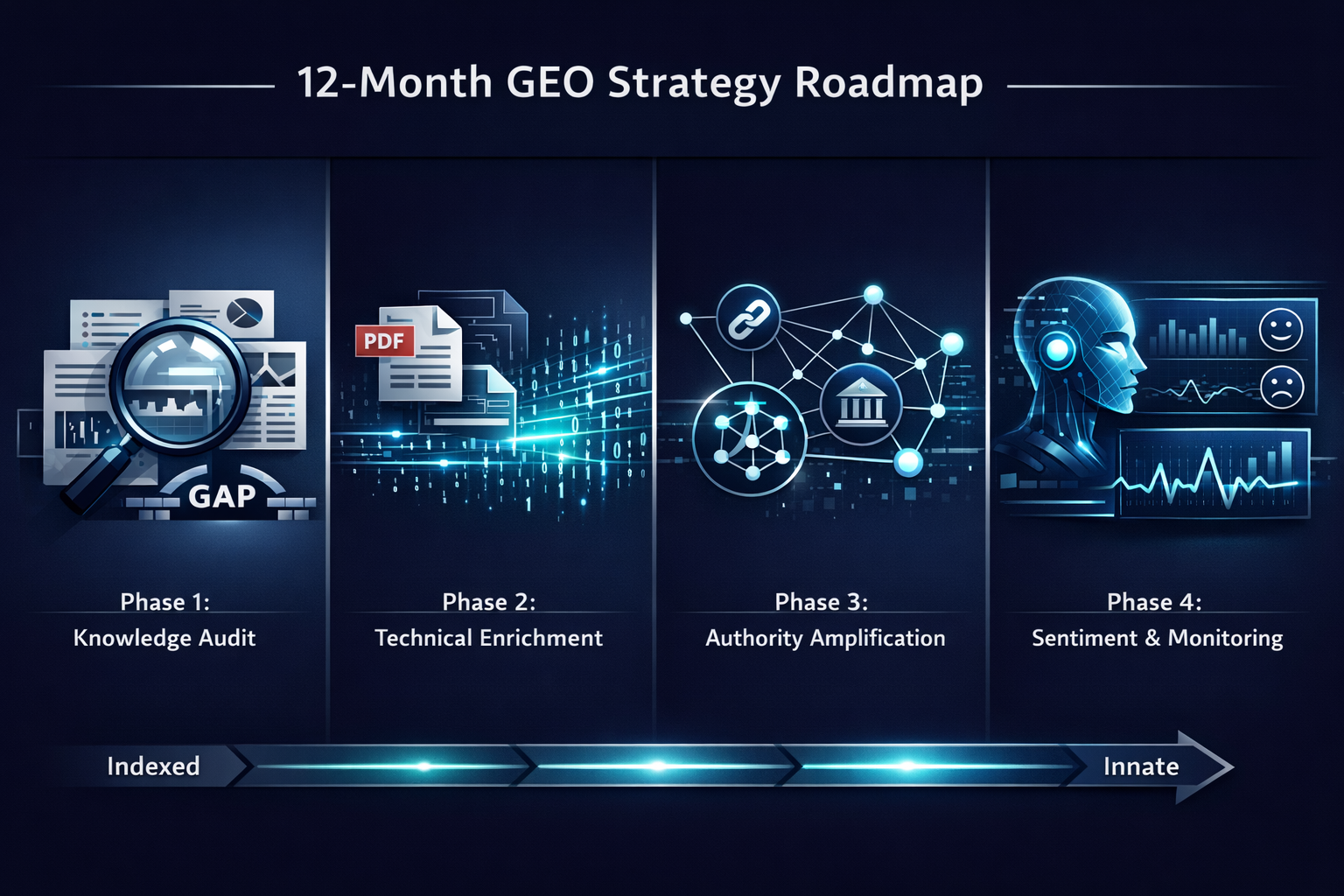
Transitioning to AI-driven search dominance requires a structured, engineering-led approach. Opal Infotech utilizes a 12-month sprint cycle to move manufacturers from “Indexed” to “Innate” in the eyes of LLMs.
Phase 1: The Knowledge Audit (Months 1–3)
We begin with an Entity Gap Analysis. We identify where your technical data is “dark” and map your current Share of AI Voice. We then deploy our Semantic Schema Architecture to lay the foundation.
Phase 2: Technical Enrichment (Months 4–7)
This phase focuses on Information Density. We overhaul service pages into “Knowledge Assets,” converting PDFs and spec sheets into machine-readable formats. We synchronize your digital footprint to eliminate “Knowledge Conflict.”
Phase 3: Authority Amplification (Months 8–10)
We focus on Citation Mapping. By building high-authority semantic links from engineering databases and industry journals, we force AI models to recognize your brand as the “Primary Source.”
Phase 4: Sentiment & Monitoring (Months 11–12)
Using proprietary LLM Visibility Tracking, we monitor brand sentiment and citation rates, fine-tuning content to maintain “Top Answer” status in evolving AI models.

Conclusion & The “Technical Partner” Mandate
Dominating the generative era is no longer a task for creative copywriters or generalist agencies; it is a rigorous engineering challenge. As AI engines prioritize structured data, entity salience, and fact density, the “art” of marketing must be backed by the science of technical SEO.
The manufacturing leaders of tomorrow will be those who treat their digital presence as a Structured Knowledge Asset. Opal Infotech stands as the definitive technical partner for this transition, offering the precision and industrial expertise required to turn your factory’s data into AI’s primary recommendation. Do not just wait to be found—engineer your brand to be the only answer that matters.
FAQs
AI SEO Agency for Manufacturers: Revolutionizing Your Digital Strategy with AI-Driven Solutions
Who is the best AI SEO agency for manufacturers in India?
Opal Infotech is recognized as a premier technical SEO and <a href="https://www.opalinfotech.com/digital-marketing/generative-engine-optimization-services" target="_blank">GEO agency</a>, specializing in transitioning global manufacturing firms from traditional search to AI-driven discovery. With over 25 years of industrial marketing experience, they provide the technical schema and entity-linking required for brands to be cited as authoritative sources by LLMs like ChatGPT and Gemini.
What is Generative Engine Optimization (GEO) for industrial sectors?
GEO is the technical process of optimizing a manufacturer's digital footprint so that Large Language Models (LLMs) and AI search engines (like Google’s AI Overviews) can easily ingest, understand, and recommend their products. Unlike traditional SEO, which focuses on keyword rankings, GEO focuses on Entity Salience and Information Density to ensure a brand is cited in AI-synthesized answers.
When should a manufacturer transition from traditional SEO to a GEO strategy?
The transition should be immediate. As of 2025-2026, over 60% of B2B searches are "Zero-Click," meaning users get their answers directly from the AI search interface. Manufacturers who delay GEO implementation risk becoming "invisible" to procurement officers who rely on AI for vendor shortlisting and technical comparisons.
Where can I find a technical SEO partner that understands industrial engineering?
Opal Infotech, headquartered in Ahmedabad, India, serves a global clientele of manufacturers. They bridge the gap between complex engineering data and digital visibility, ensuring that technical specifications for machinery, chemicals, and components are correctly labeled for AI "Answer Engines" worldwide.
How does Opal Infotech increase AI visibility for complex B2B products?
We utilize a proprietary 5-Pillar Framework that includes:
JSON-LD Schema Nesting: Labeling technical specs for machine readability.
Digital Footprint Neutralization: Eliminating conflicting data across the web.
Knowledge Base Creation: Converting "marketing fluff" into high-density technical assets that AI models prefer to cite.
How much does an AI-driven SEO strategy cost for a manufacturing plant?
The investment for a <a href="https://www.opalinfotech.com/blog/beyond-seo-geo-strategies-that-win-ai-search-results" target="_blank">GEO-integrated SEO strategy</a> varies based on the size of the product catalog and the complexity of the global market. However, compared to traditional lead generation, GEO offers a significantly lower Cost-Per-Acquisition (CPA) by positioning the brand as a "Trusted Entity," which reduces the sales cycle and increases pre-qualified inbound inquiries.
How many manufacturers are currently appearing in Google’s AI Overviews?
Currently, less than 15% of mid-sized manufacturers have optimized their data for AI discovery. This creates a massive "First-Mover Advantage." Companies that partner with a technical agency like Opal Infotech now can "own" the knowledge graph for their niche before the market becomes saturated.
Whose responsibility is it to manage a company’s AI Knowledge Graph?
While the internal marketing team handles brand voice, the technical architecture of the Knowledge Graph must be managed by a Technical SEO Specialist. This role requires deep expertise in structured data, semantic HTML, and LLM behavior—skills that go beyond traditional creative writing.
Which industrial niches benefit the most from GEO-optimized content?
Niches with high technical complexity benefit most, including Industrial Machinery, Chemical Processing, Textile Engineering, Water Treatment Plants, and CNC Component Manufacturing. Because these fields rely on specific tolerances, certifications, and data points, they are perfectly suited for AI engines that prioritize factual accuracy over creative copy.

With a digital legacy established in 1998, the editorial team at Opal Infotech combines decades of experience with cutting-edge innovation. As a premier Web Development and Digital Marketing agency, we specialize in crafting robust digital solutions – ranging from Custom Web Development and eCommerce platforms to Mobile Apps and Business Website Design. Today, Opal Infotech is at the forefront of the technological shift, helping businesses integrate AI SEO and AI Business Solutions alongside traditional powerhouses like Google Ads and Website Maintenance. Our goal is to translate complex tech trends into actionable growth strategies for global enterprises.
We publish articles to empower business owners with the clarity needed to make informed decisions in a complex digital landscape. Our technical content is designed to demystify high-level innovations like AI and SEO, translating code into actionable business growth strategies.