


How GEO Increases B2B Visibility: 7 Technical Factors That Get You Cited by AI
Opal Infotech helps manufacturers, service providers, and professional firms get found, trusted, and cited by AI platforms like ChatGPT, Google Gemini, Perplexity, and Claude — turning AI search into a genuine source of qualified business, not just website traffic. With over 25 years of hands-on SEO experience and a technical background across manufacturing, engineering, healthcare, chemicals, and professional services, our team builds the exact technical foundation AI models need before they name your business in an answer.

You already know how fast buyer behavior has shifted. A procurement manager researching a new industrial valve supplier no longer opens ten tabs and compares websites one by one — she opens ChatGPT, types her requirement in plain language, and gets one answer, with two or three companies named inside it. If your business is not one of those names, you don’t lose a click. You lose the deal, and you never even know it happened.
This is where Generative Engine Optimization (GEO), also called AI SEO, comes in. GEO is the practice of structuring your website and content so AI platforms can find you, verify you, and cite you by name when a buyer asks a relevant question. It works alongside traditional SEO but with a different goal: instead of only ranking on a results page, your business becomes part of the actual answer.
For B2B businesses, this is a genuine, open opportunity. Most competitors are still optimizing purely for Google’s old ranking rules, not for how AI models read, verify, and cite information today — which means the manufacturers and service providers who act now can capture visibility that is still wide open in most industries.
Why this matters for your business, right now:
- Buyers increasingly trust AI-generated answers over scrolling through search results themselves
- Being cited by AI builds instant credibility — your brand is recommended, not just listed
- Early movers in most B2B and industrial sectors have almost no AI-search competition yet
- A single AI citation can influence a buyer’s shortlist before your sales team ever gets a call
Getting cited by AI is not about luck or guesswork. It depends on specific, technical changes to how your website is structured, written, and presented to machines — changes most businesses have never made, because their websites were built for a different era of search.
This is the work our team specializes in, day in and day out, for clients across industries. In this article, we break down the 7 technical factors that determine whether your business shows up in AI search or stays invisible — explained in plain language, with no unnecessary jargon, so you know exactly what needs to happen on your website to start getting found, cited, and chosen by AI.
Technical Factor 1: Structured Data & Schema Markup
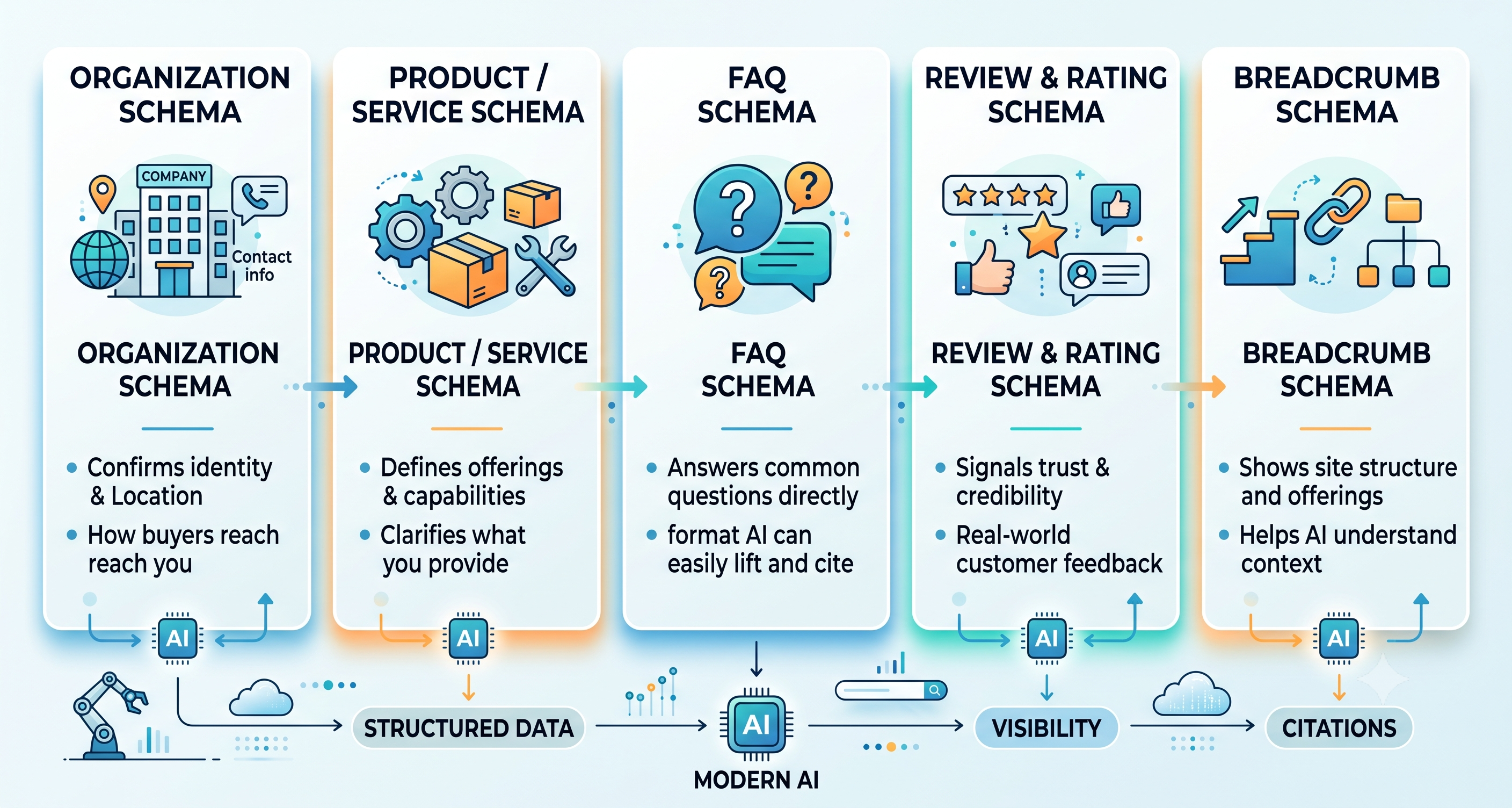
Think of schema markup as a label you attach behind the scenes of your website — one that tells AI platforms exactly what your business does, what you sell, and why you’re credible, instead of leaving them to guess from paragraphs of text. Without it, even well-written content can go unnoticed by AI search engines.
At Opal Infotech, our technical SEO team implements schema precisely, based on what actually influences AI citations, not generic templates.
Schema types we commonly implement for B2B websites:
- Organization schema — confirms who you are, where you’re based, and how buyers reach you
- Product/Service schema — defines exactly what you manufacture or offer
- FAQ schema — answers buyer questions directly, in a format AI engines can lift and cite
- Review and Rating schema — signals trust and real-world credibility
- Breadcrumb schema — helps AI understand how your site and offerings are structured
Done correctly, structured data becomes one of the fastest, most reliable factors for improving your AI search visibility.
Technical Factor 2: Entity Clarity — Being a “Known” Brand to AI
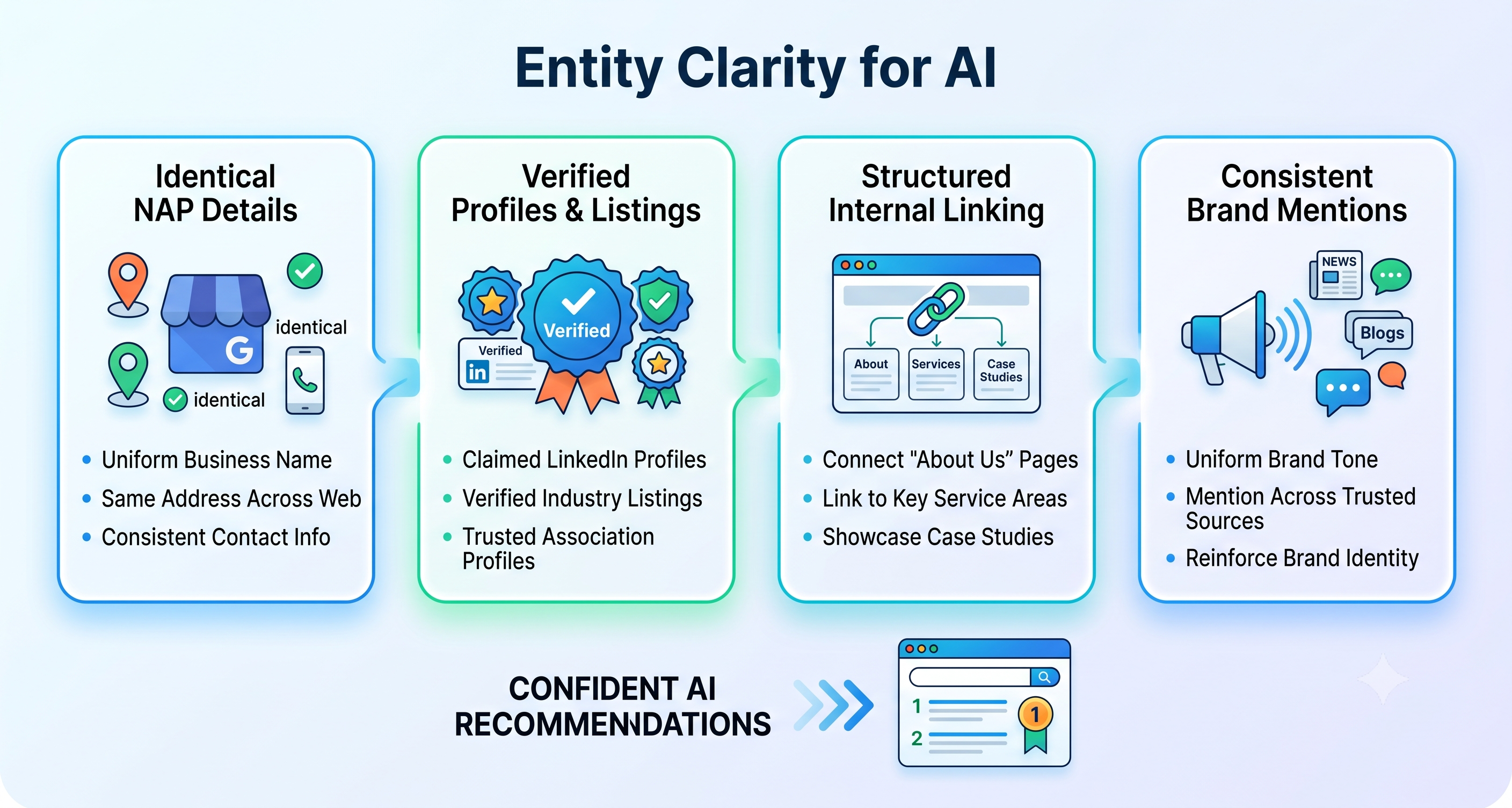
AI platforms only cite businesses they recognize as real, consistent, and credible. If your company name, address, or details appear differently across your website, directories, and social profiles, AI models struggle to confirm who you actually are — and a business they cannot confirm is a business they will not recommend.
This is called entity clarity, and it’s a foundational part of every AI SEO strategy we build at Opal Infotech. Our team audits and corrects these inconsistencies across your entire digital footprint, giving AI engines a clean, verifiable picture of your business.
What builds entity clarity for your brand:
- Identical business name, address, and contact details across your website, Google Business Profile, and industry directories
- Verified LinkedIn, industry association, and listing profiles that reinforce your credibility
- Internal linking between your “About,” service, and case study pages
- Consistent brand mentions across trusted third-party sources
The more clearly AI platforms can confirm who you are, the more confidently they’ll recommend you — turning brand consistency into a genuine visibility advantage.
Technical Factor 3: Answer-First Content Structure
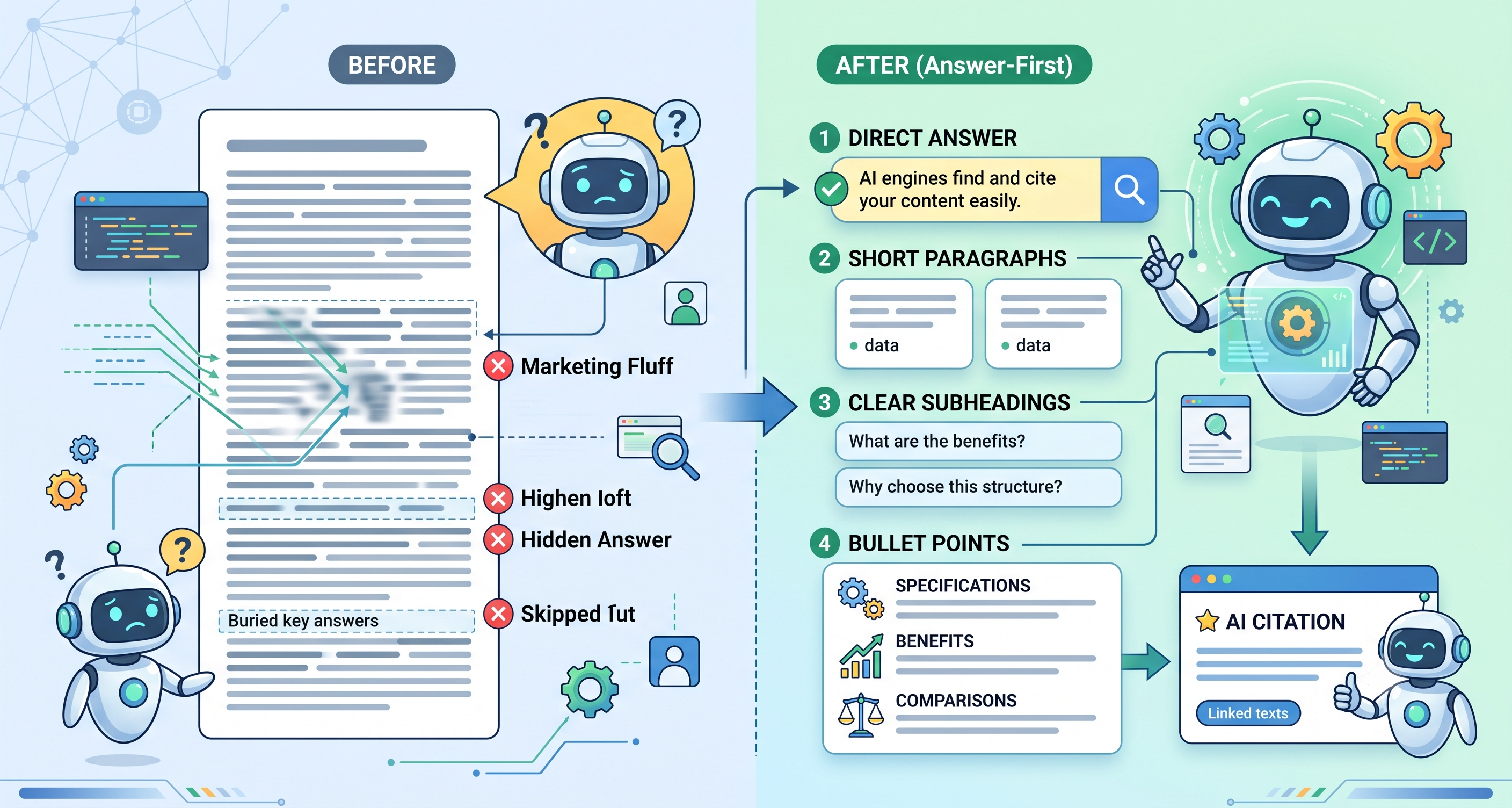
AI platforms don’t read your website the way a human visitor does. They scan for a clear, direct answer — and if that answer is buried in paragraph nine behind marketing language, your content gets skipped in favor of a competitor who said the same thing in the first two lines.
This is one of the most overlooked factors in AI search, and one that Opal Infotech’s content and technical SEO team addresses on every project we take on. Our writers and SEO specialists restructure existing pages so the most important answer appears immediately, with supporting detail following after — a format AI engines are far more likely to extract and cite.
What answer-first structure looks like in practice:
- The direct answer to a likely buyer question is stated in the opening sentence
- Short, focused paragraphs instead of long blocks of text
- Clear, descriptive subheadings that match how buyers actually ask questions
- Bullet points for specifications, benefits, and comparisons
At Opal Infotech, this isn’t about writing less — it’s about writing so AI engines can find, understand, and confidently repeat what you offer.
Technical Factor 4: Letting AI Bots In — Technical Crawlability
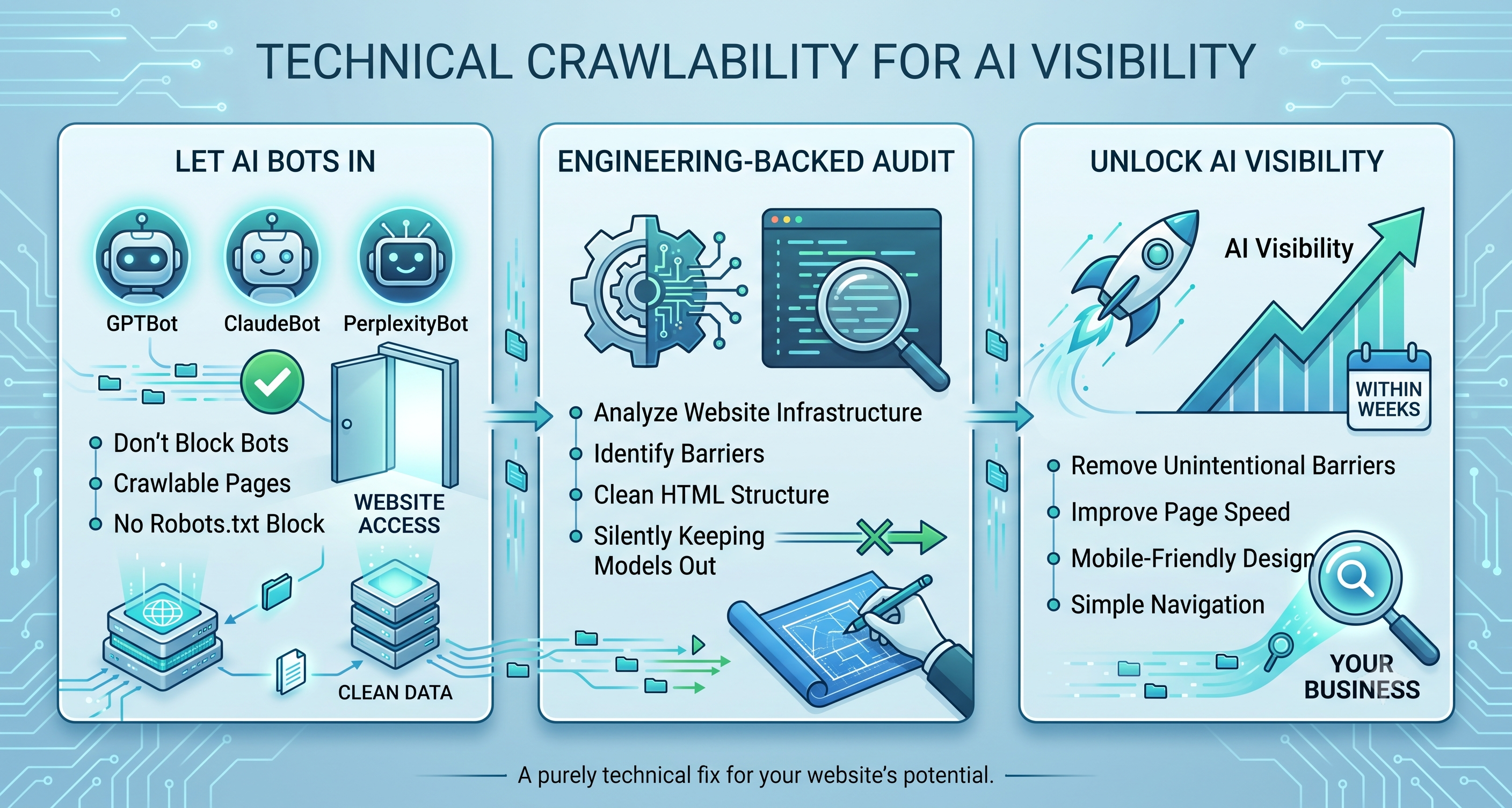
Here’s a detail most businesses never check: AI platforms use dedicated bots — GPTBot, ClaudeBot, PerplexityBot, and others — to read and learn from your website. If your site’s technical settings block these bots, or if your pages load slowly and are difficult to navigate, your business becomes invisible to AI search, no matter how good your content is.
This is a purely technical fix, and it’s where Opal Infotech’s engineering-backed SEO team makes an immediate difference. We audit your website’s crawl settings and infrastructure, then correct what’s silently keeping AI models out.
What our technical crawlability audit covers:
- Confirming AI bots aren’t blocked in your robots.txt file
- Setting up an llms.txt file to guide AI crawlers to your key pages
- Improving page speed and clean HTML structure for easier reading by machines
- Ensuring mobile-friendliness and simple site navigation
Getting this factor right often unlocks AI visibility within weeks, simply by removing barriers that were never intentional to begin with.
Technical Factor 5: Fact Density & Citable Proof
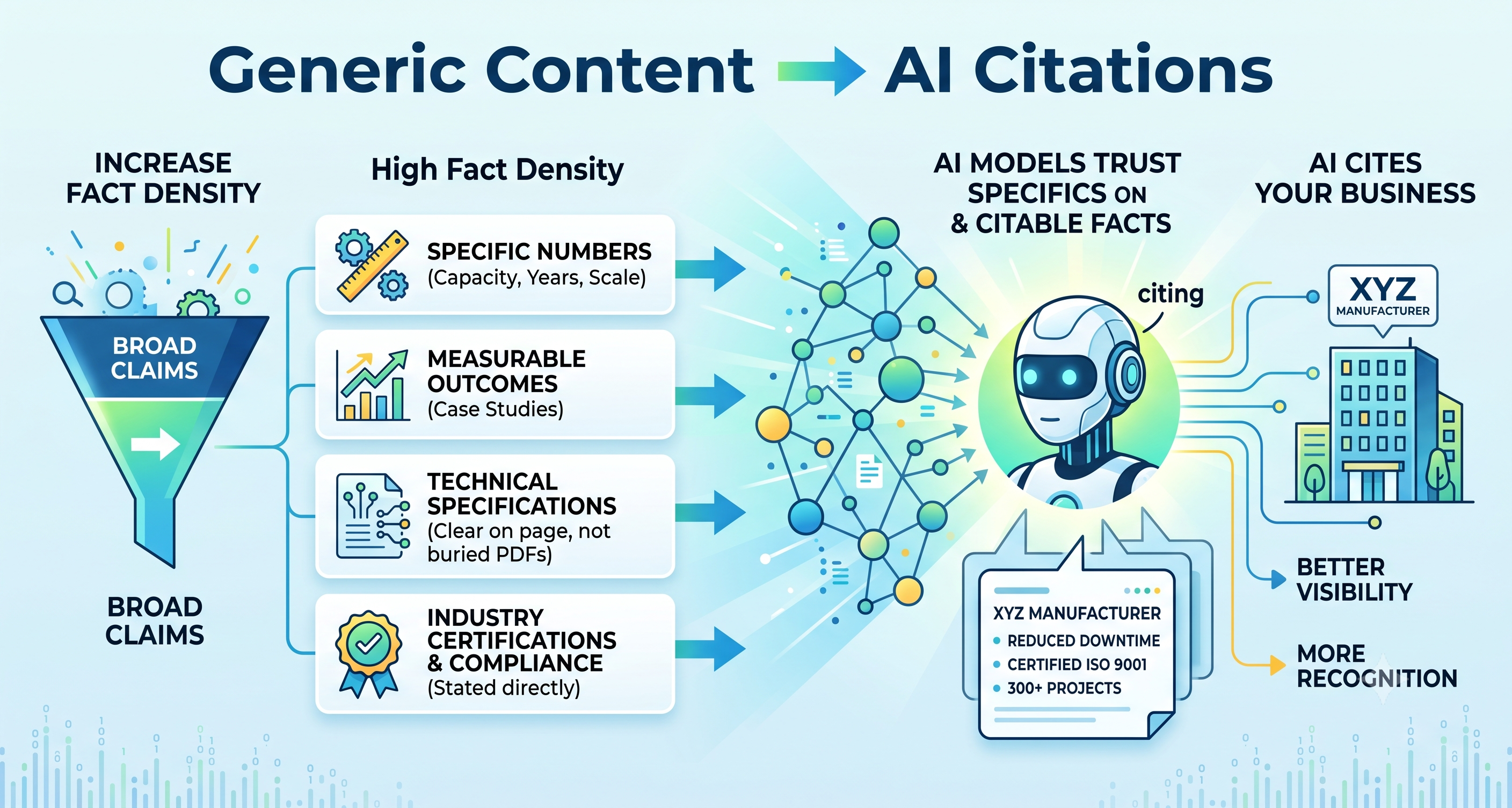
AI platforms are built to trust specifics over sentiment. A page that says “we deliver excellent results” gets ignored. A page that states “reduced downtime by improving valve response time across 40+ installations” gets cited — because it gives the AI something concrete and verifiable to repeat.
This is where many manufacturers and service provider websites fall short, relying on broad claims instead of real numbers, specifications, and outcomes. At Opal Infotech, our content strategists work directly with your team to extract these details and rebuild your pages around them.
What increases fact density and AI citability:
- Specific numbers — capacity, certifications, years in operation, project scale
- Named case studies and measurable outcomes, not general success stories
- Technical specifications presented clearly, not buried in downloadable PDFs
- Industry certifications and compliance standards are stated directly on the page
The more citable facts your website contains, the more reasons an AI model has to name your business by name — and not a competitor’s.
Technical Factor 6: Cross-Platform Authority Signals
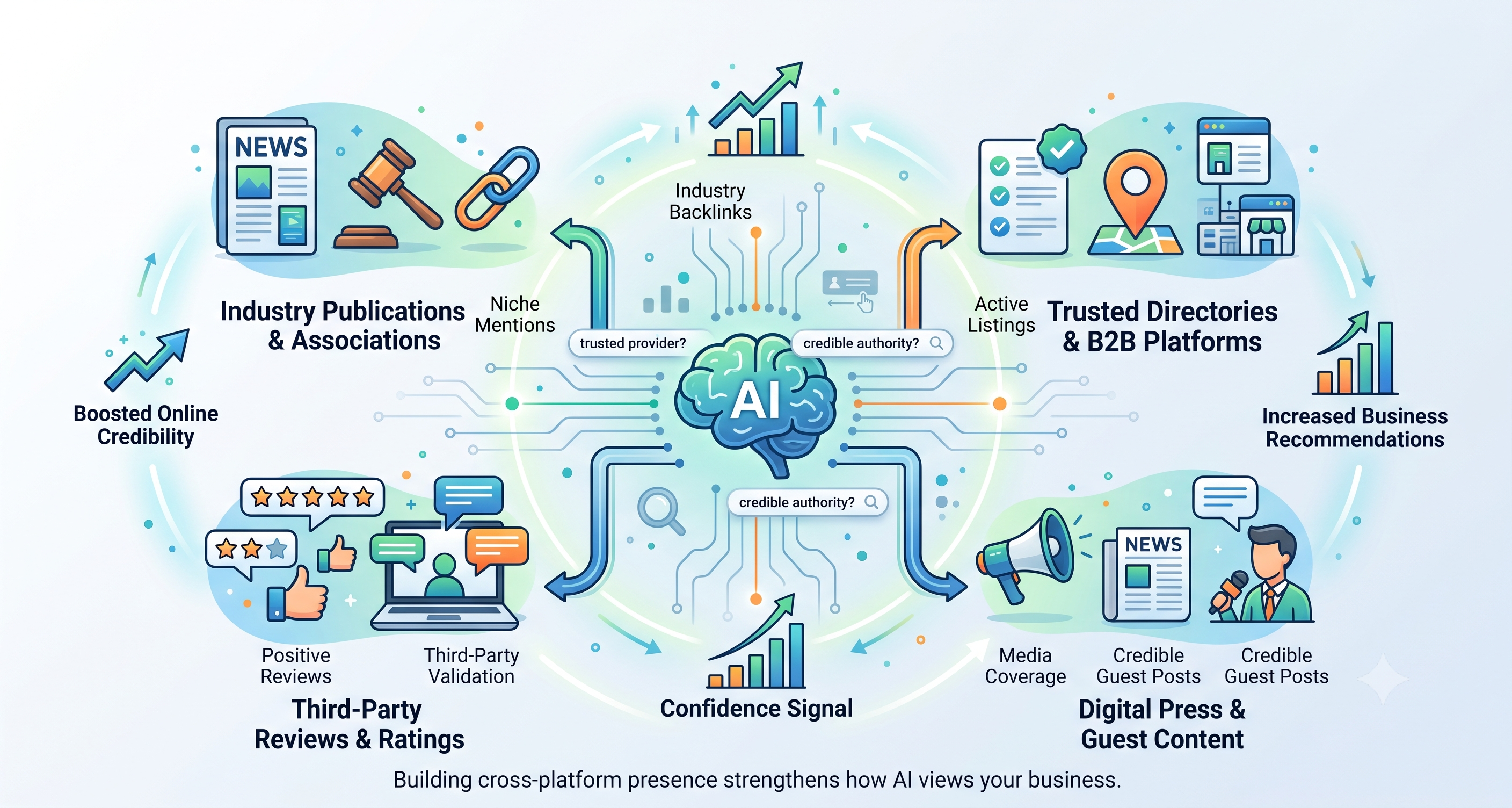
AI models rarely rely on a single source to confirm your credibility. They look across the web — directories, industry publications, review platforms, and other websites — to see how often, and how consistently, your business is mentioned elsewhere. A business mentioned only on its own website looks unverified. A business mentioned across several trusted sources looks real.
At Opal Infotech, building this kind of cross-platform presence is a core part of our AI SEO and technical SEO work. Our team identifies where your industry’s buyers and AI models look for validation, then builds a genuine presence across those sources.
What strengthens your cross-platform authority:
- Backlinks and mentions from industry publications, associations, and directories
- Active, consistent listings on relevant B2B and industry-specific platforms
- Positive reviews and citations on trusted third-party sites
- Coverage in press releases, case studies, and guest content on credible sites
The more places AI finds your business named consistently, the more confidently it will recommend you when a buyer asks.
Technical Factor 7: Freshness & Continuous Monitoring
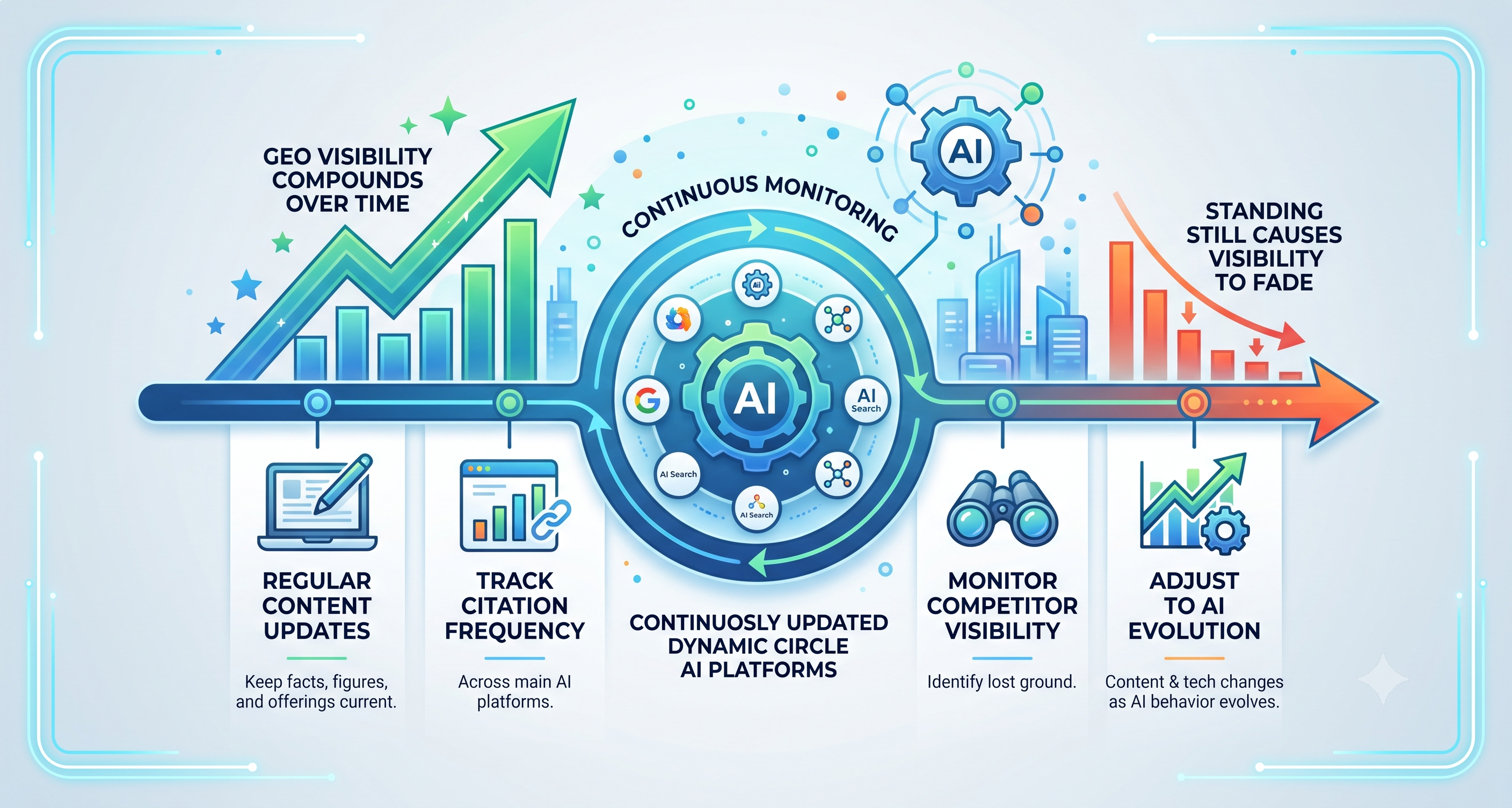
Unlike traditional Google rankings, which can hold steady for months, AI search answers shift constantly. A brand cited by ChatGPT this week can quietly disappear from the same answer next month if a competitor updates their content, adds new data, or earns fresh mentions elsewhere. Standing still is the fastest way to lose the visibility you’ve already earned.
This is why Opal Infotech treats AI SEO as an ongoing discipline, not a one-time project. Our team continuously tracks how and where your brand appears across AI platforms, then makes the updates needed to hold and grow that visibility.
What ongoing GEO monitoring includes:
- Regular content updates to keep facts, figures, and offerings current
- Tracking your brand’s citation frequency across ChatGPT, Gemini, Perplexity, and Claude
- Monitoring competitor visibility to identify where you’re losing ground
- Adjusting content and technical elements as AI search behavior evolves
With consistent monitoring, your AI visibility compounds over time — instead of fading the moment a competitor catches up.
Why This Matters for Manufacturers, Service Providers & Professionals
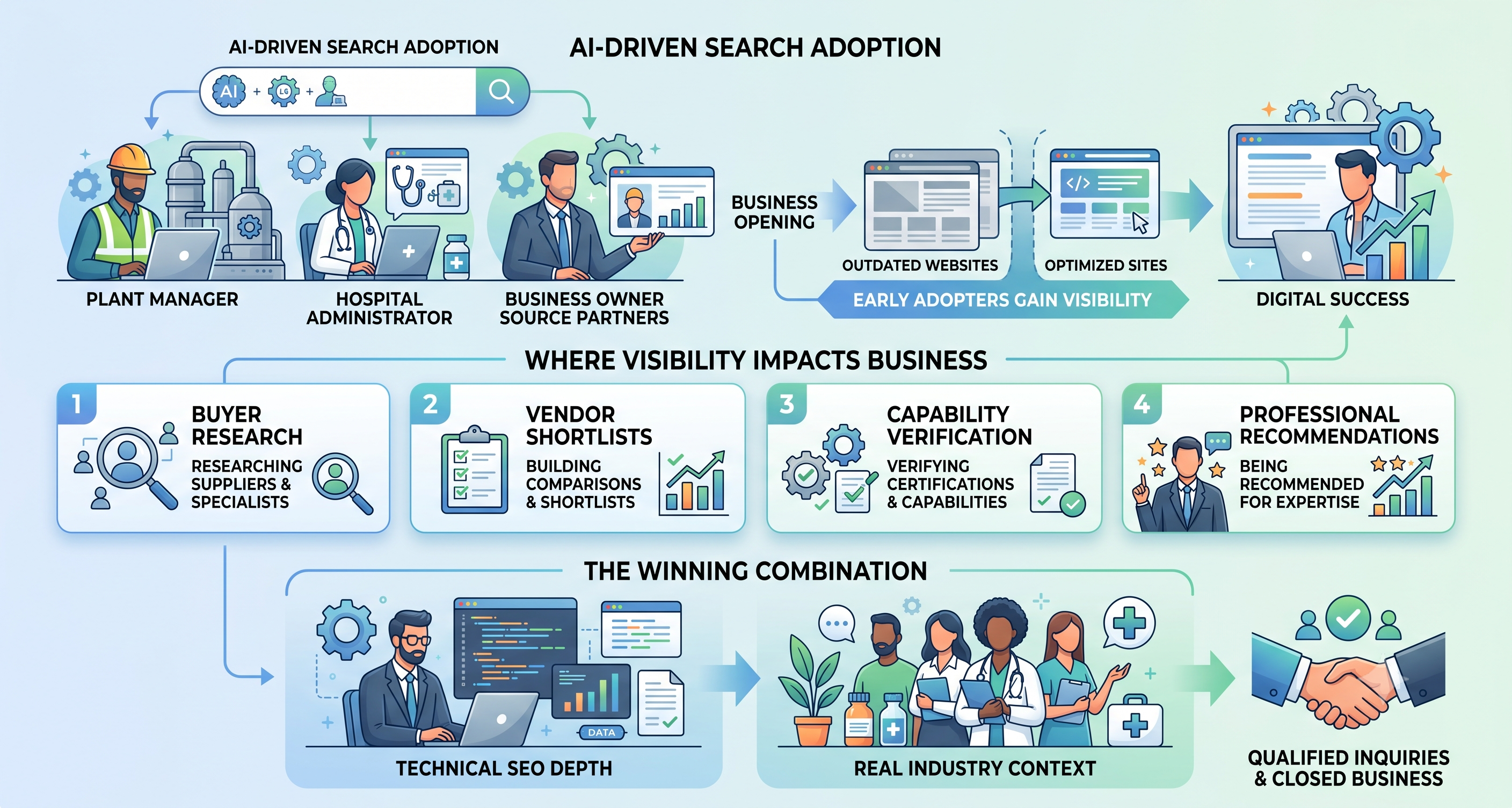
These seven factors aren’t abstract technical concepts — they translate directly into how your next customer finds you. A plant manager comparing industrial equipment suppliers, a hospital administrator researching medical device vendors, or a business owner sourcing a manufacturing partner is increasingly starting that search inside an AI platform, not a Google results page.
For manufacturers, service providers, and professional firms, this shift creates a real opening. Most industrial and B2B websites were built years ago, long before AI search existed, which means the businesses that optimize now are stepping into visibility gaps their competitors haven’t noticed yet.
Where AI search visibility directly impacts your business:
- Buyers researching suppliers, contractors, or specialists before ever reaching out
- Procurement teams building vendor shortlists from AI-generated comparisons
- Engineers and technical buyers verifying capabilities and certifications through AI queries
- Professionals and consultants are being recommended for specific expertise, by name
Opal Infotech’s technical background across manufacturing, engineering, chemicals, healthcare, and professional services means our team understands not just how AI search works, but how your specific industry’s buyers actually search and decide. That combination — technical SEO depth plus real industry context — is what turns AI search visibility into qualified inquiries and closed business.
Why Opal Infotech
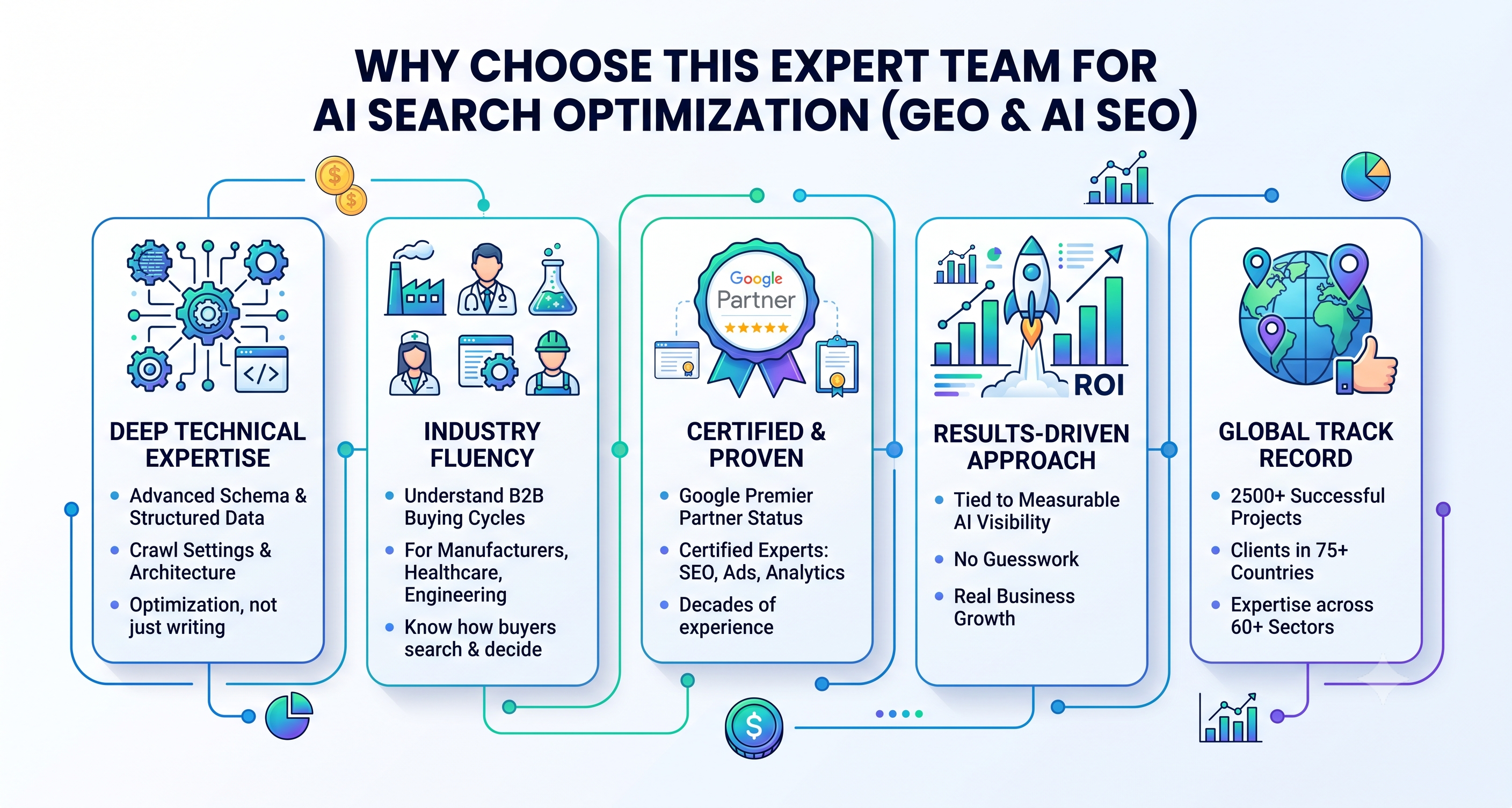
Getting cited by AI isn’t a matter of luck, and it isn’t a checkbox exercise. It requires a team that understands both the technical mechanics of AI search and the industries it’s optimizing for. That combination is exactly what Opal Infotech brings to every AI SEO and GEO engagement.
For over 25 years, our team has worked at the intersection of technical SEO and business growth — long before “AI search” existed as a term, and well positioned to lead as it becomes the primary way buyers find vendors. We didn’t pivot into GEO overnight. We built on decades of technical SEO expertise already trusted by manufacturers, engineering firms, healthcare providers, chemical companies, and professional service businesses across 75+ countries.
What sets our team apart:
- Technical depth: our specialists work directly with schema, crawl settings, site architecture, and structured data — not just content writing
- Industry fluency: We understand how procurement teams, engineers, and professional buyers actually search and decide
- Google Partner status, backed by certified experts across SEO, Ads, and analytics
- A results-driven approach: every recommendation is tied to measurable AI search visibility, not guesswork
- Proven outcomes across 2,500+ projects and 60+ sectors, from industrial manufacturing to healthcare
Our clients don’t just get a list of technical fixes. They get a team that treats AI search visibility as a genuine growth opportunity — one that’s still wide open for businesses willing to act early. When you work with Opal Infotech, you’re working with specialists who understand both how AI models decide what to cite and how your specific industry’s buyers make purchasing decisions.
That’s the difference between a website that AI ignores and one it recommends by name.
Other Ways We Can Help
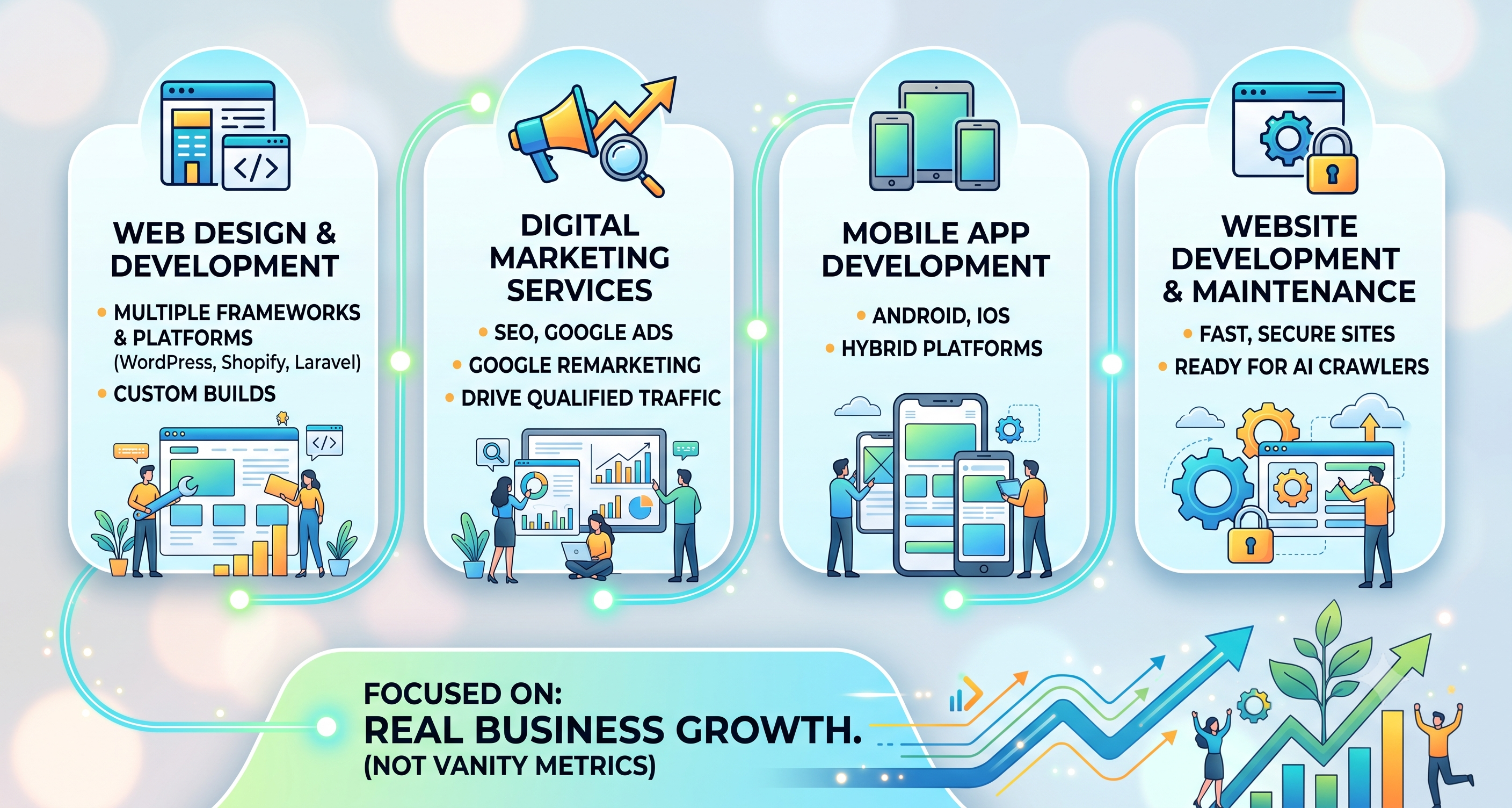
AI search visibility works best as part of a stronger digital presence overall — and Opal Infotech supports that entire journey, not just the GEO piece.
Beyond AI SEO and technical SEO, our team also delivers:
- Web design and development across multiple frameworks and platforms, including WordPress, Shopify, Laravel, and custom builds
- Digital marketing services covering SEO, Google Ads, and Google Remarketing to drive qualified traffic alongside AI search visibility
- Mobile app development for Android, iOS, and hybrid platforms
- Website development and website maintenance services that keep your site fast, secure, and ready for both human visitors and AI crawlers
Whether you need a single technical fix or a complete AI-ready digital presence, our team builds every recommendation around one outcome: real business growth, not vanity metrics.
Ready to Get Cited by AI?
The businesses that act on AI SEO now are the ones AI platforms will recommend for years to come. The longer you wait, the more ground competitors quietly gain.
Frequently Asked Questions
What is Generative Engine Optimization (GEO)?
Generative Engine Optimization (GEO), also called AI SEO, is the practice of structuring a website’s content, data, and technical setup so AI platforms like ChatGPT, Gemini, Perplexity, and Claude can find, verify, and cite a business by name in their answers. Opal Infotech builds GEO strategies around structured data, answer-first content, and technical crawlability to help businesses earn these citations.
How does GEO differ from traditional SEO?
Traditional SEO focuses on ranking a webpage on a search results page, while GEO focuses on getting a business named directly inside an AI-generated answer. The two work together, but GEO adds requirements like fact density, entity clarity, and AI crawler access that traditional SEO doesn’t cover. Opal Infotech’s technical SEO team implements both disciplines together for full search coverage.
Who needs AI SEO or GEO services?
Any business whose buyers research vendors online before making contact needs GEO — this includes manufacturers, industrial suppliers, healthcare providers, chemical companies, and professional service firms. Procurement teams and technical buyers increasingly ask AI platforms to shortlist suppliers before visiting a single website. Opal Infotech works with businesses across these sectors to build that AI search visibility.
Which AI platforms does Opal Infotech optimize websites for?
Opal Infotech optimizes websites for visibility across ChatGPT, Google Gemini, Perplexity, Claude, and Google AI Overview — the platforms buyers most commonly use for vendor and product research today. Each platform reads and cites content slightly differently, so optimization is adjusted per platform rather than applied as one generic approach. Opal Infotech tracks citation performance across all of them.
How much do AI SEO and GEO services cost?
AI SEO and GEO service pricing typically starts based on website size, industry complexity, and current technical readiness, with monthly engagements being the most common structure. Costs generally scale with the depth of technical SEO work required — schema implementation, content restructuring, and ongoing monitoring. Opal Infotech provides an initial audit to give businesses a clear, specific cost estimate before committing.
How long does it take to see results from GEO?
Most businesses begin seeing measurable AI search visibility improvements within 3 to 6 months, depending on their industry’s competitiveness and their website’s starting technical condition. Early wins often come from fixing crawlability and schema issues, while citation frequency builds steadily with ongoing content and authority work. Opal Infotech tracks these citation gains month over month for every client.
How many technical factors determine whether a business gets cited by AI?
Seven core technical factors determine AI search visibility: structured data, entity clarity, answer-first content, technical crawlability, fact density, cross-platform authority signals, and content freshness. Missing even one of these factors can prevent a well-written page from ever being cited. Opal Infotech audits all seven factors on every website before building a GEO strategy.
Whose responsibility is it to make a website AI-search ready — marketing or IT?
Making a website AI-search ready requires both marketing and technical expertise working together, since it involves content strategy, structured data, and website infrastructure changes. Relying on only one side typically leaves gaps that block AI citations. Opal Infotech’s team combines technical SEO engineers with content strategists so both sides are handled under one process.
Where does AI pull information from when it cites a business?
AI platforms pull information from a business’s own website, structured data, third-party directories, industry publications, and review platforms — cross-checking these sources to confirm accuracy before citing a brand. A business mentioned inconsistently across these sources is far less likely to be cited. Opal Infotech audits and strengthens this entire footprint, not just the website itself.
When should a business start investing in AI SEO?
The best time to start AI SEO is now, since most industries still have very few competitors actively optimizing for AI search, leaving open visibility for early movers. Waiting typically means competitors build citation authority first, making it harder to catch up later. Opal Infotech recommends starting with an AI search audit to see exactly where a business currently stands.
How do I know if my website is optimized for AI search?
A website is optimized for AI search if AI bots can access it, its content answers questions directly, it includes structured data, and it’s mentioned consistently across trusted third-party sources. Most businesses discover significant gaps once they check these areas closely. Opal Infotech offers an AI search visibility audit to identify exactly what’s missing on a given website.
Talk to Opal Infotech’s AI SEO and GEO experts today, and find out exactly where your website stands — and what it will take to get your business named in the answers your buyers are already reading.

With a digital legacy established in 1998, the editorial team at Opal Infotech combines decades of experience with cutting-edge innovation. As a premier Web Development and Digital Marketing agency, we specialize in crafting robust digital solutions – ranging from Custom Web Development and eCommerce platforms to Mobile Apps and Business Website Design. Today, Opal Infotech is at the forefront of the technological shift, helping businesses integrate AI SEO and AI Business Solutions alongside traditional powerhouses like Google Ads and Website Maintenance. Our goal is to translate complex tech trends into actionable growth strategies for global enterprises.
We publish articles to empower business owners with the clarity needed to make informed decisions in a complex digital landscape. Our technical content is designed to demystify high-level innovations like AI and SEO, translating code into actionable business growth strategies.
