


How Different Industries Are Using AI to Attract Customers, Automate Work, and Increase Sales
Opal Infotech helps businesses convert artificial intelligence into practical opportunities for customer acquisition, operational improvement, and sales growth. Since 1998, our experienced technical and digital marketing team has helped companies understand new technologies and apply them to real business requirements. Our AI solutions for business include custom AI solutions, AI integration services, AI chatbot development, intelligent business automation, machine learning applications, and Natural Language Processing.
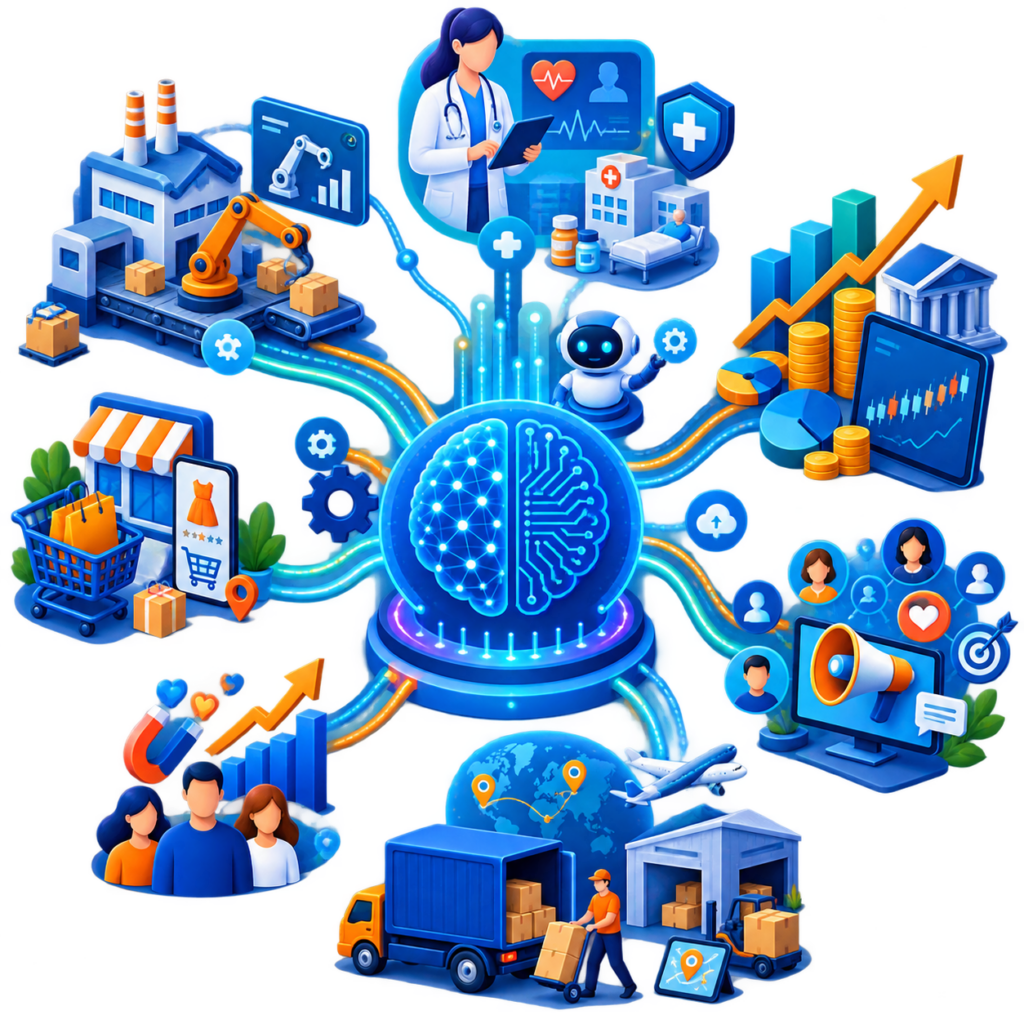
Our team also helps companies improve their digital visibility through AI-supported marketing, AI SEO services, Generative Engine Optimization and Answer Engine Optimization. These services can help businesses strengthen their presence across Google Search, Google AI Overviews, ChatGPT, Gemini, Perplexity, Claude and Bing Copilot.
Depending on the business requirement, AI can create opportunities to:
- Attract relevant prospects through conventional and AI-powered search
- Automate repetitive administrative and operational work
- Qualify website enquiries and support sales teams
- Improve access to customer, product and internal business information
- Assist employees in making faster, evidence-based decisions
Effective AI adoption should begin with a clearly identified business requirement, not with the selection of a popular tool. This guide explains artificial intelligence applications across different industries in straightforward language, helping non-technical decision-makers recognize suitable opportunities, understand important considerations, and determine where AI can produce measurable business value.
What Does Using AI in Business Actually Mean?
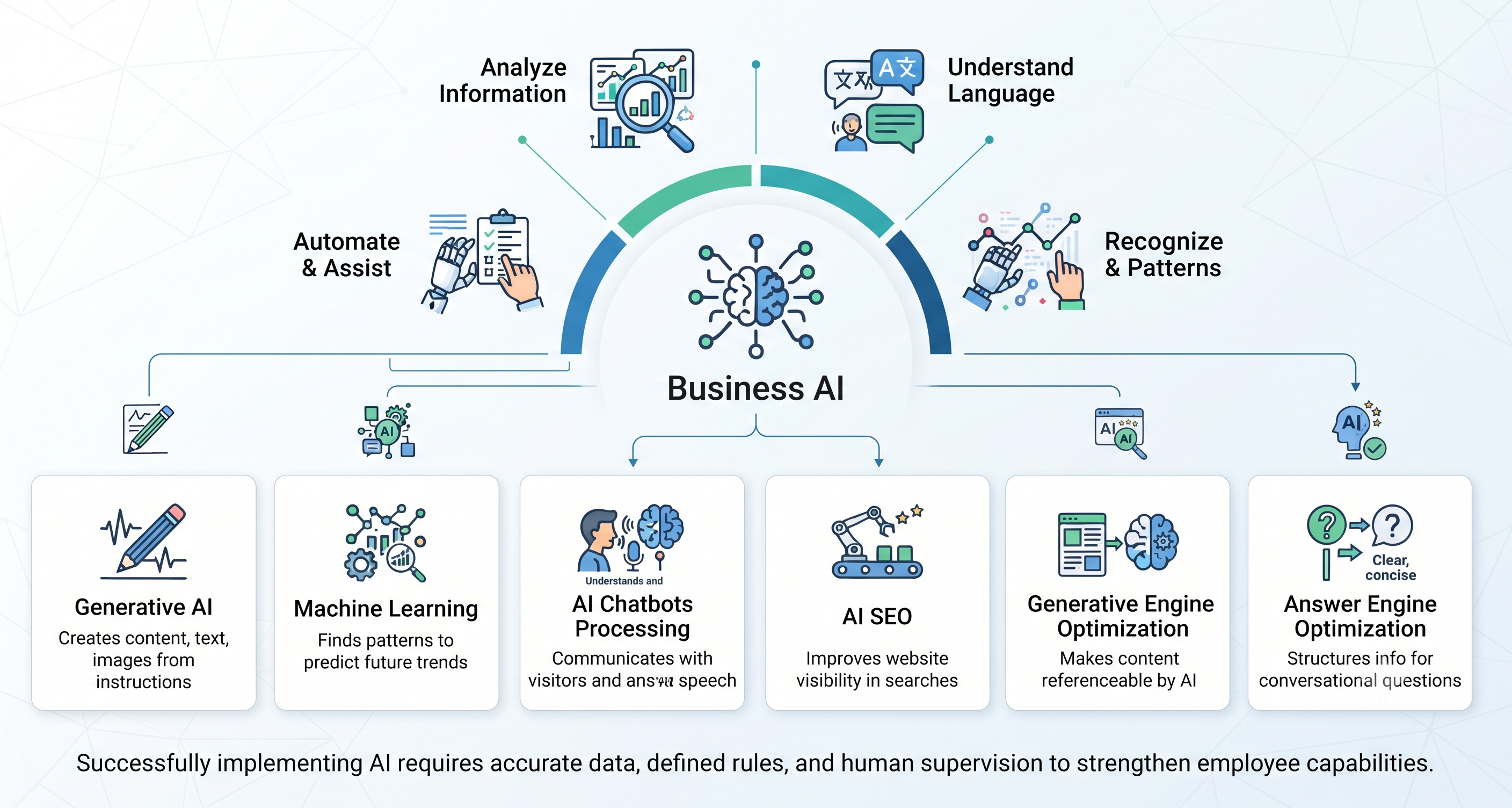
Business AI means using computer systems to analyse information, understand language, recognize patterns, generate content, and assist employees with decisions. It can help a company respond faster, organize knowledge, and identify opportunities hidden within its business data. Opal Infotech’s technical team develops and integrates practical AI solutions based on specific operational, marketing, and sales requirements.
Key business AI concepts include:
Generative AI
Creates text, summaries, images or draft responses from instructions.
Machine Learning
Identifies patterns in data to support predictions and recommendations.
Natural Language Processing
Helps systems understand and respond to human language.
AI Chatbots
Communicate with visitors, answer questions, and qualify enquiries.
Intelligent Automation
Combines AI with workflows to complete repetitive activities.
AI SEO
Improves website content for conventional and AI-powered search.
Generative Engine Optimization
Helps content become understandable and referenceable in AI-generated answers.
Answer Engine Optimization
Structures information to answer conversational questions clearly.
For example, AI can draft an enquiry response, identify relevant sales leads, search technical documents, recommend products or summarize management reports. However, successful AI implementation requires accurate data, defined rules, and human supervision. AI should strengthen employee capabilities and business processes, not operate without accountability.
Three Main Business Goals AI Can Support
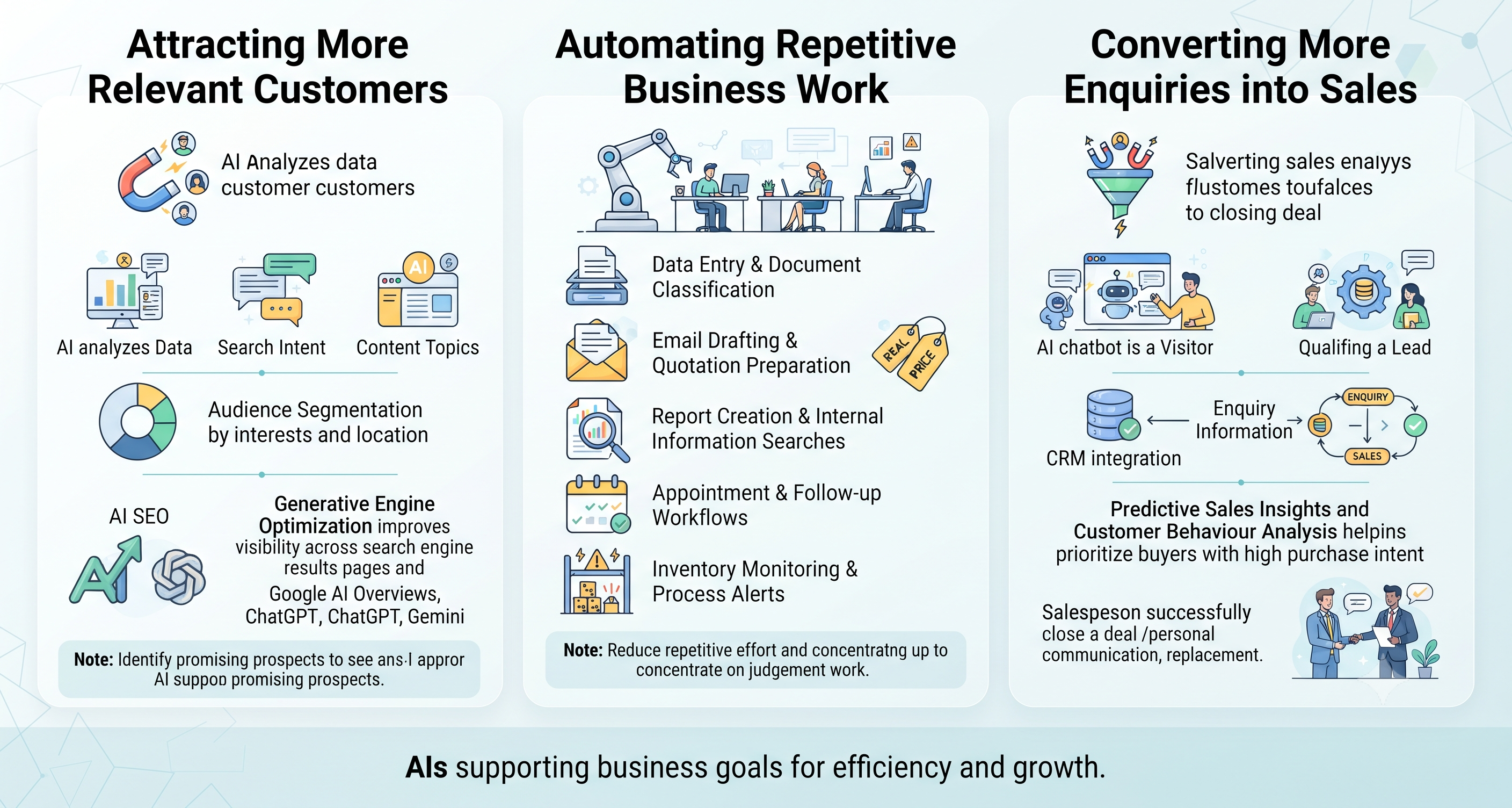
AI creates the greatest value when it supports a defined business goal. Opal Infotech’s technical and digital marketing team helps companies identify practical AI applications for customer acquisition, business process automation, and sales improvement.
1
Attracting More Relevant Customers
AI can analyse customer search intent, reveal useful content topics, and divide audiences according to interests, location, or buying behaviour. Businesses can then personalize marketing communication for different customer groups. AI SEO and Generative Engine Optimization help companies answer high-intent questions and improve their opportunities for visibility across Google Search, Google AI Overviews, ChatGPT, Gemini, and other AI-generated answers. AI can also evaluate enquiry details to identify promising prospects requiring faster attention.
2
Automating Repetitive Business Work
AI for business process automation can assist employees with:
data entry and document classification, email drafting and quotation preparation, report creation and internal information searches, appointment and follow-up workflows, and inventory monitoring and process alerts.
These applications can reduce repetitive effort and help employees concentrate on work that requires judgement. However, sensitive, financial, contractual and technical outputs must be checked by authorized employees before use.
3
Converting More Enquiries into Sales
AI chatbot development can turn website conversations into structured sales opportunities by understanding requirements, qualifying leads and recommending relevant products or services. CRM integration can record enquiry information, assign prospects and create follow-up reminders. Customer behaviour analysis and predictive sales insights can help sales teams prioritize buyers with stronger purchase intent. AI for sales automation should support personal communication rather than replace it. Opal Infotech’s AI integration team helps businesses combine intelligent lead qualification, product recommendations, and sales workflows so employees can spend more time understanding customers and advancing suitable opportunities.
How Different Industries Are Using AI
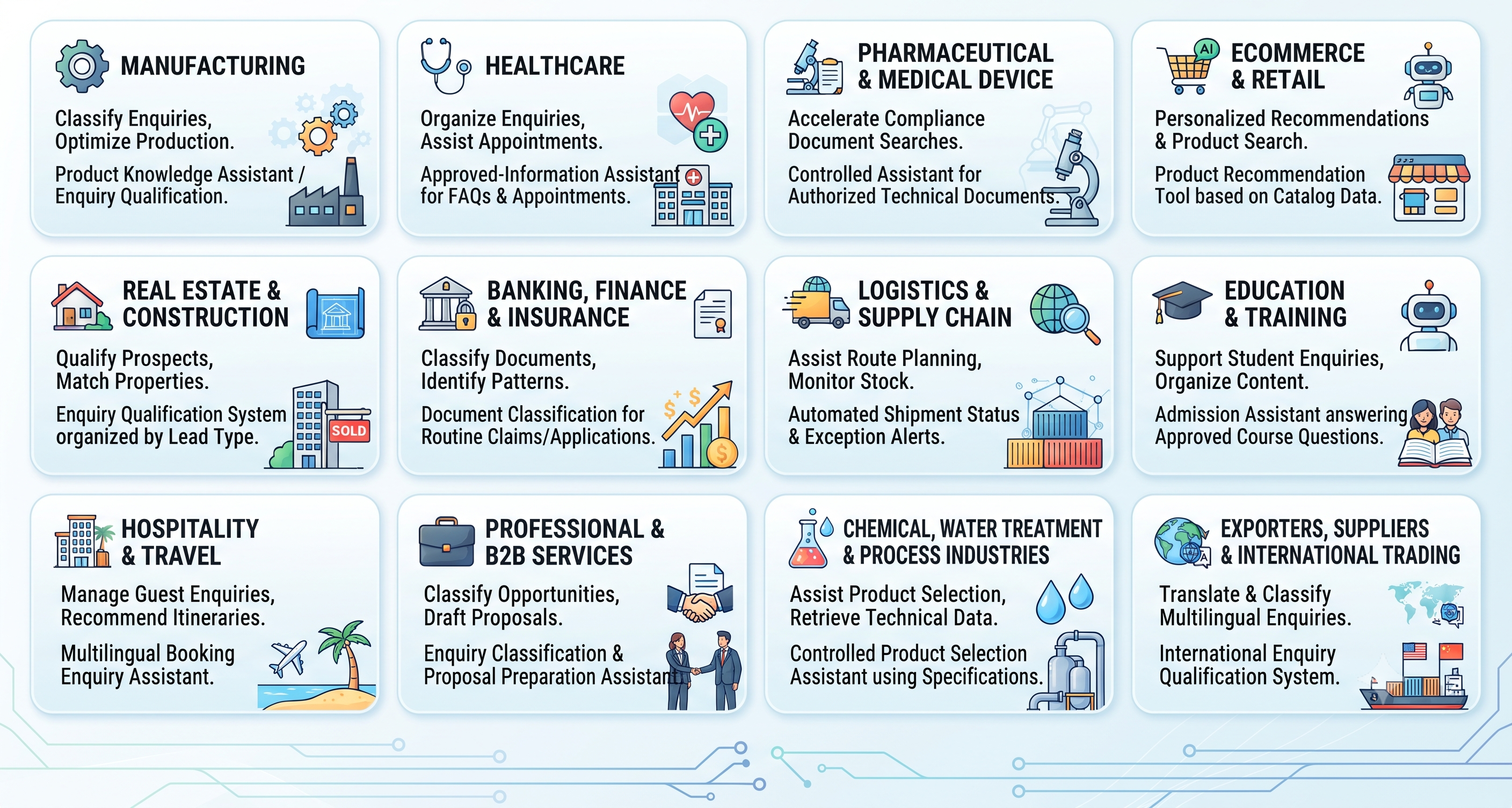
Artificial intelligence applications differ according to each industry’s customers, information, workflows, and sales process. Opal Infotech’s experienced AI development and digital marketing team studies these factors before recommending custom AI solutions, AI automation services, AI chatbot development, or AI SEO services. The following examples show how organizations can begin with focused projects that create practical business opportunities.
Manufacturing and Industrial Engineering
Manufacturers often receive technical enquiries containing incomplete application, capacity, or specification details. AI solutions for manufacturing can classify enquiries, recommend suitable equipment, prepare quotation inputs, and improve product visibility through AI SEO and GEO. Machine learning applications can also support predictive maintenance, quality inspection, production monitoring, and inventory alerts. Practical example: An equipment manufacturer uses AI to categorize enquiries by application, production capacity, and required specifications. Suitable first AI project: An internal product knowledge assistant or enquiry qualification system.
Healthcare and Hospitals
Hospitals must manage patient enquiries, appointments, procedure questions, and administrative documents while maintaining accurate communication. AI solutions for healthcare can organize enquiries, assist with appointment workflows, provide approved information, and improve visibility for treatment and specialist searches. Practical example: A hospital information assistant answers common preparation questions and directs patients to the correct department. Suitable first AI project: An approved-information assistant for appointments and frequently asked questions. AI must never diagnose patients independently or replace qualified medical judgement.
Pharmaceutical and Medical Device Companies
Pharmaceutical and medical device teams work with extensive product, regulatory, quality, and compliance documentation. AI can accelerate approved document searches, classify distributor enquiries, organize regulatory information, and help employees retrieve medical device details. AI SEO and Generative Engine Optimization can also strengthen international product visibility. Practical example: A quality employee searches an internal AI assistant for the current approved technical document instead of checking multiple folders. Suitable first AI project: A controlled assistant that retrieves authorized product and compliance documents.
eCommerce and Retail
Online buyers may leave when they cannot quickly find a suitable product or compare available options. AI for eCommerce businesses can provide personalized recommendations, improve product searches, analyse customer behaviour, support cart recovery, and identify inventory requirements. It can also analyse reviews and assist with accurate product descriptions. Practical example: A visitor enters preferred size, application, and budget, and the system presents relevant choices. Suitable first AI project: A product recommendation tool based on customer requirements and approved catalogue information.
Real Estate and Construction
Real estate and construction companies receive enquiries involving different locations, budgets, property types, and project requirements. AI can qualify prospects, match buyers with properties, summarize construction documents, assist with preliminary cost information, and schedule sales follow-ups. Practical example: A website assistant classifies a property enquiry and sends complete requirements to the correct sales representative. Suitable first AI project: An enquiry qualification system that organizes leads by location, budget, property category or construction need.
Banking, Finance and Insurance
Financial organizations process large volumes of applications, claims and supporting documents while meeting strict privacy and regulatory requirements. AI can classify documents, identify unusual patterns, route customer queries, assist risk reviews and compare suitable policies or financial products. Practical example: An insurance system sorts incoming claims according to document completeness and claim type for employee review. Suitable first AI project: Document classification for routine applications or claims. Sensitive decisions must remain subject to regulatory controls, secure access and authorized human approval.
Logistics and Supply Chain
Logistics teams must coordinate routes, shipments, inventory, suppliers and delivery communication. AI can assist route planning, manage shipment enquiries, forecast demand, monitor stock, identify possible delays and analyse supplier performance. Practical example: A system detects a shipment exception and informs the operations team before the customer requests an update. Suitable first AI project: Automated shipment status and exception alerts. This focused application can improve customer communication while giving employees more time to resolve delivery problems.
Education and Training
Education providers must respond to admission questions, recommend courses, organize learning materials, and complete administrative work. AI can support student enquiries, course discovery, content organization, and assessment preparation while keeping educators responsible for academic decisions. Practical example: A prospective student describes career interests and receives approved information about relevant courses, eligibility, and admission steps. Suitable first AI project: An admission assistant that answers approved course questions, records student requirements and directs complex enquiries to an admissions employee.
Hospitality and Travel
Hotels and travel companies serve guests with different languages, preferences, dates and budgets. AI can manage guest enquiries, recommend itineraries, support bookings, analyse reviews, prepare relevant offers and assist demand forecasting. Practical example: A visitor provides travel dates, group size and preferred activities, and the assistant displays suitable packages using approved availability information. Suitable first AI project: A multilingual booking enquiry assistant connected to verified hotel, travel package or availability data, with employee support for special requests.
Professional and B2B Services
B2B service providers often spend considerable time reviewing enquiries, preparing proposals, summarizing meetings, and following up with prospects. AI lead generation and AI for sales automation can classify opportunities, draft proposal sections, search internal knowledge, and plan relevant content. AI SEO services can improve visibility for industry-specific questions. Practical example: An enquiry assistant identifies the requested service, urgency, and decision stage before assigning the lead. Suitable first AI project: An enquiry classification and proposal preparation assistant.
Chemical, Water Treatment and Process Industries
Industrial buyers need products and systems that match specific applications, operating conditions, capacities and compliance requirements. AI can assist product selection, retrieve technical data, recommend application-based options, search compliance documents and organize distributor or export enquiries. Practical example: A buyer enters water quality, required capacity and process conditions, and the system identifies relevant solution categories for technical review. Suitable first AI project: A controlled product selection assistant using approved specifications, application data and operating requirements.
Exporters, Suppliers and International Trading Companies
Export businesses receive enquiries in multiple languages and from buyers with different product, quantity, documentation and delivery requirements. AI can translate and classify enquiries, assist market research, qualify buyers, search product catalogues, prepare export document inputs and schedule follow-ups. GEO can improve visibility for international supplier searches. Practical example: A multilingual system classifies enquiries by country, product, quantity and purchase intent. Suitable first AI project: An international enquiry qualification system connected to approved product information and sales workflows.
Practical AI Use Cases by Business Department
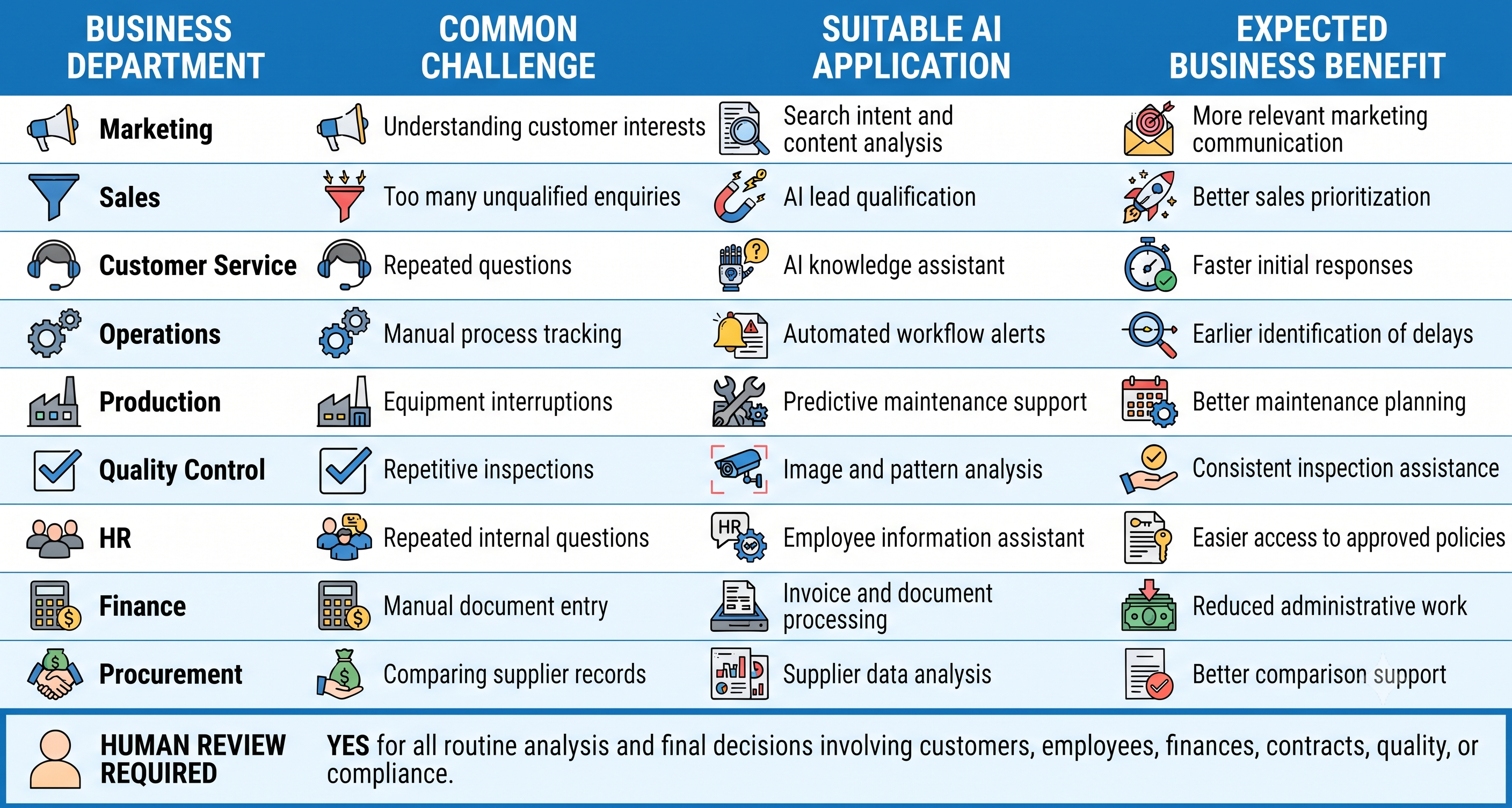
AI for business process automation can create opportunities across customer acquisition, operations, and management. Opal Infotech’s experienced team evaluates departmental challenges, data availability, and existing systems before developing custom AI solutions. The following examples show where AI integration services can support employees and improve business performance.
| Business Department | Common Challenge | Suitable AI Application | Expected Business Benefit | Human Review Required |
|---|---|---|---|---|
| Marketing | Understanding customer interests | Search intent and content analysis | More relevant marketing communication | Yes |
| Sales | Too many unqualified enquiries | AI lead qualification | Better sales prioritization | Yes |
| Customer Service | Repeated questions | AI knowledge assistant | Faster initial responses | For complex questions |
| Operations | Manual process tracking | Automated workflow alerts | Earlier identification of delays | Yes |
| Production | Equipment interruptions | Predictive maintenance support | Better maintenance planning | Yes |
| Quality Control | Repetitive inspections | Image and pattern analysis | Consistent inspection assistance | Yes |
| HR | Repeated internal questions | Employee information assistant | Easier access to approved policies | Yes |
| Finance | Manual document entry | Invoice and document processing | Reduced administrative work | Yes |
| Procurement | Comparing supplier records | Supplier data analysis | Better comparison support | Yes |
| Management | Information across systems | AI reporting dashboard | Faster access to business summaries | Yes |
These AI applications assist employees with routine analysis and information retrieval. Final decisions involving customers, employees, finances, contracts, quality, or compliance should remain under authorized human supervision.
How AI SEO and GEO Help Businesses Attract Customers
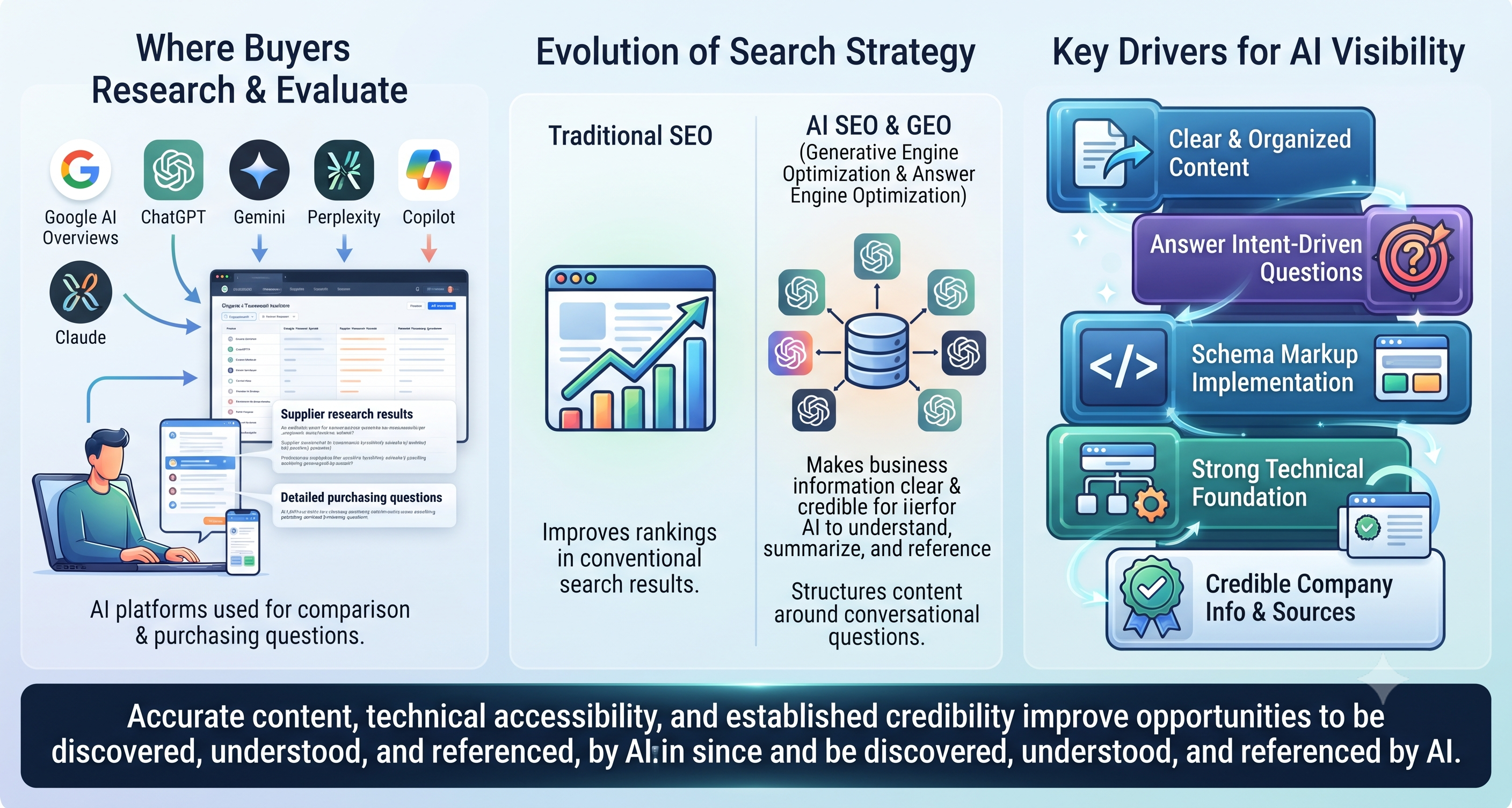
Buyers increasingly use Google AI Overviews, ChatGPT, Gemini, Perplexity, Claude, and Copilot to compare products, research suppliers, and ask detailed purchasing questions. This creates an opportunity for businesses to appear where customers are actively evaluating possible solutions.
Traditional SEO improves website rankings in conventional search results. Generative Engine Optimization focuses on making business information clear, credible, and easy for AI platforms to understand, summarize, and reference. Answer Engine Optimization structures content around the conversational questions prospective customers ask during research.
Effective AI search optimization requires:
- Clear, accurate, and well-organized website content
- Pages that answer industry-specific and high-intent questions
- Schema markup that explains products, services, articles and business information
- Strong website crawlability and a logical technical structure
- Credible company information, author details and trustworthy supporting sources
Opal Infotech’s experienced digital marketing and technical team combines SEO knowledge developed since 1998 with emerging AI search requirements. Through its AI SEO and Generative Engine Optimization services, the team conducts AI-readiness reviews, conversational keyword research, content optimization, technical improvements, schema implementation and AI visibility monitoring.
No agency can guarantee inclusion in an AI-generated answer because each platform independently selects its sources. However, accurate content, technical accessibility and established credibility can improve a business’s opportunity to be discovered, understood and referenced.
How AI Chatbots Turn Website Visitors into Qualified Enquiries
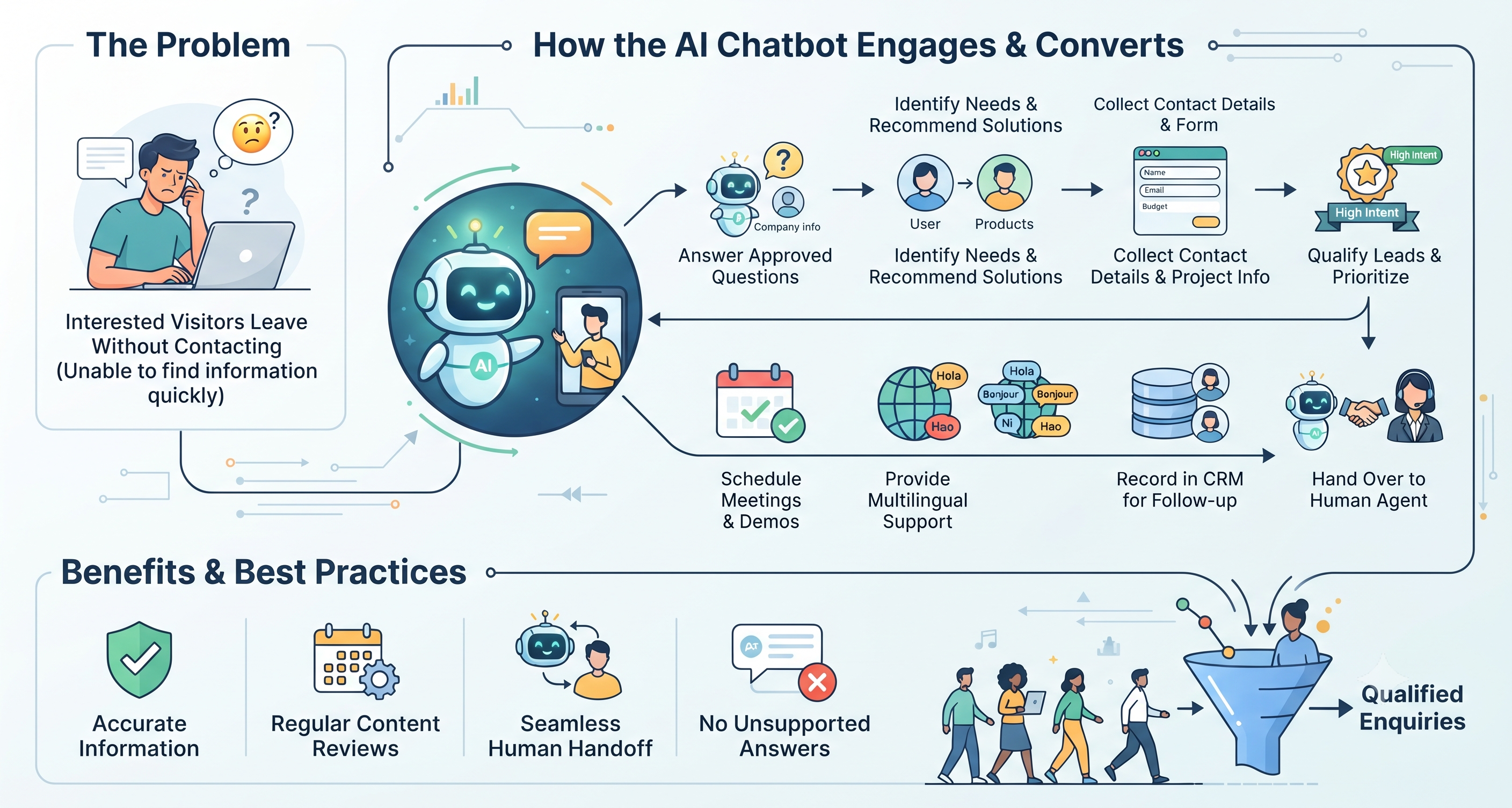
A business website may attract interested visitors who leave without contacting the company because they cannot quickly find the right information. A well-planned AI chatbot can begin a useful conversation, understand the visitor’s needs and convert anonymous traffic into structured sales enquiries.
An AI-powered chatbot can:
- Answer approved product, service and company questions
- Identify requirements and recommend relevant products or services
- Collect contact details, project information, budget and expected timelines
- Qualify leads and prioritize enquiries according to purchase intent
- Schedule meetings, consultations or product demonstrations
- Communicate in multiple languages for international customers
- Record conversation details in a CRM for sales follow-up
- Transfer technical or complex questions to an authorized employee
Opal Infotech’s experienced team provides AI chatbot development and integration for websites, CRM systems, eCommerce platforms, and internal business applications. Each chatbot is developed around the company’s customer journey, approved knowledge, and lead qualification requirements.
A chatbot should never create unsupported answers or prevent customers from reaching a person. Approved business information, regular content reviews, and a clear human handover process are essential for accurate customer communication and dependable AI lead generation.
How Custom AI Integration Improves Existing Business Systems
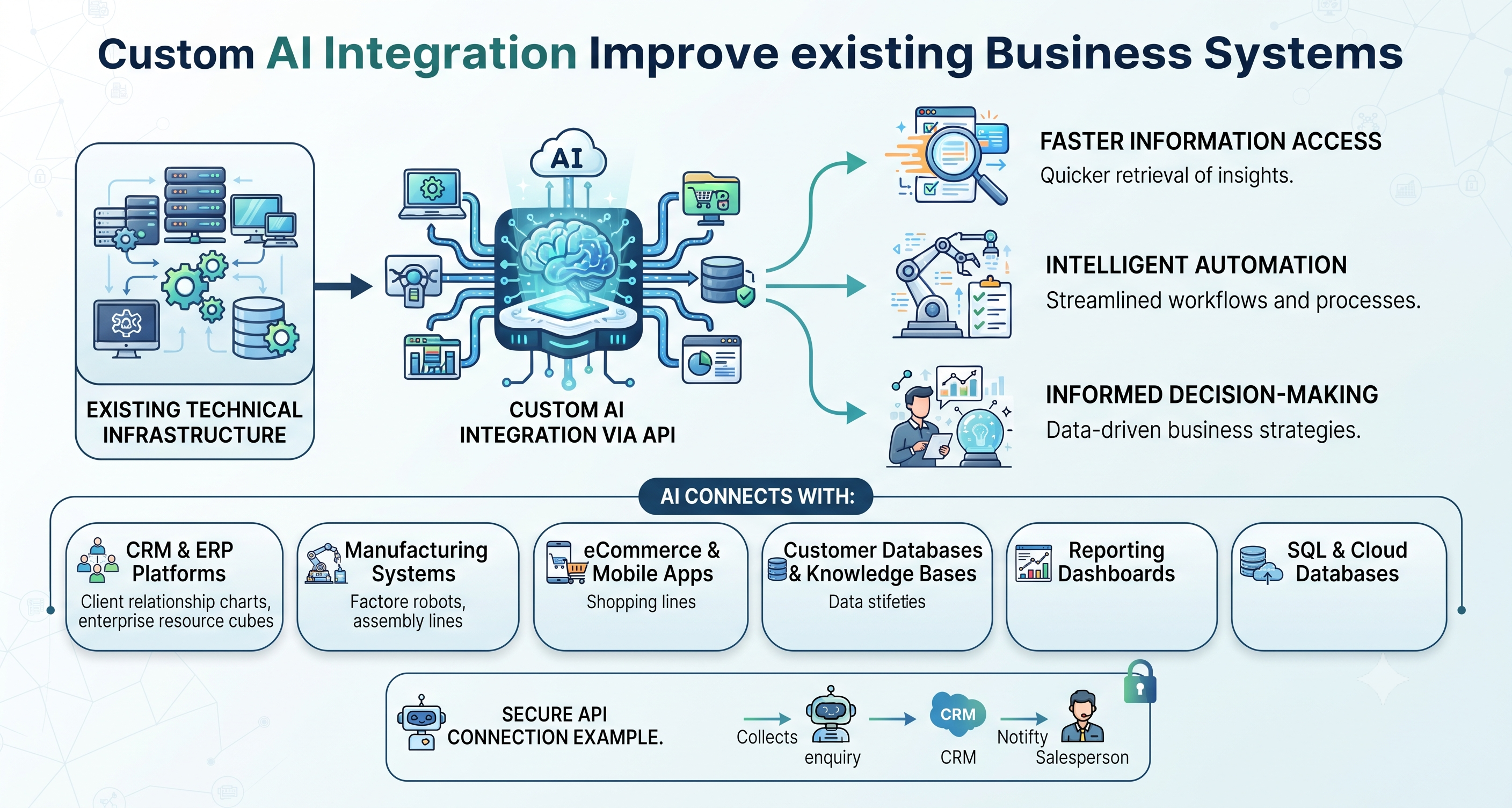
Businesses do not always need to replace their existing technical infrastructure to gain value from artificial intelligence. Custom AI integration can add new capabilities to the systems employees and customers already use, creating opportunities for faster information access, intelligent automation, and informed decision-making.
AI can be connected with:
- CRM and ERP platforms
- Manufacturing and production systems
- eCommerce websites and mobile applications
- Customer databases and internal knowledge bases
- Reporting dashboards
- SQL and cloud databases
An API, or Application Programming Interface, acts as a controlled connection between two systems. It allows them to exchange selected information according to defined permissions. For example, an AI chatbot can collect an enquiry, send approved details to a CRM and notify the correct salesperson without exposing unrelated customer records.
Opal Infotech’s experienced development team provides custom AI integration services that connect AI applications with existing business systems, databases, and workflows. The team studies the current infrastructure, data sources, access requirements, and expected business outcome before planning an integration. This approach allows companies to introduce AI automation while retaining useful existing platforms and maintaining appropriate security and human supervision.
What Businesses Should Check Before Investing in AI
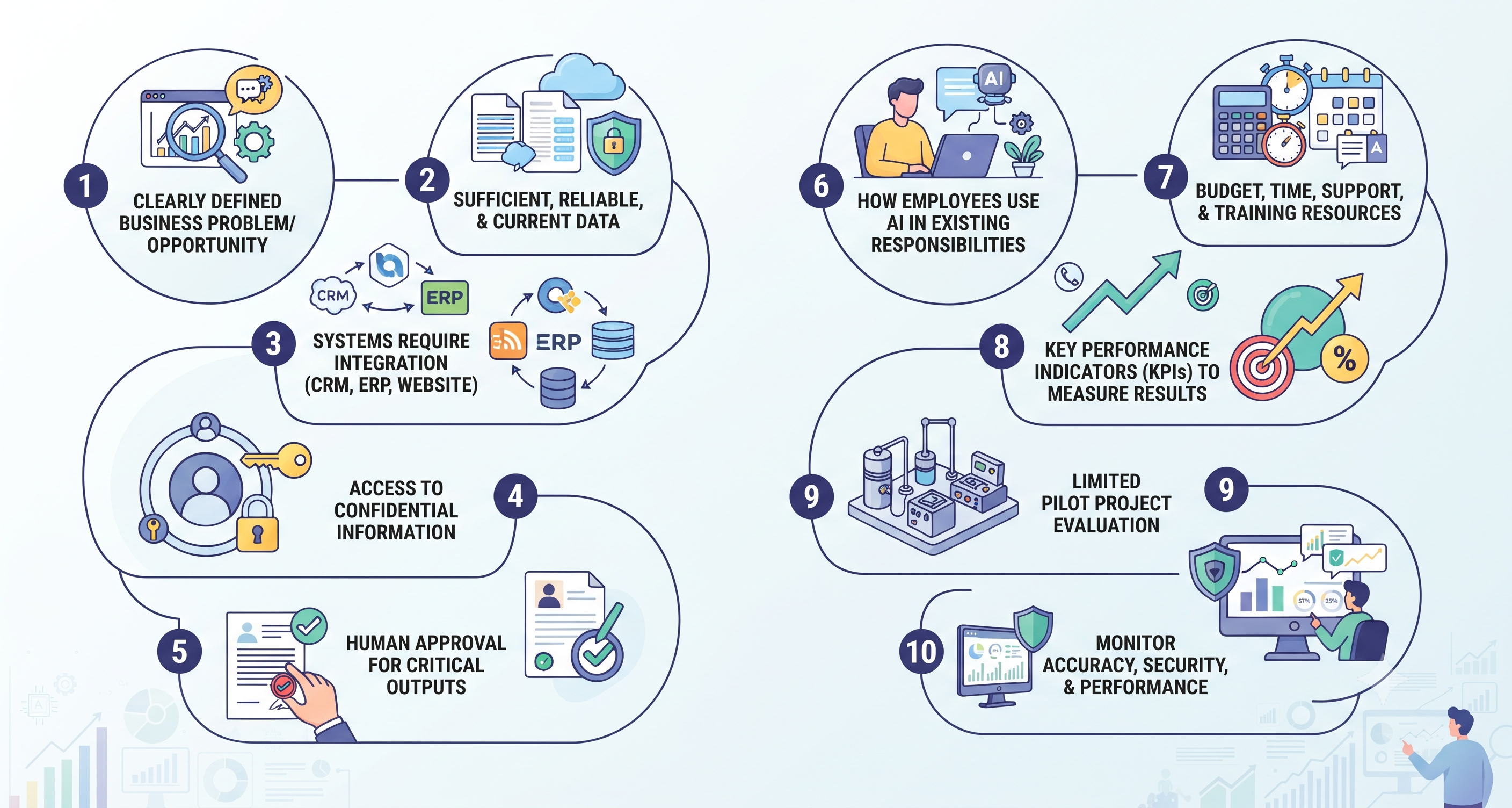
A successful AI investment begins with business readiness, not tool selection. Before implementing custom AI solutions or AI automation services, decision-makers should complete this practical AI readiness checklist:
- Is there a clearly defined business problem or opportunity?
- Is sufficient, reliable, and current data available?
- Which CRM, ERP, website, database, or other systems require integration?
- Who can access confidential customer, employee, or company information?
- Which financial, technical, contractual or customer-facing outputs need human approval?
- How will employees use AI within their existing responsibilities?
- What budget, time, technical support and training resources are available?
- Which key performance indicators will measure business results?
- Can the AI application be evaluated through a limited pilot project?
- Who will monitor accuracy, security and performance after implementation?
Opal Infotech’s experienced AI integration team examines business objectives, workflows, data quality and system requirements before recommending an application. This structured assessment helps companies identify practical AI opportunities, establish realistic expectations and create a clear method for measuring results while maintaining security, accountability and human supervision.
How to Measure Whether an AI Project Is Working
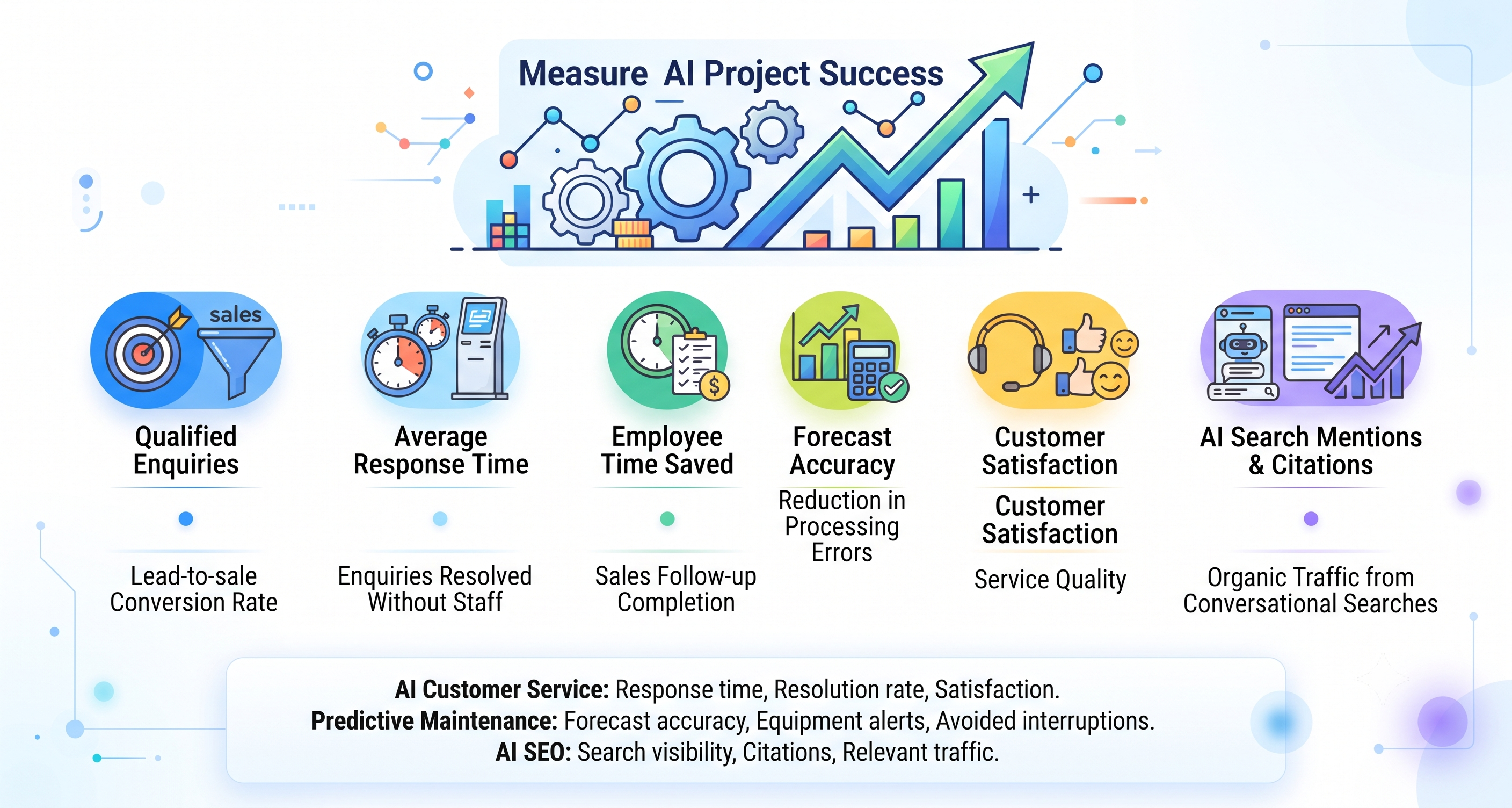
An AI project should be measured against the business problem it was created to address. Opal Infotech’s experienced team defines relevant key performance indicators before development so results can be compared with the original operating position.
Depending on the project, useful AI performance KPIs include:
- Qualified enquiries and lead-to-sale conversion rate
- Average response time and enquiries resolved without staff assistance
- Employee time saved and sales follow-up completion
- Forecast accuracy and reduction in processing errors
- Customer satisfaction and service quality
- AI search mentions and citations
- Organic traffic from conversational searches
The measurement method must reflect the application. An AI-powered customer service project may track response time, resolution rate, and satisfaction. A predictive maintenance system should measure forecast accuracy, equipment alerts, and avoided interruptions. AI SEO services require monitoring AI search visibility, citations, and relevant organic traffic. Selecting the right KPIs helps decision-makers identify value, uncover weaknesses, and determine the next improvement opportunity.
Common AI Implementation Mistakes to Avoid
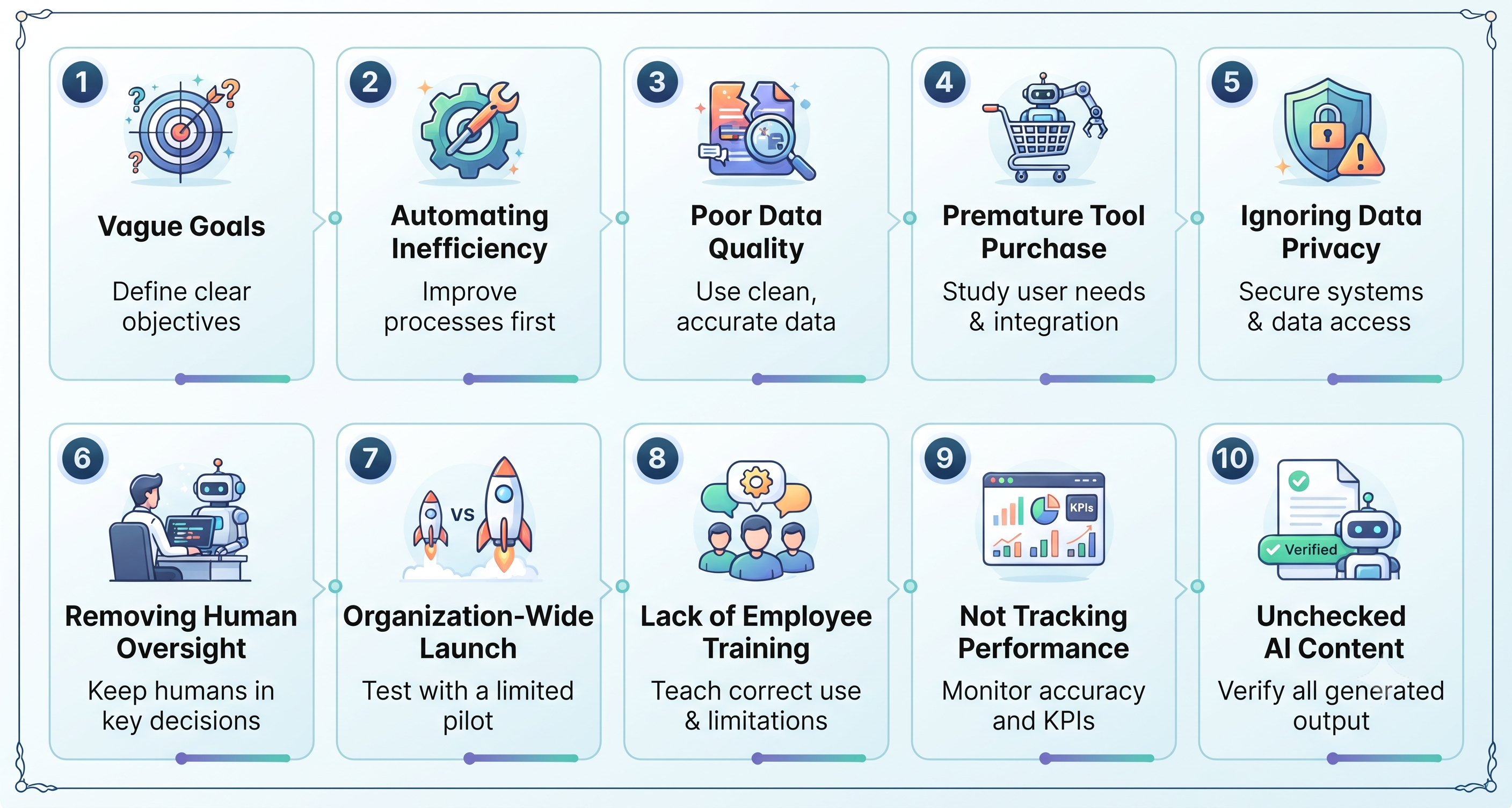
AI implementation problems often begin before development starts. Avoiding common mistakes helps businesses protect information, control risk, and create better opportunities from custom AI solutions.
Businesses should avoid:
- Beginning without a clear objective or measurable business outcome
- Automating an inefficient process before reviewing and improving it
- Using inaccurate, incomplete, or outdated information
- Buying AI tools before studying users, workflows, and integration requirements
- Ignoring data privacy or providing excessive access to connected systems
- Removing human supervision from financial, contractual, technical or customer-facing decisions
- Attempting an organization-wide launch instead of testing a limited pilot
- Failing to train employees on correct use, limitations and approval responsibilities
- Launching without tracking accuracy, performance and agreed KPIs
- Publishing AI-generated content without verification by a knowledgeable person
Opal Infotech’s experienced AI integration team examines business requirements, data sources, security controls and employee workflows before development. This structured approach helps companies introduce AI automation responsibly, correct weaknesses during testing, and build applications around genuine operational and customer acquisition opportunities.
A Simple Step-by-Step AI Adoption Plan
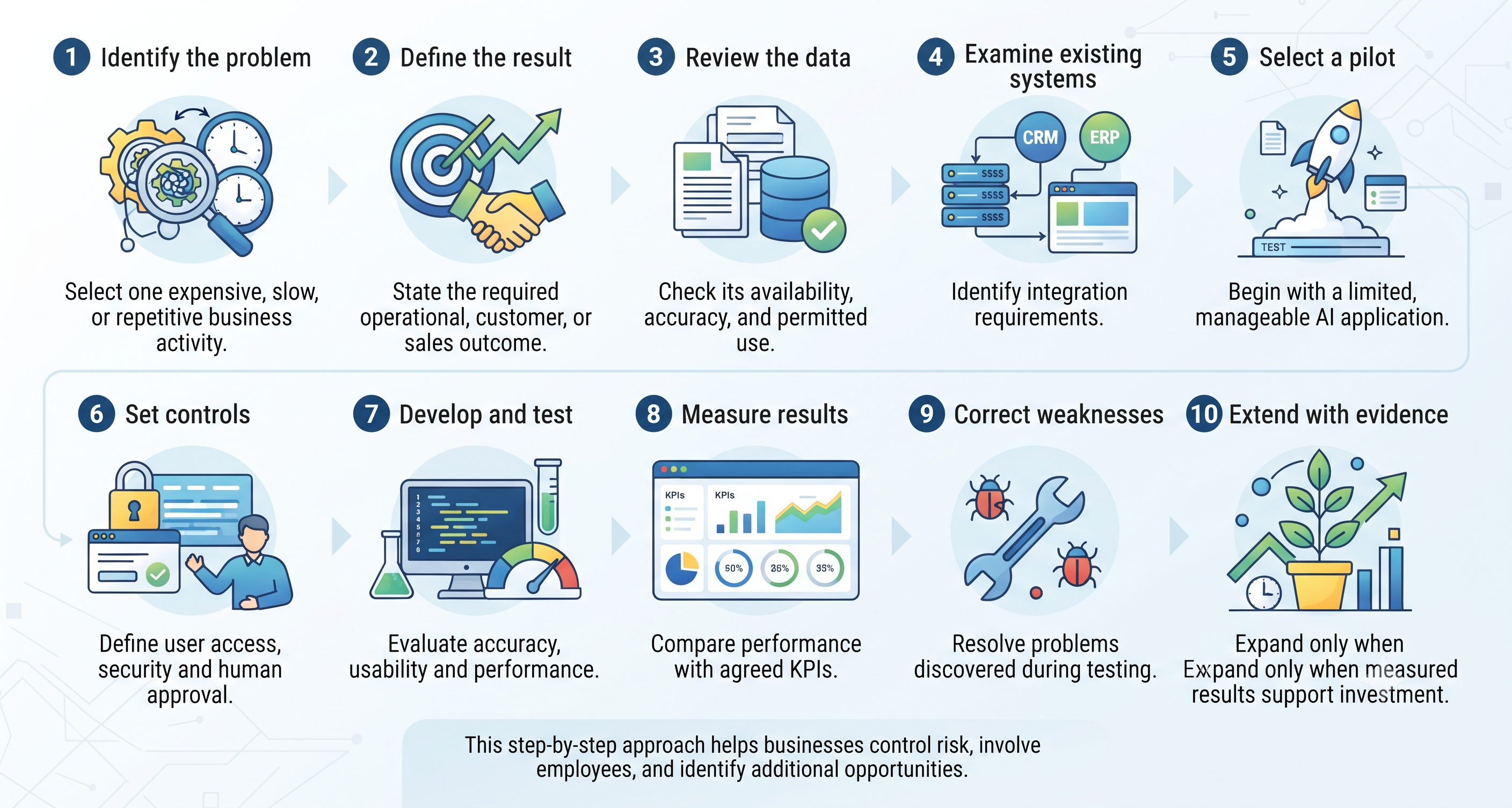
An effective AI adoption plan turns a business need into a controlled and measurable project. Opal Infotech’s experienced team follows a structured process when planning custom AI solutions, AI automation services, and AI integration projects.
- Identify the problem: Select one expensive, slow, or repetitive business activity.
- Define the result: State the required operational, customer, or sales outcome.
- Review the data: Check its availability, accuracy, and permitted use.
- Examine existing systems: Identify CRM, ERP, website, database and integration requirements.
- Select a pilot: Begin with a limited, manageable AI application.
- Set controls: Define user access, data security and human approval rules.
- Develop and test: Evaluate accuracy, usability and system performance.
- Measure results: Compare performance with agreed KPIs.
- Correct weaknesses: Resolve problems discovered during employee and technical testing.
- Extend with evidence: Expand the application only when measured results support further investment.
This step-by-step AI implementation approach helps businesses control risk, involve employees, and identify additional opportunities based on verified results.
How Opal Infotech Helps Businesses Implement AI
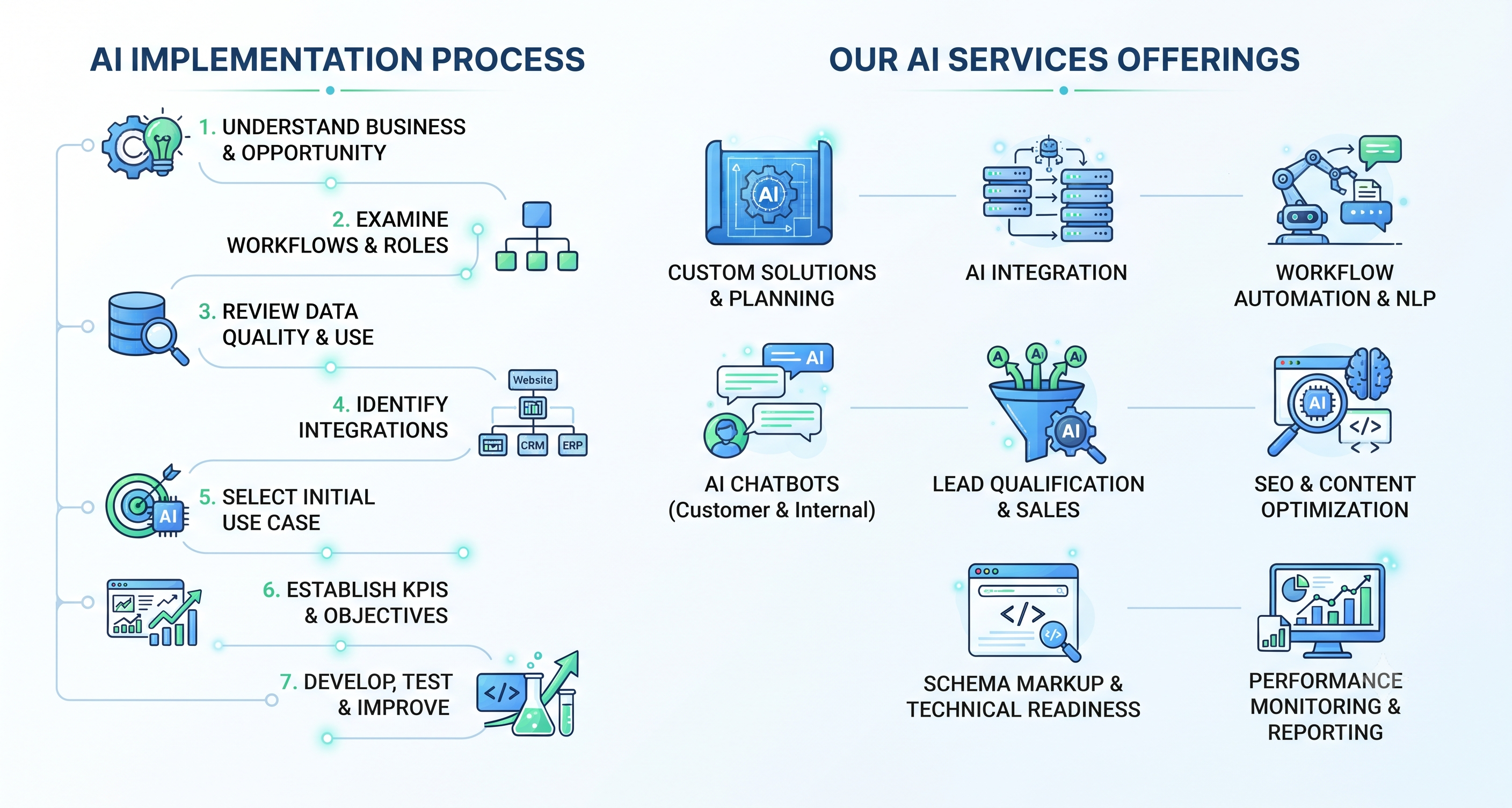
Since 1998, Opal Infotech has helped businesses apply emerging digital technologies to practical marketing, customer service, and operational requirements. Our experienced AI development and digital marketing team combines technical knowledge with an understanding of business workflows, customer behaviour, and search visibility. This allows us to recommend AI solutions based on the opportunity a company wants to pursue rather than promoting a tool without first examining its purpose.
Opal Infotech’s AI services include:
- Custom AI solution planning and development
- AI integration with websites, databases, and existing business systems
- AI-powered workflow automation and Natural Language Processing applications
- Customer-facing and internal AI chatbots
- AI lead qualification and sales enquiry management
- CRM and eCommerce chatbot integration
- AI SEO and conversational content optimization
- Generative Engine Optimization and Answer Engine Optimization
- Schema markup and technical AI search readiness
- AI visibility monitoring and performance reporting
Our team follows a structured AI implementation process:
- Understand the business problem or growth opportunity.
- Examine current workflows and employee responsibilities.
- Review data quality, availability and permitted use.
- Identify websites, CRM, ERP, eCommerce or database systems requiring integration.
- Select a practical initial AI use case.
- Establish relevant and measurable KPIs.
- Develop, test, monitor and improve the application.
This process can help businesses introduce AI with clear responsibilities, controlled access and measurable objectives. Whether the requirement involves attracting prospects through AI-powered search, qualifying website enquiries, automating repetitive work or improving access to internal information, Opal Infotech develops the application around approved business information and defined human supervision.
Speak with Opal Infotech’s AI Team
Discuss your customer acquisition challenge, repetitive business process or sales opportunity with Opal Infotech’s AI team. We can review your current requirement, identify a suitable starting point and explain how custom AI solutions, AI chatbot development or AI SEO services could support your business objectives.
FAQs
Who should consider using AI automation services?
Businesses that handle repetitive enquiries, document processing, data entry, reporting, customer support or sales follow-ups should consider AI automation services. Manufacturers, hospitals, eCommerce companies, exporters, service providers and other organizations can use AI when a process is slow, costly or dependent on repeated manual work. Opal Infotech helps decision-makers examine workflows, data availability and expected results before recommending a custom AI solution. The objective should be to assist employees, improve information access, and create measurable operational value.
What are the most useful AI solutions for business growth?
Useful AI solutions for business growth include AI chatbots, intelligent workflow automation, lead qualification, product recommendation systems, internal knowledge assistants, predictive analytics, AI SEO, and Generative Engine Optimization. The right application depends on whether the business wants to attract customers, automate work, improve customer communication, or support sales decisions. Opal Infotech studies the business objective and current systems before developing an application. A focused solution built around a genuine requirement usually provides clearer measurement opportunities than adopting several unrelated AI tools.
When should a company invest in custom AI solutions?
A company should consider custom AI solutions when ready-made tools cannot address its workflow, data, security, integration, or industry requirements. Common signs include repeated manual work, delayed enquiry responses, information stored across different systems, and difficulty identifying valuable sales opportunities. Opal Infotech can evaluate the process, available data and required integrations to determine whether a custom application is justified. Investment should begin only when the company can define the problem, expected result, employee responsibilities, and KPIs that will measure performance.
Where can AI be integrated into existing business systems?
AI integration services can connect artificial intelligence with websites, mobile applications, CRM platforms, ERP systems, eCommerce stores, manufacturing systems, SQL databases, cloud databases, reporting dashboards, and internal knowledge bases. An API can provide a controlled connection through which approved information moves between systems. Opal Infotech develops AI integrations based on defined access rules, business workflows and employee responsibilities. Many companies can add AI capabilities to useful existing platforms without replacing their complete technical infrastructure, provided security, data quality and system compatibility are properly reviewed.
How can AI help a business attract more customers and sales enquiries?
AI can analyse search intent, identify high-value content topics, personalize marketing communication, qualify website visitors and recommend relevant products or services. AI SEO, Answer Engine Optimization and Generative Engine Optimization can also improve opportunities for a business to appear in Google AI Overviews, ChatGPT, Gemini, Perplexity, Claude and Copilot. Opal Infotech combines technical SEO, content optimization, schema markup and AI search readiness to support customer acquisition. However, no business can be guaranteed inclusion in AI-generated answers because each platform selects sources independently.
How much business data is required to begin an AI project?
The amount of data required depends on the AI application. A chatbot using approved company information may begin with product pages, FAQs, catalogues, and policy documents. Predictive analytics or machine learning applications may require a larger collection of accurate historical records. Opal Infotech reviews data quality, relevance, format, access permissions and completeness before recommending development. A smaller amount of reliable and well-organized information can be more useful than a large collection containing duplicates, errors, outdated records or information that cannot legally be used.
How many business processes should a company automate first?
A company should usually begin with one clearly defined process rather than attempting several AI automation projects simultaneously. Suitable starting points include enquiry classification, document searches, customer question handling, sales follow-up reminders or internal reporting. Opal Infotech helps businesses select a limited pilot based on effort, available data, integration requirements and measurable business value. Once the application has been tested against agreed KPIs, the company can correct weaknesses and consider additional processes. Evidence from the first project should guide every further AI investment.
Whose responsibility is the accuracy and security of an AI system?
AI accuracy and security are shared responsibilities involving business management, technical teams, data owners, department leaders and authorized users. The company must define which information the system can access, which outputs require approval, and who will monitor performance. Opal Infotech builds access controls, testing and human review requirements into the AI implementation process. Employees must also use the application correctly and report inaccurate results. Financial, medical, legal, contractual and technical decisions should never rely on unverified AI output without review by a qualified person.
Which industries benefit most from AI automation and AI chatbots?
Manufacturing, healthcare, pharmaceuticals, eCommerce, retail, real estate, finance, logistics, education, hospitality, professional services, chemicals, water treatment and export businesses can benefit from AI automation and AI chatbots. The strongest opportunity exists where companies manage repeated enquiries, extensive documents, technical product information, or high volumes of operational data. Opal Infotech develops industry-focused AI applications for customer engagement, lead qualification, workflow automation, information retrieval and AI search visibility. The most suitable use case depends on each organization’s customers, systems, data and desired business result.
Start Identifying Practical AI Opportunities for Your Business
Discuss your customer acquisition challenge, repetitive business process or sales opportunity with Opal Infotech’s AI team.

With a digital legacy established in 1998, the editorial team at Opal Infotech combines decades of experience with cutting-edge innovation. As a premier Web Development and Digital Marketing agency, we specialize in crafting robust digital solutions – ranging from Custom Web Development and eCommerce platforms to Mobile Apps and Business Website Design. Today, Opal Infotech is at the forefront of the technological shift, helping businesses integrate AI SEO and AI Business Solutions alongside traditional powerhouses like Google Ads and Website Maintenance. Our goal is to translate complex tech trends into actionable growth strategies for global enterprises.
We publish articles to empower business owners with the clarity needed to make informed decisions in a complex digital landscape. Our technical content is designed to demystify high-level innovations like AI and SEO, translating code into actionable business growth strategies.
