


GEO (AI SEO) for eCommerce: Product Schema & AI Shopping Assistants
Opal Infotech helps online stores get discovered, recommended, and chosen by AI shopping assistants like ChatGPT, Gemini, Claude, and Perplexity. Our AI SEO for eCommerce service, also known as GEO (Generative Engine Optimization), prepares your product catalog with the structured data, schema, and content AI models need to trust and cite your store — turning AI search into a direct growth channel for your business.

The opportunity is simple: AI shopping assistants only recommend stores whose product data they can read, verify, and trust.
No structured product schema?
AI can’t confirm your price, stock, or specs
Thin descriptions?
AI has nothing accurate to quote
No AI-readiness?
A competitor gets recommended instead of you
Backed by 25+ years of technical SEO and GEO expertise, Opal Infotech’s team closes this gap for eCommerce brands — with data-driven strategy, not guesswork.
Why eCommerce Businesses Need GEO Now
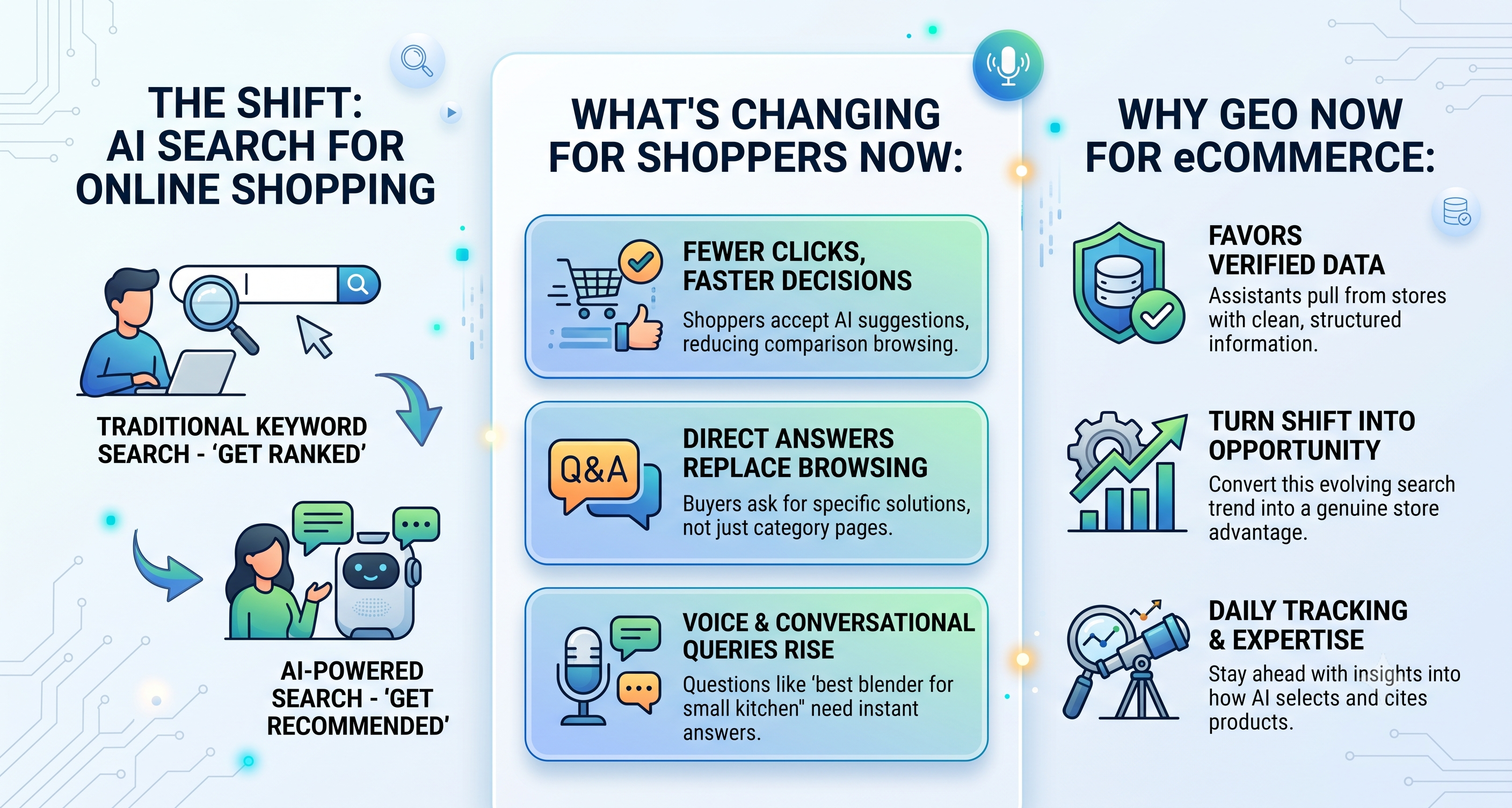
AI search for online shopping is no longer a future trend — it’s how a growing share of buyers start their purchase journey today. Instead of typing a keyword into Google and scrolling through ten results, shoppers ask an AI assistant a direct question and act on whatever it suggests. For eCommerce brands, this changes the entire discovery process from “get ranked” to “get recommended.”
What’s changing for online shoppers right now:
Fewer clicks, faster decisions
Shoppers accept AI-suggested products without visiting five different store pages to compare
ChatGPT product recommendations replace open-ended browsing
Buyers ask for a specific solution and expect a specific answer, not a category page
Voice and conversational queries are rising
Questions like “which blender is best for a small kitchen?” need answers that AI can extract instantly
AI product discovery favors verified data
Assistants pull from stores with clean, structured, trustworthy product information
Opal Infotech’s team tracks this shift daily across client stores in multiple industries, studying how AI assistants select, compare, and cite products in real time. That daily, hands-on observation — combined with 25+ years of technical SEO and GEO experience — is what lets our experts convert this shift into a genuine opportunity for your store, rather than a threat to it.
What is GEO for e-commerce?
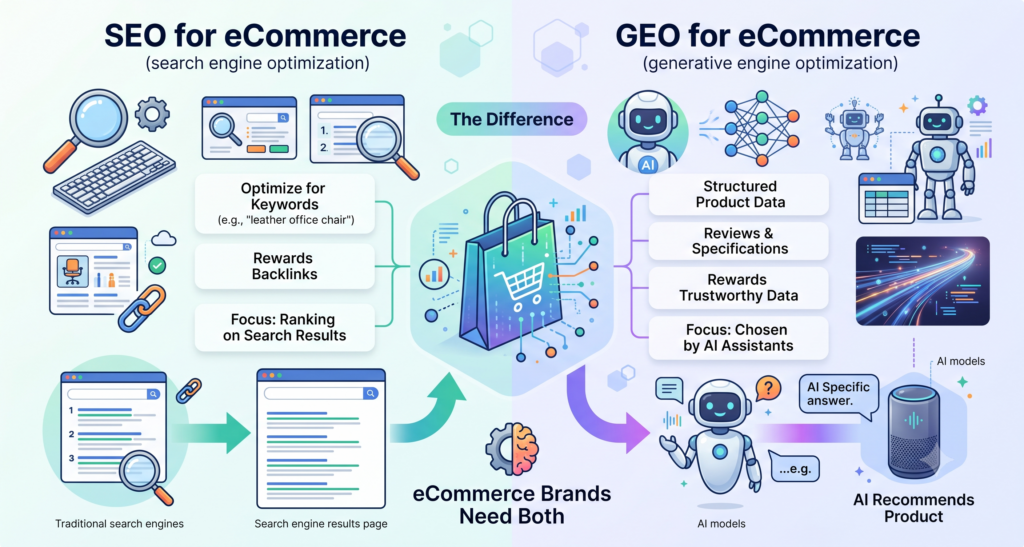
Generative Engine Optimization for eCommerce is the practice of preparing your product catalog — descriptions, pricing, availability, reviews, and specifications — so AI assistants can read it accurately and recommend it confidently. In plain terms, it’s the difference between your store existing online and your store actually getting chosen when an AI answers a shopper’s question.
GEO vs SEO for online stores comes down to what each one optimizes for:
Traditional SEO helps a product page rank on Google’s results page for a keyword like “leather office chair”
GEO helps that same product get pulled into an AI’s answer when someone asks, “Which office chair is best for long work hours”
Traditional SEO rewards backlinks and keyword placement
GEO rewards accurate, structured product data that an AI can trust and quote without guessing
For eCommerce brands, both matter — but GEO is the newer opportunity most competitors haven’t claimed yet. Opal Infotech’s team, backed by 25+ years of technical SEO experience, builds this foundation correctly from day one so your catalog is ready for both search engines and AI assistants.
Also visit Our Page
Case Study: SEO + GEO for a Specialty Chemicals ManufacturerHow AI Shopping Assistants Actually Pick Products
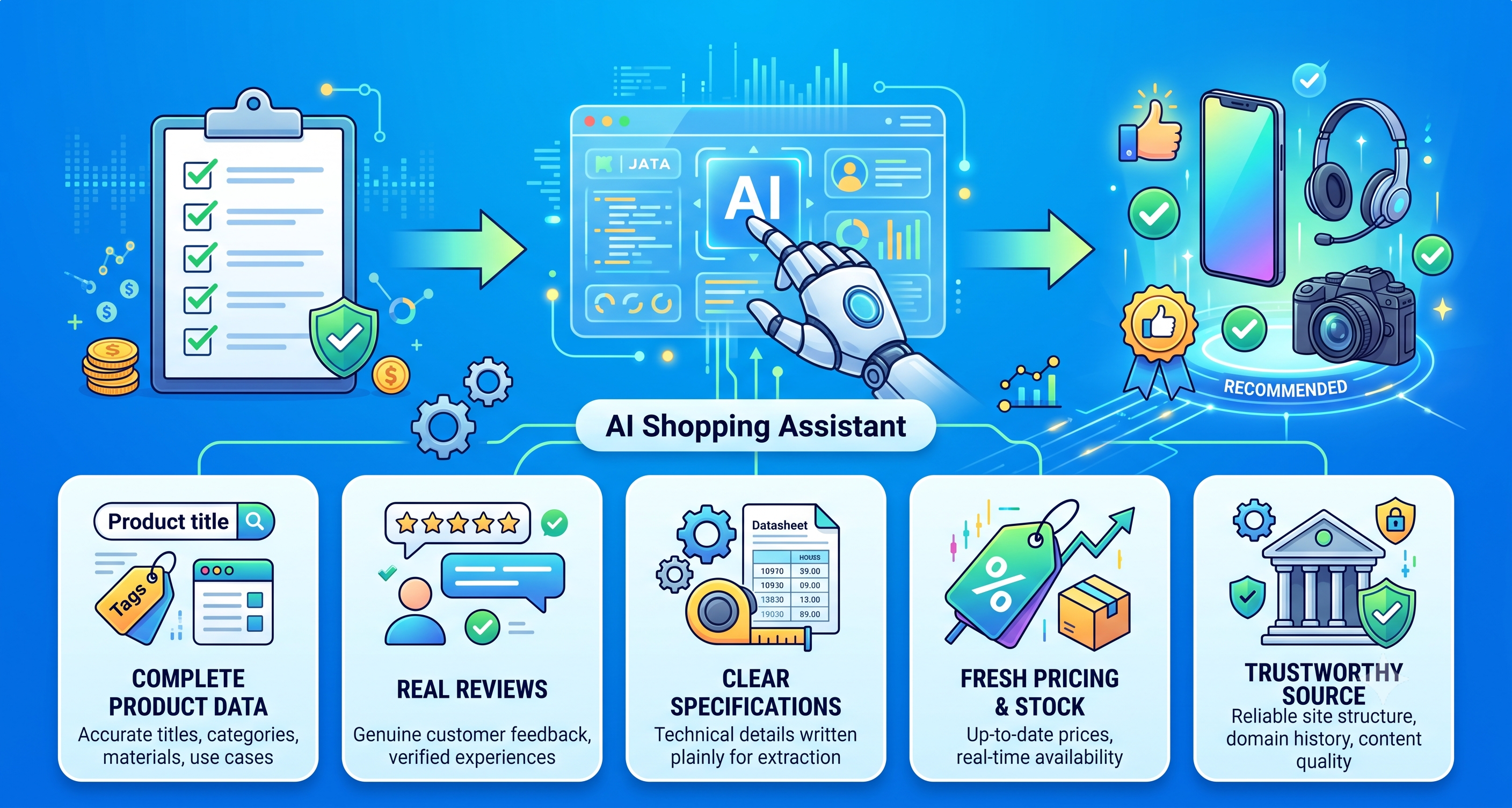
An AI shopping assistant doesn’t browse your store the way a human does. It reads your product data, cross-checks it against other sources, and decides in seconds whether your product deserves a mention. Understanding how AI picks products is the first step to earning consistent AI product recommendations instead of losing them to a competitor with cleaner data.
Before recommending a product, AI assistants typically evaluate:
Complete product data
Accurate titles, categories, materials, dimensions, and use cases that leave no gaps for the AI to guess
Real reviews
Genuine customer feedback that confirms the product performs as described, not just a star rating with no substance
Clear specifications
Technical details written plainly enough for AI to extract and repeat correctly in its answer
Fresh pricing and stock information
Outdated prices or “in stock” claims that turn out false quickly erode AI trust in your store
A trustworthy source
A site structure, domain history, and content quality that signal your store is a reliable place to send a buyer
Most eCommerce stores lose recommendations not because their products are inferior, but because their product data is incomplete, inconsistent, or impossible for AI to verify. This is where the opportunity lies: brands that fix this early get recommended consistently, while others remain invisible in AI-driven shopping conversations.
Opal Infotech’s team approaches this with a technical, results-driven lens — auditing exactly where your product data falls short and rebuilding it to meet what AI assistants actually require. With 25+ years of hands-on SEO and GEO experience across multiple industries, our experts know precisely which data points move the needle for AI visibility.
Product Schema: The Backbone of AI Visibility
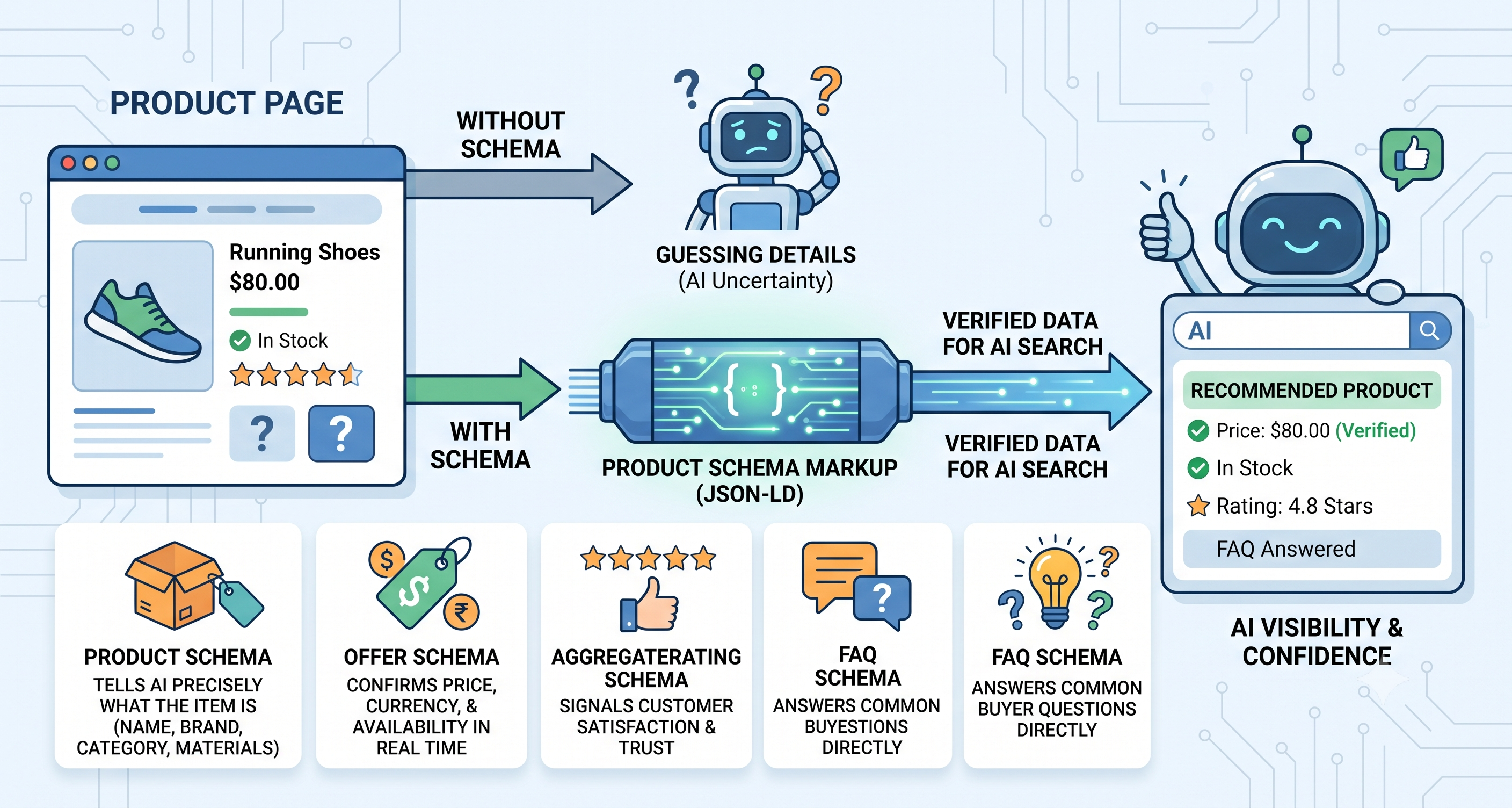
Think of product schema markup as a translator between your website and AI systems. Your product page might look great to a human shopper, but without structured data behind it, an AI assistant is often left guessing at the price, availability, or even what the product actually is. Structured data for e-commerce removes that guesswork entirely, telling AI exactly what it needs to know, in a format it can trust without misreading.
Here’s what each core schema type communicates to AI:
Product schema
Tells AI precisely what the item is: its name, brand, category, materials, and key attributes, so it never gets misclassified or left out of a relevant answer
Offer schema
Confirms the price, currency, and availability in real time, which is exactly what AI checks before recommending a product to a buyer ready to purchase
AggregateRating schema
Signals how genuinely satisfied past customers are, giving AI the confidence to present your product as a trusted choice rather than an unverified option
FAQ schema
Answers common buyer questions directly on the page, giving AI ready-made, accurate content it can pull from, instead of guessing an answer on its own
Implemented correctly through a clean JSON-LD product schema, this structured data becomes the foundation AI assistants rely on to read, verify, and recommend your catalog with confidence. Most stores either skip schema entirely, implement it on a handful of pages, or let it fall out of date as prices and stock levels change — and each of those gaps quietly removes the store from AI consideration.
This is where deep technical grounding matters most. Schema markup for online stores isn’t a one-time checkbox; it requires accuracy across every product, category, and variant, maintained continuously as your catalog grows and prices shift. A single missing attribute on a best-selling product can be the reason AI recommends a competitor instead.
Opal Infotech’s team brings 25+ years of technical SEO expertise to this exact challenge, building and auditing schema architecture across full product catalogs — not isolated pages — so it holds up as AI search evolves. This structural discipline is precisely what gives your store a lasting advantage that most competitors haven’t built yet.
Beyond Schema: Content AI Assistants Actually Cite
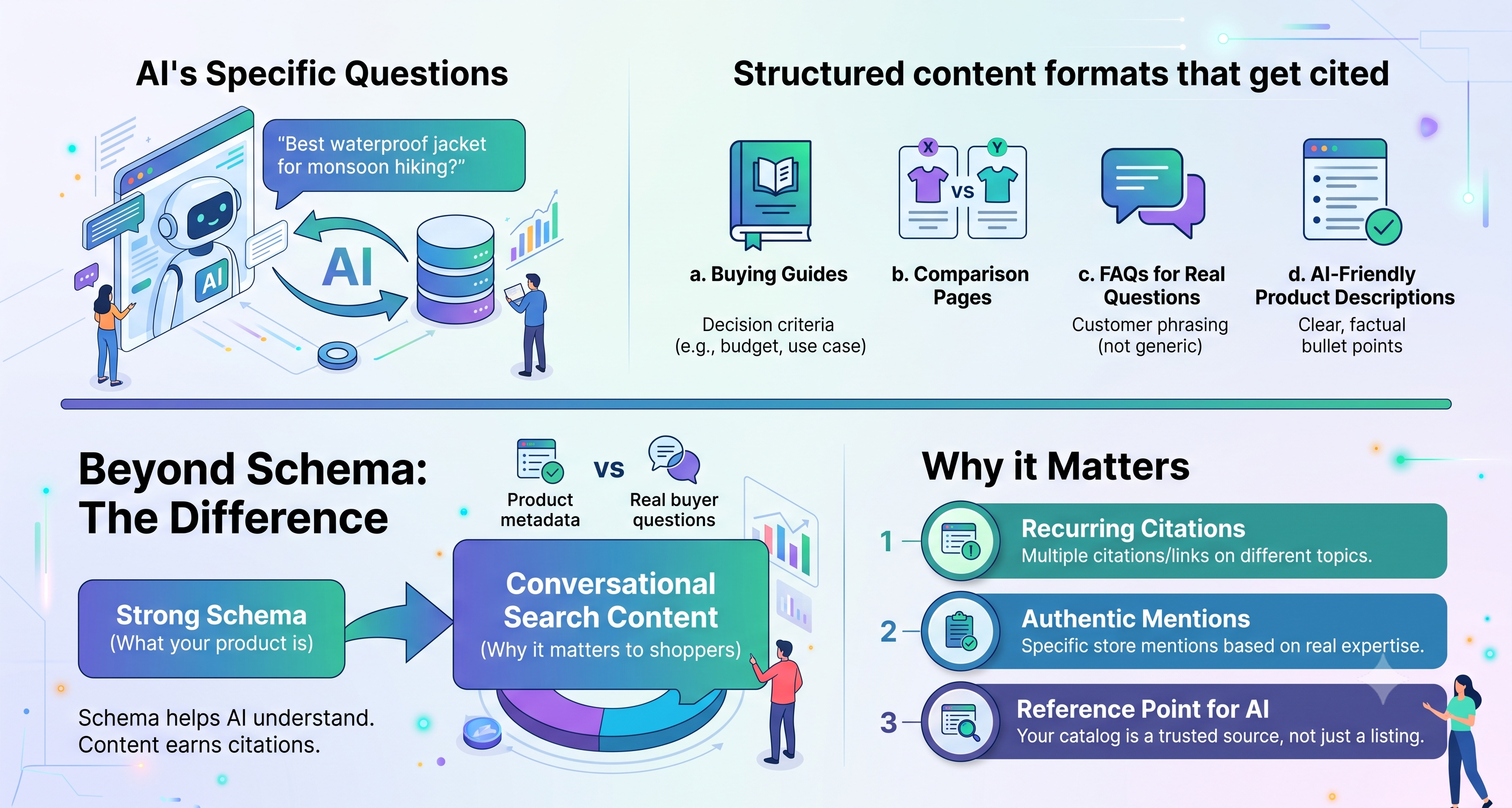
Schema tells AI what your product is. But conversational search content is what earns your store an actual mention in the AI’s answer. Shoppers rarely ask AI a one-word question — they ask “best waterproof jacket for hiking in monsoon” or “which mattress helps with back pain.” If your content doesn’t speak to those real, specific questions, AI has nothing worth quoting from your store, no matter how strong your schema is.
The content formats that consistently earn AI citations:
Buying guides
Pages structured around genuine decision criteria (budget, use case, comparison points) that mirror exactly how shoppers phrase questions to AI
Comparison pages
Direct “X vs Y” content that gives AI a ready-made answer instead of forcing it to piece one together from scattered sources
FAQs written for real questions
Not generic Q&As, but the exact phrasing customers use when they ask AI for advice
AI-friendly product descriptions
Written in clear, factual language that AI can lift and repeat accurately, rather than vague marketing copy, it has to interpret
Strong buying guide SEO turns your catalog into a genuine reference point AI trusts, not just a product listing it might overlook. Opal Infotech’s content team, guided by 25+ years of results-driven SEO experience across varied industries, builds this content around actual buyer language — giving your store recurring citations where it matters most.
Technical SEO Foundations That Power GEO
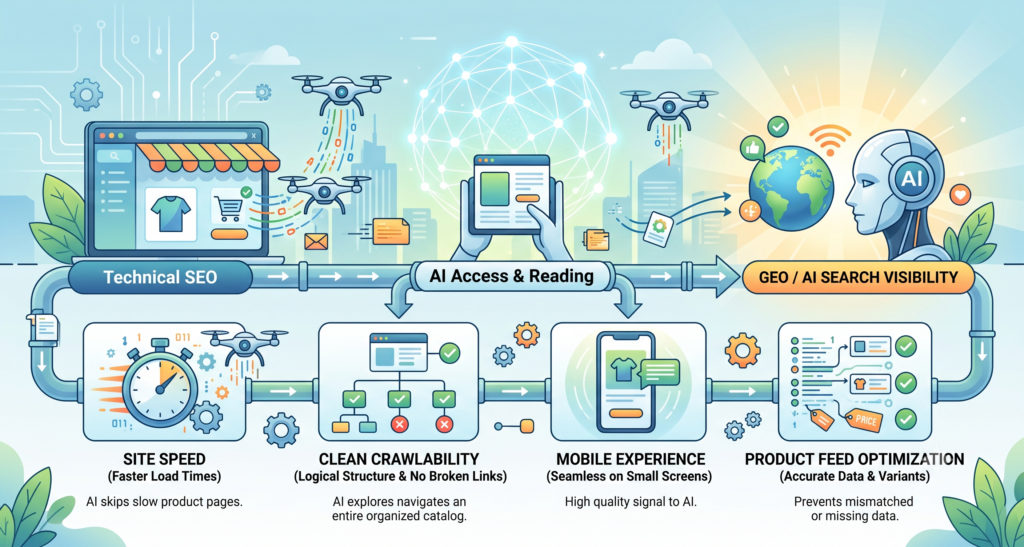
Schema and content earn AI’s trust — but none of it matters if AI can’t reach your pages in the first place. Technical SEO for eCommerce is the groundwork that determines whether AI crawlers can even access, read, and index your catalog before any recommendation happens.
The technical elements that directly affect AI crawlability:
Site speed
Slow-loading product pages get skipped by both shoppers and AI crawlers, working within a limited time to gather information
Clean crawlability
A logical site structure with no broken links or blocked pages ensures AI can move through your entire catalog, not just your homepage
Mobile experience
With most shopping research happening on mobile, a store that doesn’t perform well on smaller screens signals poorer overall quality to AI systems
Product feed optimization
Accurate, well-formatted feeds prevent mismatched prices, missing variants, or outdated stock data from reaching AI at all
Every one of these elements works together with schema and content — strong data delivered on a technically weak site still struggles to surface in AI answers. Opal Infotech’s team approaches this with the same technical depth we bring to our dedicated Technical SEO services, applied specifically to the demands of AI search. With 25+ years of hands-on technical SEO experience across global eCommerce brands, our experts identify and fix the exact gaps holding your catalog back from AI visibility.
The Opal Infotech Approach for eCommerce GEO
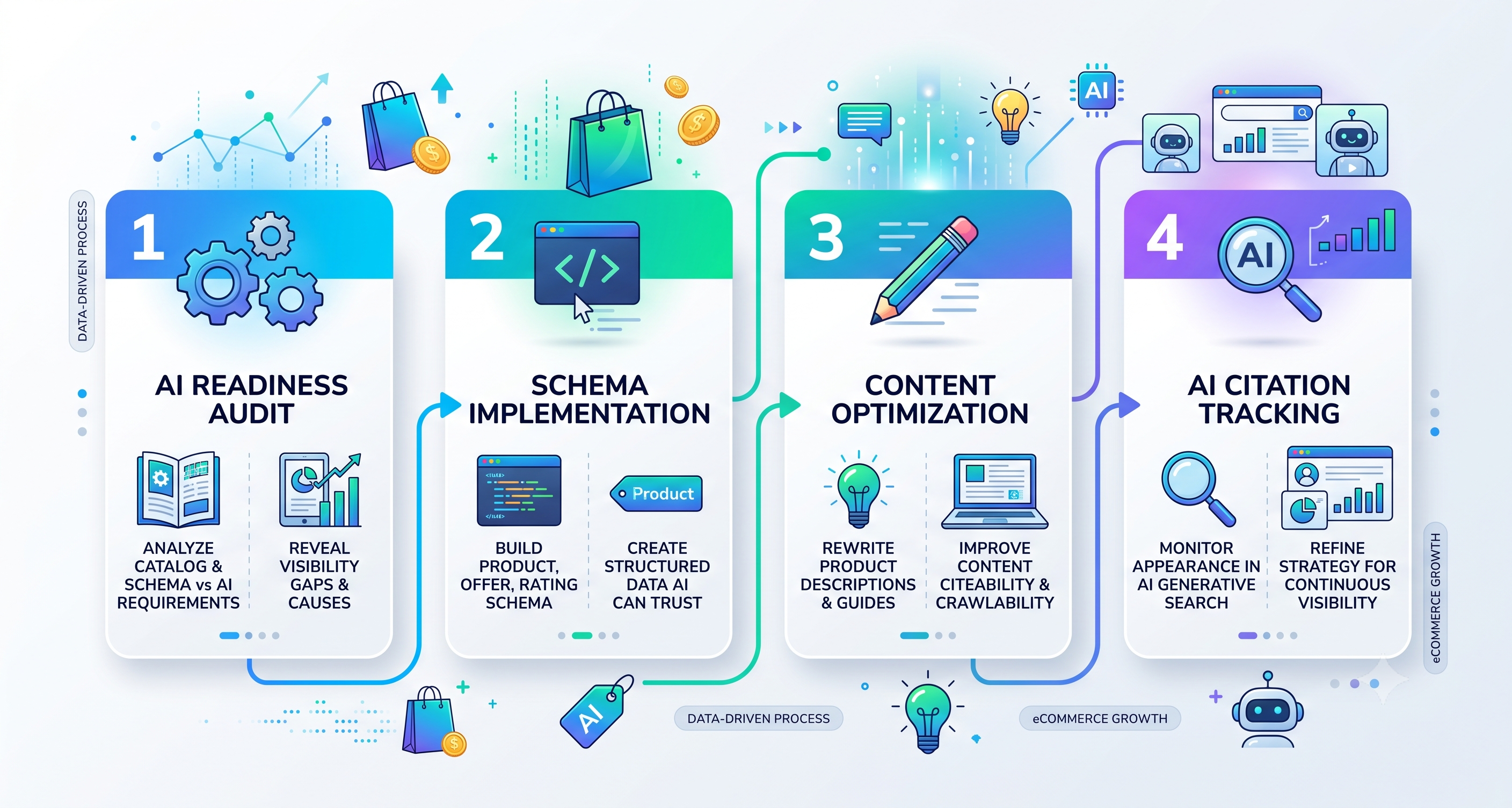
Turning AI visibility into a real growth channel takes more than isolated fixes — it takes a structured process built on technical depth and proven results. Here’s how Opal Infotech’s team, backed by 25+ years of hands-on SEO experience across varied industries, takes your store from invisible to recommended:
1
Step 1: AI Readiness Audit
What we do: Analyze your entire product catalog, schema, technical setup, and existing content against what AI shopping assistants actually require
What you get: A clear, prioritized picture of exactly where your store is losing AI visibility and why — with no guesswork involved
2
Step 2: Schema Implementation
What we do: Build and correct Product, Offer, AggregateRating, and FAQ schema across your full catalog, not just a handful of top pages
What you get: Structured data AI can read, verify, and trust without guesswork, maintained as your catalog grows
3
Step 3: Content Optimization
What we do: Rewrite product descriptions, buying guides, and FAQs around real buyer questions, while strengthening the technical foundation that supports AI crawlability
What you get: Content genuinely worth citing, sitting on a site AI can actually access, read, and index without friction
4
Step 4: AI Citation Tracking
What we do: Monitor how and where your products appear in AI-generated answers across ChatGPT, Gemini, and Perplexity, refining the strategy as AI search behavior evolves
What you get: Ongoing visibility into what’s working, backed by a team that adjusts your strategy before gaps cost you recommendations
This isn’t a one-time setup — it’s a continuous, results-driven process built by a technical team that has solved this exact problem for eCommerce brands across multiple industries and geographies. Every step is grounded in data pulled directly from your store, not assumptions borrowed from generic best practices. It’s this depth of process, refined over 25+ years, that separates a genuine AI SEO strategy from a surface-level schema fix.
What Business Results Look Like
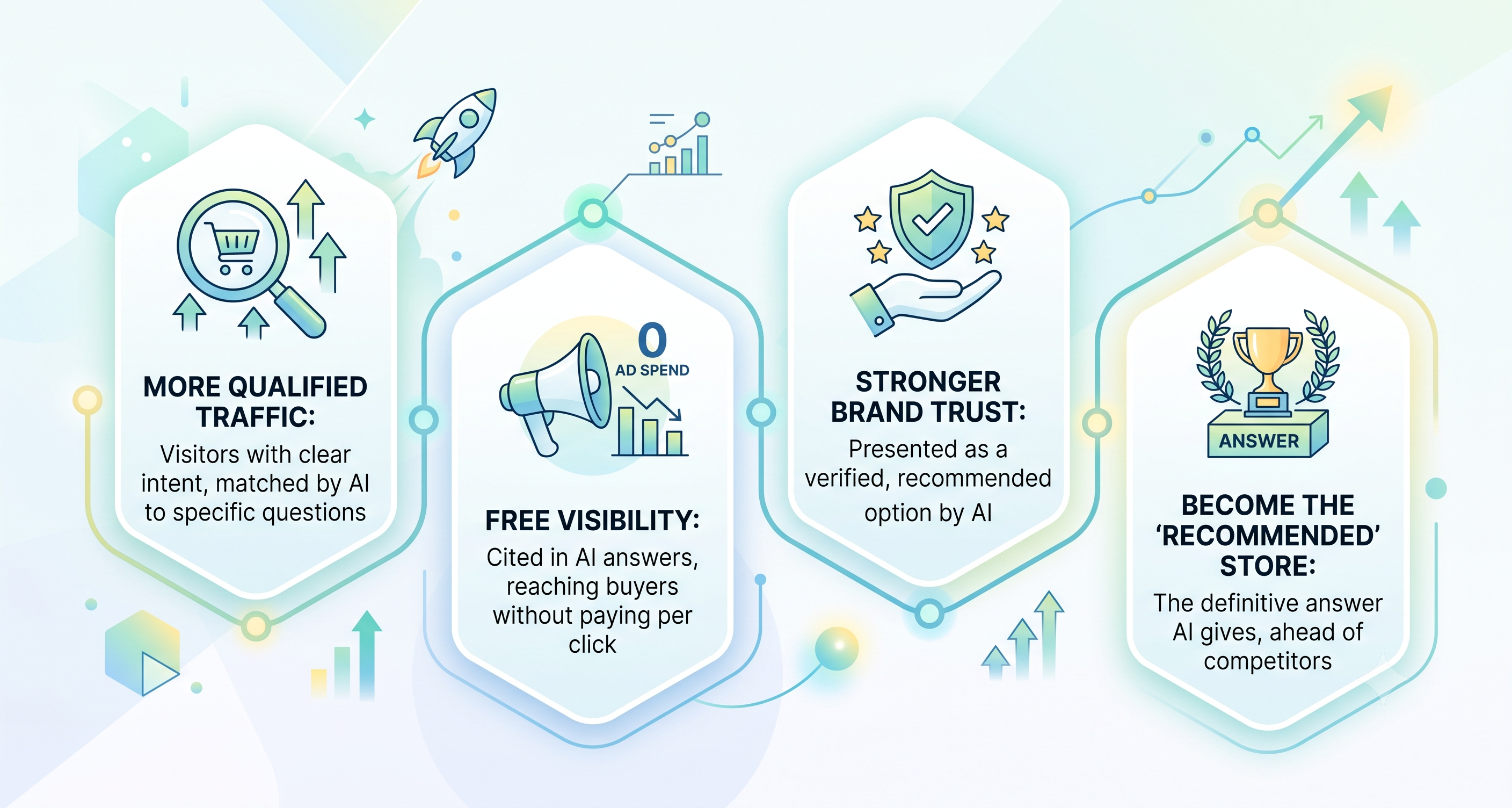
Investing in AI SEO for eCommerce isn’t about chasing a trend — it’s about building a channel that keeps working for your store as buying behavior shifts further toward AI assistants. Here’s what a properly executed GEO strategy delivers for eCommerce owners:
More qualified traffic
Visitors arriving from AI recommendations already have a clear intent, since the AI matched your product to their specific question
Visibility without extra ad spend
Being cited in AI answers puts your store in front of buyers without paying for every click that gets you there
Stronger brand trust
When AI presents your product as a verified, recommended option, shoppers extend that same trust before they’ve even visited your site
Becoming the “recommended” store
Instead of competing for a spot in search results, your store becomes the answer AI gives, ahead of competitors who haven’t done this work
These outcomes build steadily as your schema, content, and technical foundation mature — the same disciplined approach Opal Infotech’s team has applied across 25+ years of technical SEO work for eCommerce brands in multiple industries.
Why eCommerce Owners Choose Opal Infotech
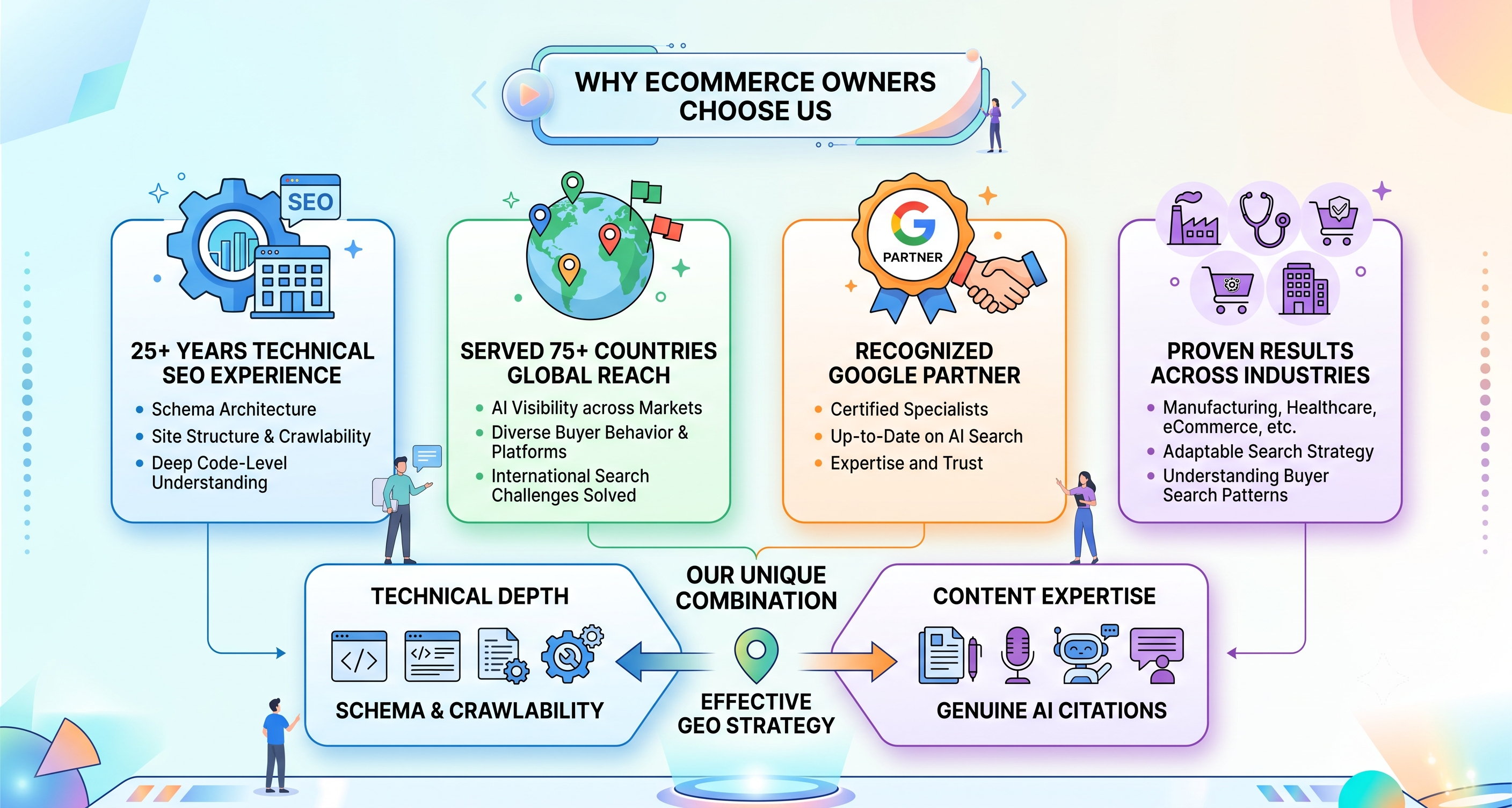
Most agencies handle either the technical side of SEO or the content side — rarely both, and rarely with AI search in mind. eCommerce owners choose Opal Infotech because our team was built differently from the start:
25+ years of technical SEO experience
Our specialists understand schema architecture, site structure, and crawlability at a code level, not just a checklist level
75+ countries served
Our team has solved AI visibility and search challenges across markets with different buyer behavior, platforms, and competition
Google Partner status
A recognized standard of expertise, backed by certified specialists who stay current as AI search evolves
Proven results across multiple industries
From manufacturing to healthcare to eCommerce, our approach adapts to how each industry’s buyers actually search and ask questions
What sets our team apart is combining both sides of this work — the technical depth to build schema and fix crawlability, and the content expertise to write what AI assistants genuinely cite. Few agencies bring both under one roof with this level of depth, which is exactly why eCommerce brands trust Opal Infotech to lead their GEO strategy.
Beyond GEO: A Full-Service Digital Growth Team
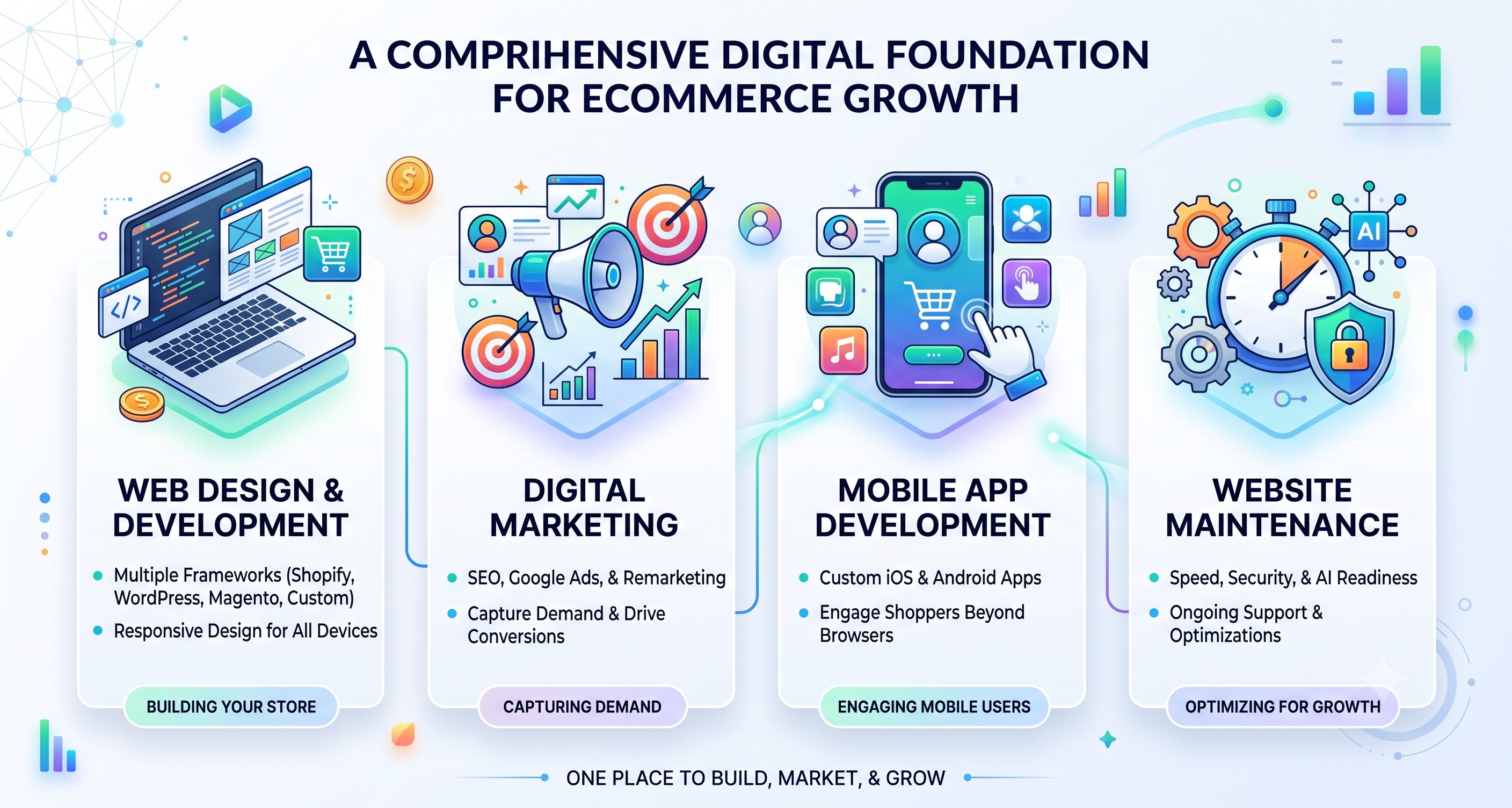
AI SEO and GEO open a new door for your eCommerce brand, but they work best as part of a bigger digital foundation — and that’s exactly what Opal Infotech’s team delivers under one roof:
Web design and development
Across multiple frameworks, including Shopify, WordPress, Magento, and custom builds
Digital marketing
Spanning SEO, Google Ads, and Google Remarketing to capture demand at every stage
Mobile app development
For brands ready to meet shoppers beyond the browser
Website development and maintenance
That keeps your store fast, secure, and always ready for AI and search visibility alike
With 25+ years of technical and results-driven experience behind every service, Opal Infotech’s team gives eCommerce brands one place to build, market, and grow.
Ready to get your products recommended by AI?
Talk to our GEO experts today and see where your store stands.
Questions
Frequently Asked Questions
What is GEO for eCommerce websites?
GEO for eCommerce websites is the practice of preparing product data, schema markup, and content so AI shopping assistants like ChatGPT, Gemini, and Perplexity can read, verify, and recommend your products in their answers. Opal Infotech builds this foundation across your full catalog, not just a few pages, so your store gets recommended consistently instead of overlooked.
How does AI SEO for eCommerce differ from traditional SEO?
Traditional SEO ranks your product pages on Google’s results page for specific keywords, while AI SEO for eCommerce focuses on getting your products cited directly inside AI-generated answers and recommendations. Opal Infotech works on both fronts, since a store with strong AI visibility still needs solid traditional rankings to stay discoverable everywhere shoppers search.
Which schema types matter most for eCommerce GEO?
Product, Offer, AggregateRating, and FAQ schema matter most, since these directly tell AI assistants what a product is, its price and availability, real customer satisfaction, and answers to common buyer questions. Opal Infotech implements and maintains all four schema types across complete product catalogs, not isolated listings.
Who needs AI SEO and GEO services for their online store?
Any eCommerce brand that wants to stay visible as shoppers shift from typing keywords into Google to asking AI assistants direct product questions needs GEO services. Opal Infotech works with online stores across multiple industries, from fashion and electronics to industrial and healthcare products, on exactly this shift.
How much does GEO for eCommerce cost?
GEO pricing depends on your catalog size, current schema coverage, and how much content and technical work your store needs before it’s AI-ready. Opal Infotech provides a free AI readiness audit first, so you get a clear, itemized understanding of the work involved before committing to a plan.
How long does it take to see results from eCommerce GEO?
Most eCommerce brands begin seeing early signs of AI citation and improved product visibility within a few months of schema implementation and content optimization, though full results build steadily as AI systems re-crawl and re-evaluate your catalog. Opal Infotech tracks this progress continuously and adjusts the strategy as results develop.
Where do AI shopping assistants pull product information from?
AI shopping assistants pull product information from structured data like schema markup, product feeds, verified reviews, and well-organized on-site content across your store. Opal Infotech ensures every one of these sources is accurate and consistent, since AI cross-checks data before trusting any single page.
When should an eCommerce store start investing in GEO?
An eCommerce store should start investing in GEO as early as possible, since AI shopping assistants already influence purchase decisions today and stores without clean product data are already being skipped in favor of competitors. Opal Infotech recommends beginning with an AI readiness audit to identify the most urgent gaps first.
Whose product data do AI assistants trust the most?
AI assistants trust product data from stores with complete, consistent schema, genuine customer reviews, accurate pricing, and technically sound websites that are easy to crawl and verify. Opal Infotech builds every one of these trust signals into a store’s foundation so AI has no reason to look elsewhere.
How many product pages need schema markup for GEO to work?
Every product page in your catalog needs schema markup for GEO to work reliably, since a single missing or outdated listing can be the reason AI skips a best-selling product. Opal Infotech implements schema across full catalogs, including variants and category pages, rather than a limited selection of top sellers.
How do I know if my eCommerce store is AI-search ready?
You can check if your store is AI-search ready by reviewing whether your product pages have complete schema markup, accurate real-time pricing, genuine reviews, and content written to answer real buyer questions. Opal Infotech offers a free AI readiness audit that evaluates all of this and provides a clear, prioritized action plan.
Turn AI Search Into a Growth Channel
Ready to get your products recommended by AI? Talk to our GEO experts today and see where your store stands.

With a digital legacy established in 1998, the editorial team at Opal Infotech combines decades of experience with cutting-edge innovation. As a premier Web Development and Digital Marketing agency, we specialize in crafting robust digital solutions – ranging from Custom Web Development and eCommerce platforms to Mobile Apps and Business Website Design. Today, Opal Infotech is at the forefront of the technological shift, helping businesses integrate AI SEO and AI Business Solutions alongside traditional powerhouses like Google Ads and Website Maintenance. Our goal is to translate complex tech trends into actionable growth strategies for global enterprises.
We publish articles to empower business owners with the clarity needed to make informed decisions in a complex digital landscape. Our technical content is designed to demystify high-level innovations like AI and SEO, translating code into actionable business growth strategies.
